Smoke point of common cooking fats
Introduction
As was demonstrated in the blog post ‘Lotus Rock vs Other Non-stick coatings’, because Lotus Rock’s silicon-oxide crystal coating is lipophilic – fat loving – it has a highly durable, excellent non-stick release. However, just as with stainless steel, copper and cast iron cookware, the absence of a PTFE non-stick coating on Lotus Rock pans means the type of fat used should be an important consideration.
What are fats?
Fats can be liquid or solid at room temperature. If liquid they are called are oils. Oils come from plants and fish. They are not a food group, but they do provide essential nutrients.
Some commonly used oils include:
– canola oil
– corn oil
– olive oil
– soybean oil
– sunflower oil
Most oils are high in monounsaturated or polyunsaturated fats, and low in saturated fats. A few plant oils, however, including coconut oil, palm oil, and palm kernel oil, are high in saturated fats and for nutritional purposes should be considered to be solid fats.
Solid fats are fats that are solid at room temperature, like butter and shortening. Solid fats come from many animal foods and can be made from vegetable oils through a process called hydrogenation.
Some common solid fats are:
– butter
– milk fat
– pork fat (lard)
– shortening
– partially hydrogenated oil
For cooking purposes
Many chefs and mums prefer to cook with butter, notwithstanding the fats associated with it, because it complements and enhances the flavour greatly, for example when sauteing vegetables.
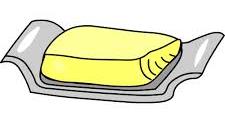
However, some people prefer to use oil because of the health benefits, and also for the range of flavors that it gives to the food.
Saturated vs Unsaturated Fat
One big disadvantage of butter is that it is high in saturated fat. In layman’s terms, these are fats that cannot be broken down by the body and so are collected and stored in different parts of it. Eating too much food containing saturated fatty acids can cause health problems such as high cholesterol (a substance containing a lot of fat that can cause heart disease), which is why many dieticians suggest avoiding foods that contain butter.
Generally cooking oils are seen as a better alternative because they have a higher percentage of unsaturated fats, both mono-unsaturated and poly-unsaturated, compared to saturated fatty acids, which are more prominent in solid fats such as butter.
However, it should be noted that some cooking oils are healthier than others. For example extra virgin olive oil doesn’t have a particularly high concentration of saturated fat, but it does have a very high monounsaturated fat content compared to polyunsaturated fat.

Polyunsaturated describes a fat or oil that has a chemical structure which, because it contains several double bonds, does not easily break down into cholesterol. However, monounsaturated fat has only one double bond and therefore can eventually be broken down into cholesterol, although much more slowly than saturated fat.
|
Comparative properties of common cooking fats (per 100g) |
|||||
|
Total fat |
|||||
|
100g |
11g (11%) |
20g (84g in high oleic variety) |
69g (4g in high oleic variety) |
||
|
100g |
16g (16%) |
23g |
58g |
||
|
100g |
7g (7%) |
63g |
28g |
||
|
100g |
14g (14%) |
73g |
11g |
||
|
100g |
15g (15%) |
30g |
55g |
||
|
100g |
17g (17%) |
46g |
32g |
||
|
71g |
23g (34%) |
8g (11%) |
37g (52%) |
||
|
100g |
39g (39%) |
45g |
11g |
||
|
81g |
51g (63%) |
21g (26%) |
3g (4%) |
||
|
100g |
86g (86%) |
6g (6%) |
2g (2%) |
||
Smoke point
In addition to concerns about high cholesterol, highly saturated fats, such as butter and olive oil, have another disadvantage – their low Flash Point or Smoke Point (the temperature at which an oil starts to evaporate, giving off gases that can be ignited). The smoke point of various fats is important to note because a fat which has exceeded its smoke point and begun to break down is no longer good for consumption. It is believed that fats that have gone past their smoke points contain a large quantity of free radicals which contribute to the risk of cancer. And of course the smoke itself, and the smell which often accompanies it, are unpleasant.
Smoking point of common cooking fats ( per 100g )
|
225 °C |
|
|
257 °C |
|
|
205 °C |
|
|
190 °C |
|
|
230 °C |
|
|
225 °C |
|
|
165 °C |
|
|
190 °C |
|
|
150 °C |
|
|
177 °C |
Cooking fats with higher concentrations of saturated fats than unsaturated will have lower smoke points. Moreover, oils with higher proportions of mono-unsaturated fats than polyunsaturated fats will also have lower smoke points. This is why olive oil has a lower smoke point than sunflower oil, as the table above shows.
Conclusion
Lotus Rock cookware comes in a variety of different shapes and sizes. The type of cooking fat used with them should suit the type of cookware – for example, different fats should be used in a stir wok and a paella pan.
Cooking fats such as butter or olive oil are generally not advised for use with stir woks, as woks require fast cooking at a high temperature. This might be diffficult with butter or olive oil, which have a very low smoke point, so for a stir wok something like Peanut or Sunflower oil would be more appropiate. Conversely, for a paella pan, which requires food to be cooked for longer, on a lower temperature and with more produce to absorb the heat from the stove top, a cooking fat with a lower smoke point could be used, perhaps coconut oil.