April 14, 2015 / arnoldtnn / 0 Comments
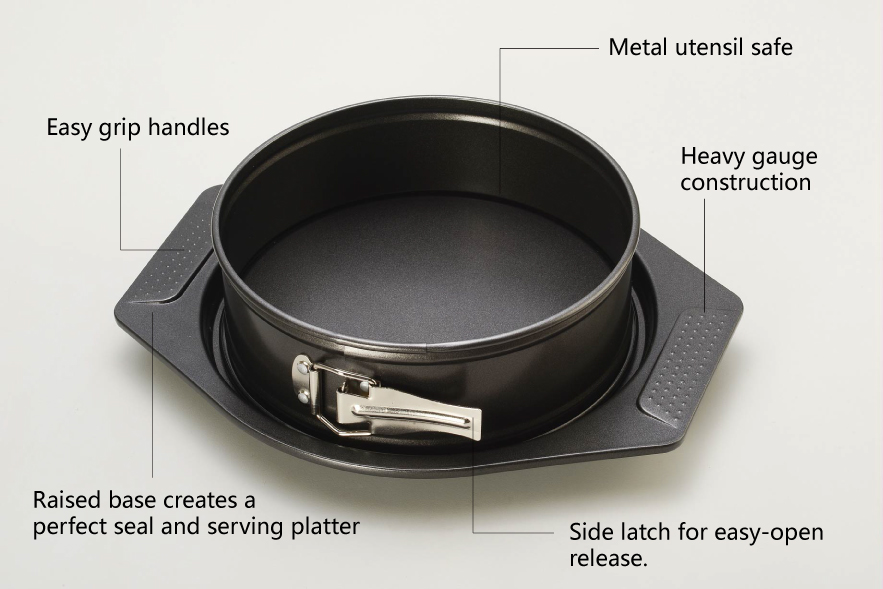
Professional-quality Lotus Rock spring form cake pan releases flawless cheesecake, torte, coffee cake and frozen dessert. The pan’s rim springs free from the base when the clamp is released, so you can remove baked goods without breaking. Easy to grip handles allow easy movement to and from the oven. 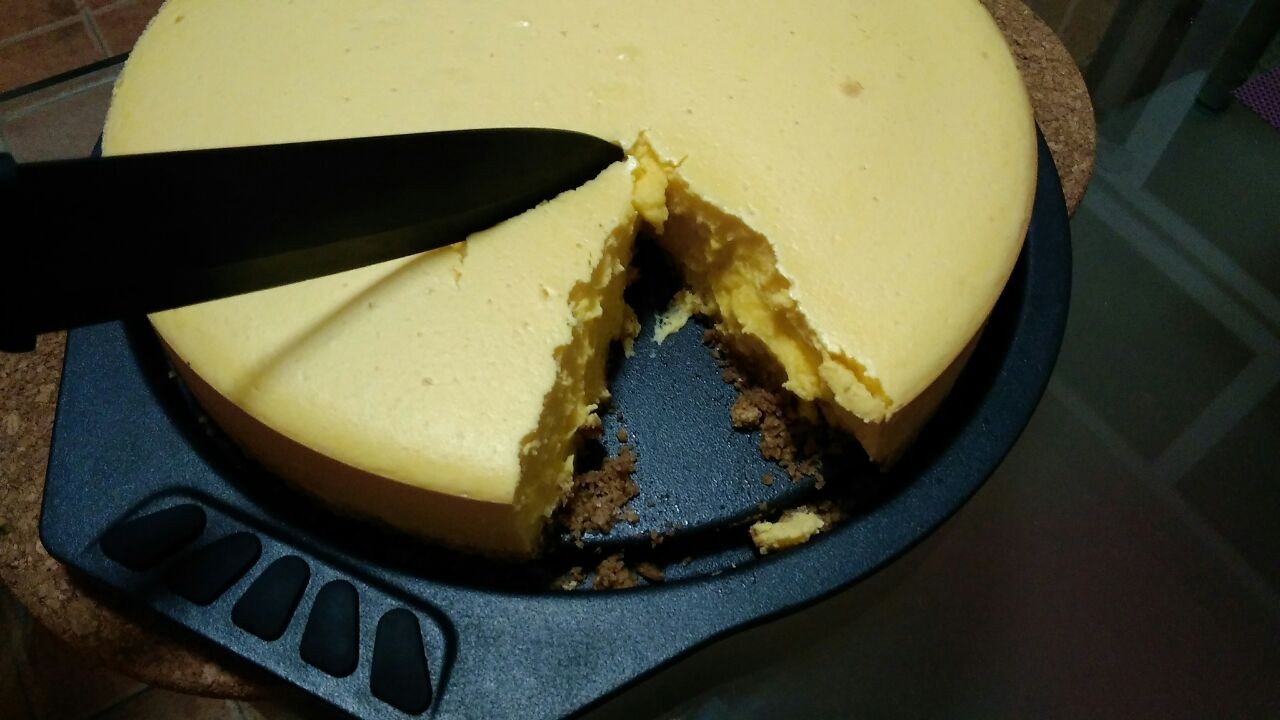 Natural, highly durable non-stick coating, with a metal utensil safe surface – suitable for carving a cake with a sharp, steel knife for serving directly on the table. Lotus Rock bakeware’s hydrophobic surface is easy-to-clean and with excellent colour stain resistance. Heavy gauge steel substrate, with a thick layer of ceramic on both the interior and exterior of the pan distributes heat quickly and evenly for consistent baking results.
Product features
- Easy-close latch creates a leak-resistant seal, keeping dessert intact.
- Spring form design is particularly helpful when releasing items that can’t be inverted, such as cheesecake, quiche, deep-dish pizza and layered frozen desserts.
- Rolled edges add rigidity to retain pan shape.
- Raised base creates a perfect seal and serving platter.
- Thick-walled construction prevents warping or bending.
- The premium Lotus Rock bakeware will not rust, chip, flake, peel or blister.
- Natural, durable nonstick coating ensures easy release and clean up.
- Ceramic coating on base is metal utensil safe.
- Lotus Rock bakeware is oven-safe to 550 F and broiler-safe.
- PTFE- and PFOA-free round springform pan is nonreactive to acidic or dairy ingredients and will not affect the flavors of foods or discolor over time like natural metals.
April 10, 2015 / arnoldtnn / 0 Comments
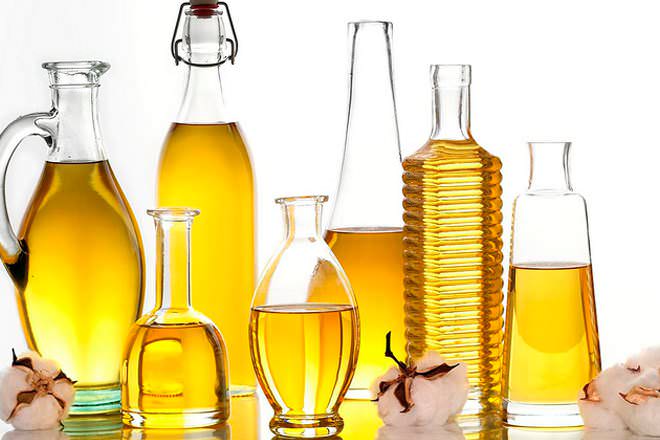
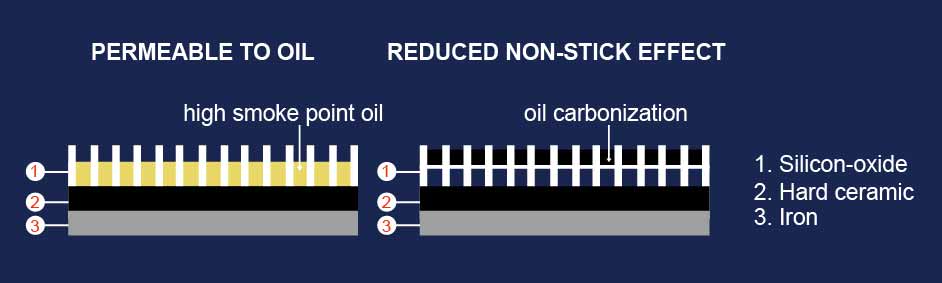
One of the significant benefits of a Lotus Rock pan is its amazing heating effect, for example, it is perfect for searing a delicious brown crust on meat and vegetables. However, if the wrong cooking oil is used for this heating effect then a dark build-up on the surface of the pan can appear, in most cases this is because of oil carbonization. This occurs over time when cooking oil is used above its smoke point – extra virgin olive oil or butter is the usual culprit. Oil carbonization can impart two particular defects to a Lotus Rock pan, first it makes it very difficult to clean, the pan no longer has a hydrophobic surface to assist for easy cleaning. The second difficulty with oil carbonization on a Lotus Rock pan is that it stops any cooking oil from permeating the lipophilic surface of the silicon-oxide crystal coating – thus making the pan no longer non-stick.
What to do?
Using a cooking oil with a high smoke point is very important, as it can give the oil time to seep into the Lotus Rock pan’s surface and provide a non-stick release for cooking, before it can carbonize and scorch on the pan. Lotus Rock recommends vegetable, canola or extra-light olive oil for most cooking needs. Unlike olive oil, for example, which should never be used because it has a very low smoke point, these three oils have quite a high smoke point and so are more suitable for the fast and high heating effect of Lotus Rock pans.
In addition to using the correct cooking oil, after each use a Lotus Rock pan should be scrubbed thoroughly with a grease fighting dish soap. This will stop too much oil from remaining on the pan, which might later become quite sticky and therefore scorch the pan when it is next used.
What if my Lotus Rock pan already has an oil carbonization mark on it?
A lot of cookware manufacturers recommend using baking powder and water to remove oil carbonization marks on a pan. However, from our own testing we have found this to be not very effective at completely removing the marks from the pan. Instead we recommend using the procedure as described here to purify the pan and renew the non-stick release.
April 2, 2015 / arnoldtnn / 6 Comments
As was noted previously here, Lotus Rock does not have a chemical non-stick release. Unlike most other famous non-stick coated pans, such as Calphalon, Scanpan and Tefal, which contain a chemical compound called PTFE for non-stick release, a Lotus Rock pan has instead a natural, durable non-stick release, which is PTFE-free.
When a general, PTFE non-stick coated pan loses its non-stick release, it cannot be renewed – it becomes obsolete. With no non-stick release a PTFE-coated pan will become harder to clean and the coating may start to peel off, making the pan unfit and hazardous for further use. However, if after some use, food begins to stick to a Lotus Rock pan and it becomes harder to clean then it can, just like with uncoated cast iron or steel, be “re-seasoned”, or to put it in a more appropiate way for a Lotus Rock pan, the non-stick release can be ‘renewed’.
If your Lotus Rock pan does become hard to clean, with a reduced non-stick effect, then the below steps can be followed to remedy this.*
*Please note, that in addition to the steps shown below, the consumer must still wipe some oil onto the surface of a Lotus Rock pan before each use.
Lotus Rock non-stick renewal procedure
First step – boil water
- Fill a Lotus Rock pan half full of water and heat until boiling.

- Continue boiling the water for around 10-15 minutes, until the residual substances inside the surface of the pan are released.
- Some gentle scrubbing may need to be done to help complete this process.
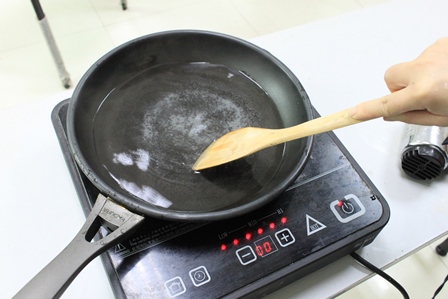
- Once finished, pour the water out of the pan, clean it and then dry.
Second step – heat oil
- Fill the pan with oil about 1cm deep and heat the oil until it starts to smoke.
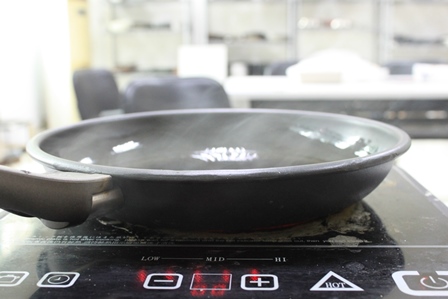
- Then, carefully pour the oil out of the pan into a suitable container.
- Clean the pot dry, and then start to use the pan again for cooking.*
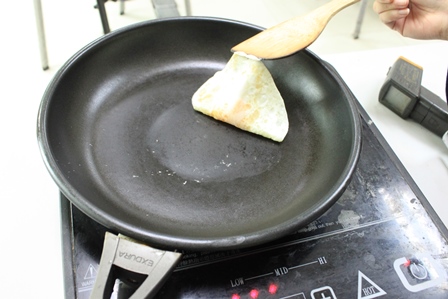
As is shown in the photos above, the Lotus Rock pan used in this test has a special feature included – the Stable Concave design. For more information about this please read here.
*Important! The pan must be washed after use. If too much cooking oil remains in the silicon-oxide crystal surface this will affect the non-stick release. Just like if oil is left around a jar it becomes sticky, which makes it uncomfortable to use