May 21, 2025 / arnoldtnn / 0 Comments
 As explained in the previous blog post, Lotus Rock has designed and patented a number of highly eye-catching, ergonomic handles for its various cookware and BBQ items. Handle materials can vary from forged steel, to a natural wood such as acacia or beech, to bakelite with soft-touch coating, and so on a silicone material, molded into a variety of different shapes, such as a lollipop.
However, for cookware usage a good handle should not just have an attractive appearance or a comfortable, stay-cool grip, it should also be safe to use as well. One particularly important feature for a handle with a Lotus Rock pan is its strength and secure attachment to the pan’s body. All Lotus Rock pans come with a very heavy carbon steel substrate of 2.0mm in thickness. Although not nearly as heavy as cast iron a Lotus Rock pan is still quite a heavy weight for certain types of cooking utensils, such as a 12” stir wok or a 28cm frying pan. Therefore, a strong, well-designed handle is especially important for a safe cooking experience with a Lotus Rock pan.
The kitchenware industry commonly uses a bending strength test, from testing standard BS EN 12983/ 7.5, to assess whether a handle is sturdy and strongly attached enough to a pot or pan.
BS EN 12983/ 7.5 Bending Strength Test Procedure
The BS EN 12983/ 7.5 procedure for the Bending Strength Test is as follows:
Lotus Rock Kyoto handle

Lotus Rock Zurich Handle
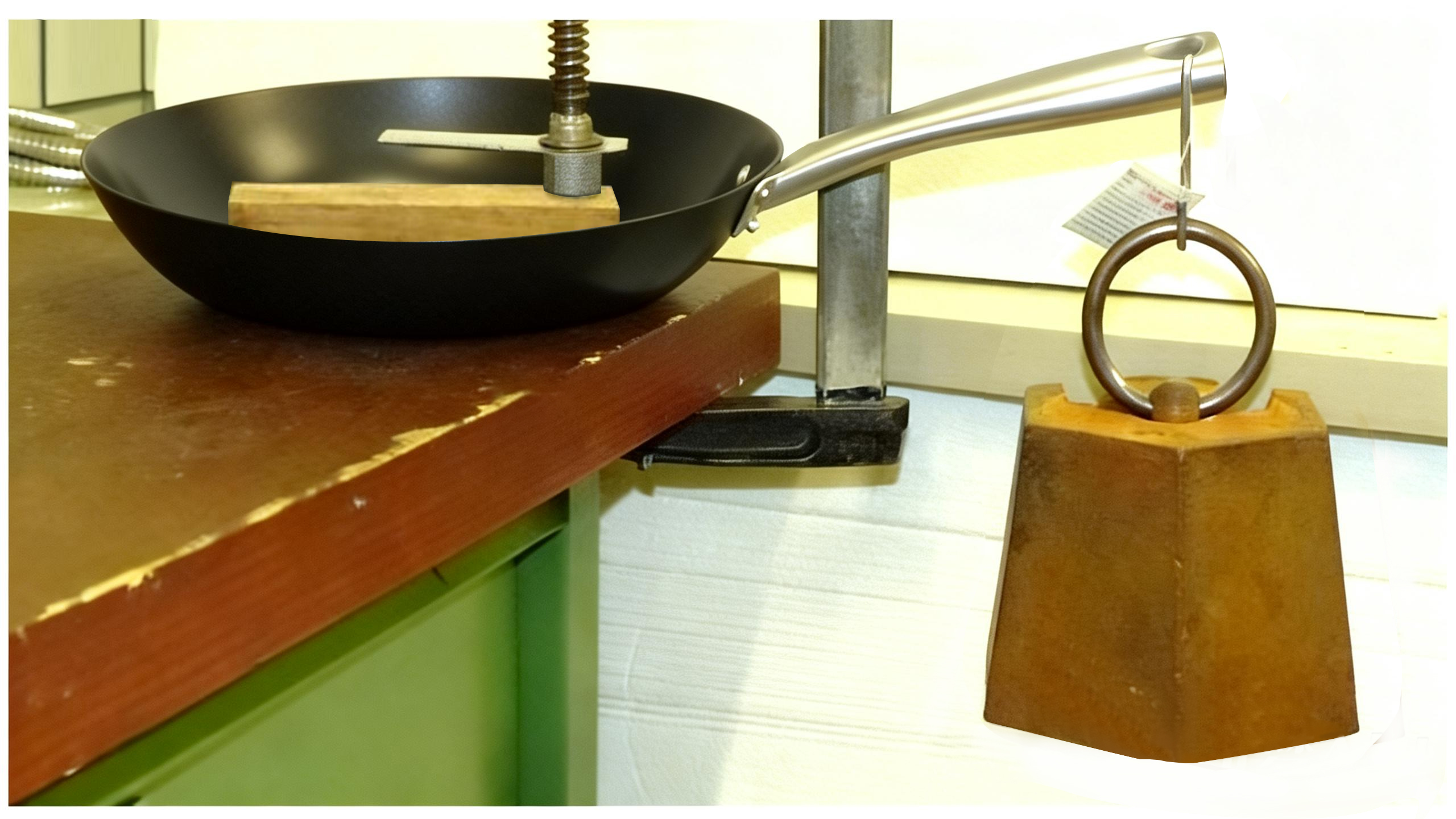
Since Lotus Rock’s was introduced into the market, a number of different types of handles for Lotus Rock pans have been tested according to the BS EN 12983/ 7.5 bending strength test. As shown in the photos above both the Zurich square wooden handle, which uses a riveted attachment method, and the bakelite handle, which uses a welding attachment method, has been stress tested with a 10kg weight attached firmly to the end of the handle. Both of these handles passed without any recorded major failure at a SQTS (Swiss Quality Testing Services) testing lab.
May 14, 2025 / arnoldtnn / 0 Comments
The previous blog post described how a migration test can be done to test the surface reactivity of a cookware pan. The benefit of a non-stick coating on a pan is that it provides a non-reactive surface whereby all kinds of ingredients, whether they are highly acidic or not, can be used for cooking without creating any undesirable colors and/ or flavors. Generally speaking, most non-stick coatings contain a substance called PTFE. This gives the coating its non-stick release and has been proven to have the lowest coefficient of friction (CoF) of any known solid. In other words, the majority of materials do not stick to a PTFE-based non-stick coating. Therefore, because of its excellent non-stick release and non-reactive surface, a PTFE-based non-stick coating should pass a standard BS EN 1186-1: 2002 migration test quite easily.
However, although PTFE- based coatings do undoubtedly provide a highly non-reactive surface for a cookware utensil, they also have some significant disadvantages; one of these is a tendency of PTFE-based non-stick coatings to peel off. Within a non-stick coating PTFE does not bond well to itself, and so by and large it doesn’t have a very stable construction. This weak coating structure is degraded through general scratching with a utensil, and also by rubbing it with a standard abrasive cleaning pad. Moreover, PTFE based coatings are generally quite thin, roughly 15-20 microns in thickness. This thinness makes PTFE-based coatings quite liable to break up and expose the substrate below it, such as aluminum or steel, to foodstuffs or oxygen which could produce some undesirable reactions and damage the quality of the cookware utensil.
Lotus Rock, on the other hand, contains no PTFE or any other non-stick chemical within its coating. On both the interior and exterior of all Lotus Rock pans is a thick ceramic layer, which is up to 100 microns thick. This not only provides excellent protection to the steel substrate below it, but the strongly bonded construction of the ceramic layer also ensures that all Lotus Rock pans have outstanding scratch and abrasion resistance.
There are two well-known tests within the kitchenware industry, from the BS 7069 : 1988 British Standard Specification for Cookware, which can demonstrate whether or not a cookware utensil has excellent scratch and abrasion resistance. Both of these tests have been used on a Lotus Rock frying pan.
1. BS 7069 Abrasion Resistance Test Procedure
Mount the item of cookware under test rigidity on the reciprocating support and apply the loaded abrasive pad to the non-stick surface, lubricate the surface by the addition of domestic washing-up liquid. Keeping the loaded abrasive pad stationary, move the reciprocating support backwards and forwards over a distance 50mm+2.5mm. Continue for 250 cycles. Renew the abrasive pad at 50 cycle intervals.
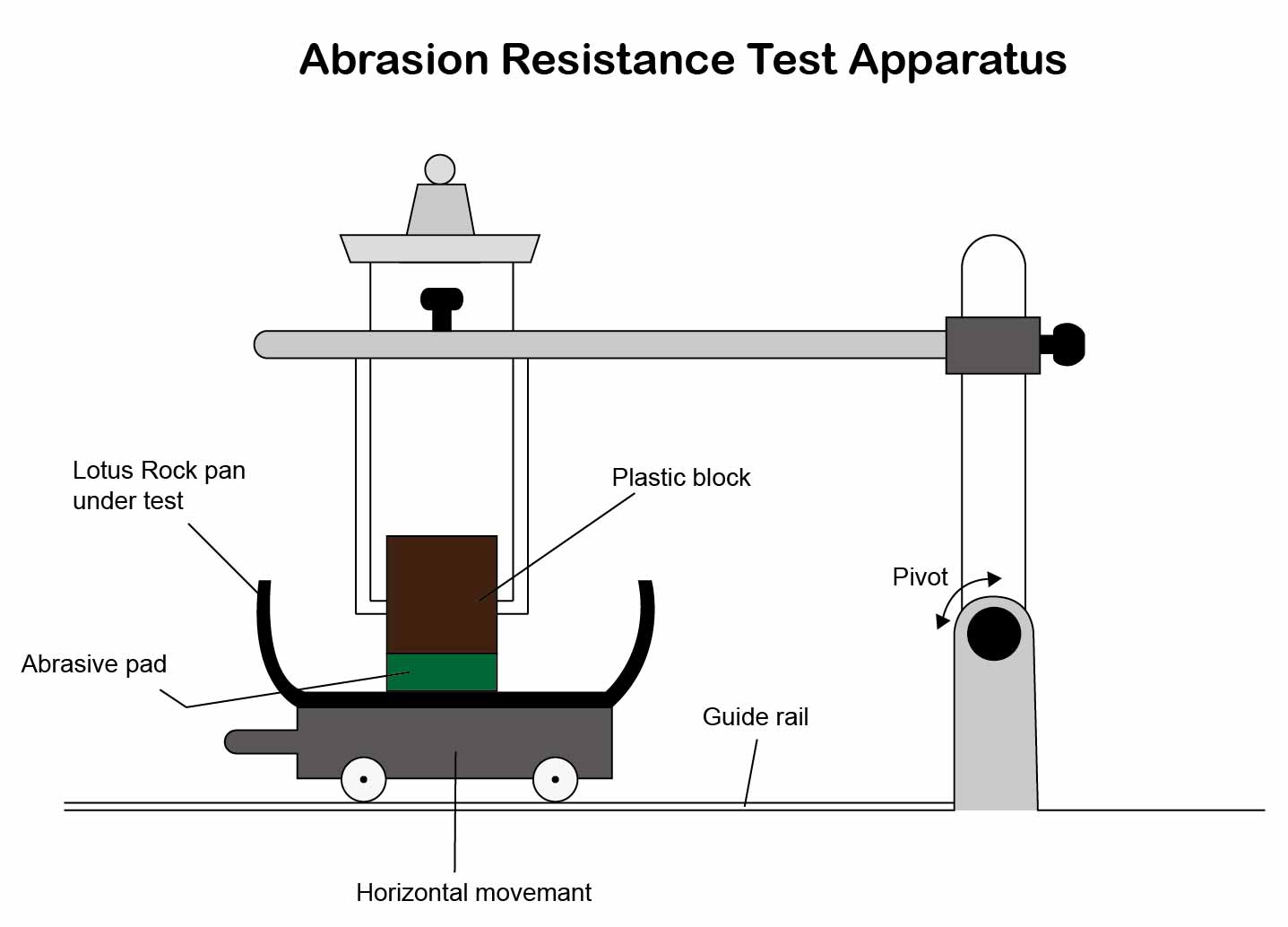
SGS test result for Lotus Rock pan = Pass. “No visible damage was found on the non-stick surface after testing.”
2. BS 7069 Scratch Resistance Test Procedure
Place a quantity of corn oil, sufficient to just cover the base of the article into it. Heat the vessel to a temperature of 220+5C and apply the loaded stylus to the heated surface. Move the loaded stylus across the surface for a distance of not less than 80mm in 1+0.1s.
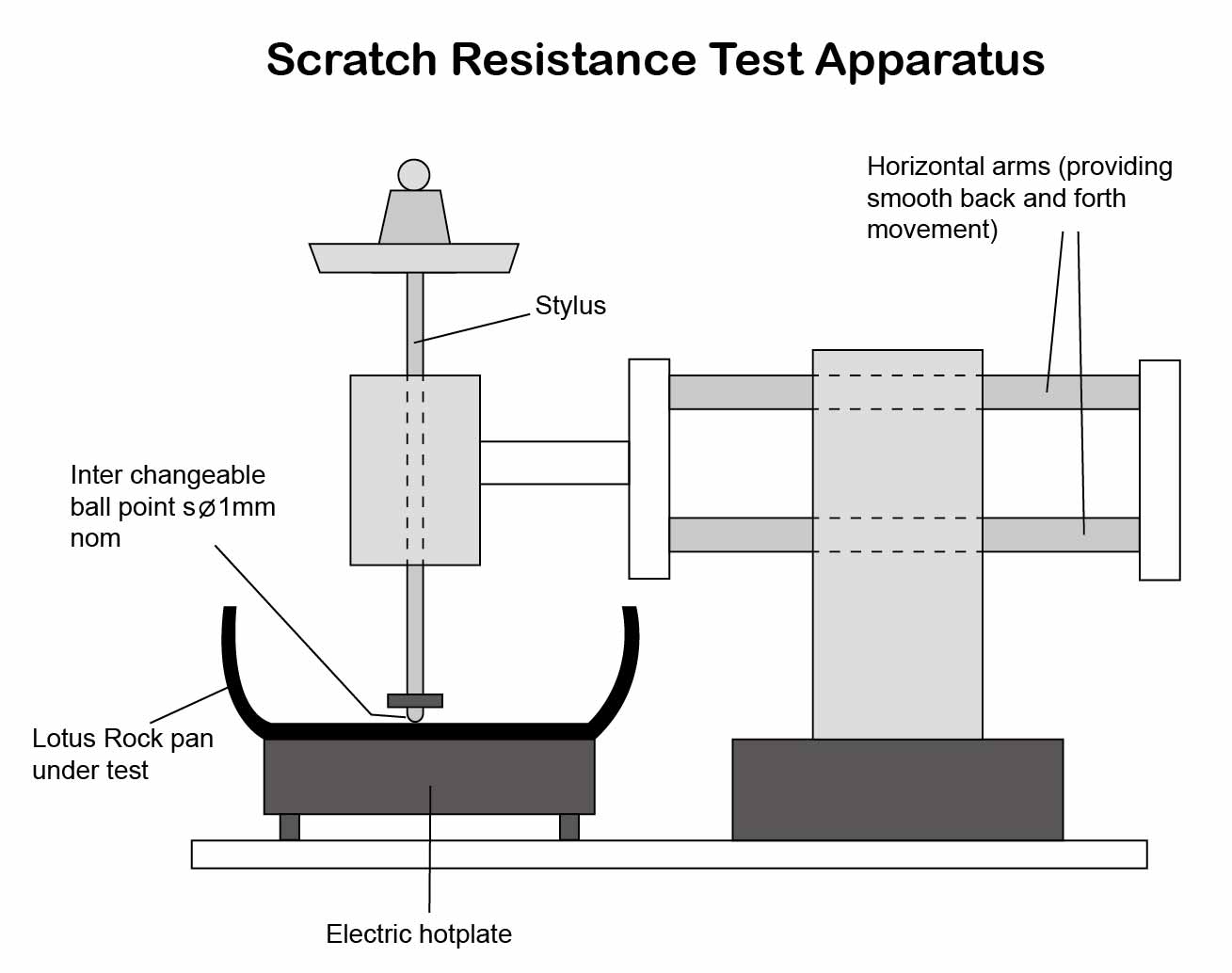
SGS test result for Lotus Rock pan = Pass. “No visible damage was found on the non-stick surface after testing.”
One of the significant benefits of a Lotus Rock pan is the high durability of the pan’s surface. Unlike general non-stick PTFE-coated pans, Lotus Rock is metal utensil safe, which means a stainless steel spatula or knife and fork can be used on the surface without any concern that the quality of the coating will be impaired or the non-stick release ruined through scratching. Moreover, for cleaning purposes a Lotus Rock pan can, unlike with a general PTFE non-stick coated pan, be scrubbed and washed vigorously with a standard abrasive cleaning pad without causing the coating to peel off.
May 11, 2025 / arnoldtnn / 0 Comments
The introduction of a new, highly innovative product into the market often generates considerable excitement and interest. However, at the same time, there is naturally also some concern as to whether this new product is safe to use and not hazardous to human health.  A famous example of this was when PTFE-coated cookware was first introduced in the 1960’s. This new, technological breakthrough in non-stick coating for cookware was a huge hit among consumers who wanted an easier, and more hassle-free way to cook daily staples, such as eggs. But in the late 90’s it was found that the emulsifier used to spread the PTFE coating evenly around the pan, called PFOA, caused birth defects in laboratory animals. This substance was subsequently banned by the Food & Drug Administration (FDA) of USA, and by government departments in many other countries.
Since its creation a number of years ago, Lotus Rock cookware and bakeware has been sold throughout the world, in countries such as USA, Australia, Israel, Turkey, South Africa and India. Part of the reason why so many retailers and wholesalers in these countries have enthusiastically sold and recommended Lotus Rock has been the numerous testing reports, produced by reputable companies such as SGS and TUV, which have demonstrated Lotus Rock’s safety for use in the kitchen.
The kitchenware industry commonly uses a migration test to assess the reactivity of a product’s surface. Cookware materials that are highly reactive are those which tend to have chemical reactions with other substances around them. Highly reactive materials include iron, copper, aluminum and carbon steel. Highly reactive cooking surfaces are disadvantageous for certain ingredients and ways of cooking because the reactions can produce undesirable colors and/or flavors. No Lotus Rock pans are highly reactive with any ingredients because they have a thick non-reactive ceramic layer on both the interior and exterior of the 2.0mm carbon steel substrate. Further, the interior of all Lotus Rock pans has an additional top coating of silicon-oxide crystal, which is permeable to cooking oil but impervious to other substances. Thus, highly reactive ingredients such as tomatoes, spinach, wine and lemon juice can be used on Lotus Rock pans without creating any chemical reactions.
The most commonly used migration test to demonstrate whether or not the surface of a cookware utensil is reactive to different ingredients, set up in accordance with British and European standards, is BS EN 1186-1.2 2002. This test involves heating four different simulants on a cookware item, at different temperatures and for different periods of time, before determining whether any part of the surface of the cookware has reacted with the simulant. These four simulants are:
- Distilled Water, to simulant boiling or simmering;
- 3% Acetic Acid in an aqueous solution, to simulate the use of citric juices such as lemon for flavor, or tomatoes for a sauce (such as Bolognese);
- 10% ethanol in aqueous solution, to simulate for example the use of alcohol for deglazing a pan to made a sauce;
- Rectified olive oil, for general high heat cooking methods, such as frying, sautéing, stir frying, browning and grilling.
The table below is the result of just such a BS EN 1186-1.2 2002 test, one which was performed on a Lotus Rock frying pan, grill pan and saucepan.
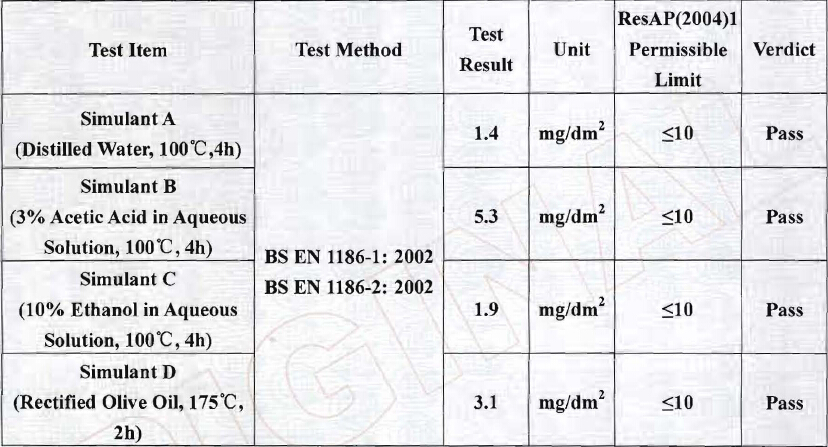
The testing standard for each simulant is expressed in milligrams of extracted of deposited material per decimeter squared. As is clearly demonstrated above, each simulant recorded an extracted quantity well below the permissible limit of 10 milligrams per decimeter squared.
The above BS EN 1186-1: 2002 migration test clearly proves that a Lotus Rock pan can be used for a variety of cooking methods, such as boiling, frying and deglazing, and can be cooked with a variety of different ingredients, without any concern that the an unwanted reaction might take place with the pan’s surface.
May 9, 2025 / arnoldtnn / 0 Comments
So far on this blog we have explained the various tests that are conducted to ensure that a Lotus Rock pan is safe and fit for purpose in a variety of domestic kitchens all over the world. Some of these tests are for the coating surface, some are for handles, and some are to check that the material composition of the pans contain no harmful substances or metals.
However, in spite of all these tests there might still be some issues with a product which all of these tests cannot safeguard against. In fact, some problems can only be experienced and then later resolved once the product has actually been used by the consumer.
One such issue, which some consumers of a Lotus Rock pan have mentioned, is staining on the coating surface. The reason this problem occurs on a Lotus Rock pan more often than, say, on either a non-stick or stainless steel pan, is that the coating surface of Lotus Rock is rougher and more uneven. As explained previously, these ‘valleys’ on a Lotus Rock pan surface are actually there for a very specific reason: to create a natural, durable non-stick surface. The silicon-oxide crystal coating is permeable to oil and rests in between these ‘valleys’. So the consumer can maintain the non-stick release of the pan regularly by wiping a small amount of oil on a Lotus Rock pan, just like they would do if they added oil to an uncoated steel or cast iron pan to season it.
However, when consumers cook with a Lotus Rock pan occasionally other ingredients might intrude into these ‘valleys’. Or alternatively the consumer might use too much oil on the pan and the surface might then become too sticky.
One particular advantage of a Lotus Rock pan which many consumers don’t fully appreciate is that it does have excellent abrasion and scratch resistance. Since the 1960’s when PTFE non-stick pans were first introduced, consumers have become accustomed to being careful about how they use and clean their non-stick pan for fear of damaging the non-stick surface. They will, for example, always use the yellow sponge side of a cleaning pad, and not the more abrasive green side.
As explained, one of the significant advantages of a Lotus Rock pan is that it can be scrubbed and cleaned in a much more thorough and robust way than a general non-stick pan. Below is an example of a Lotus Rock which has some staining on the coating surface.
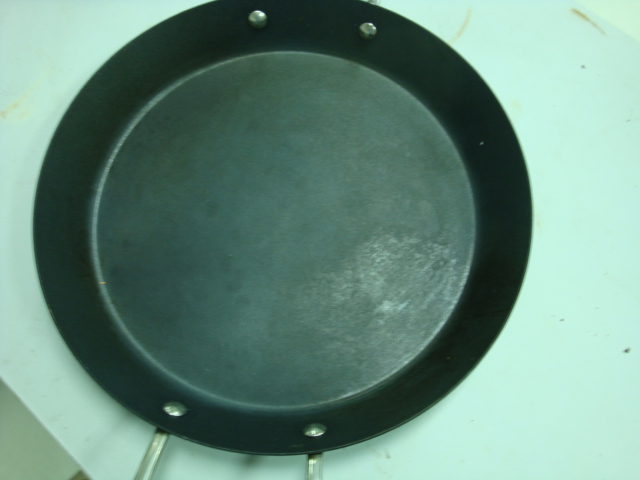
Generally, a consumer has two cleaning methods to clean this pan:
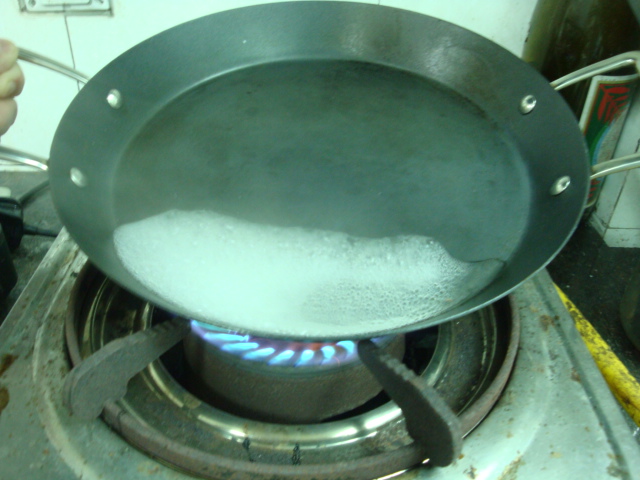
1. Boil vinegar in the pan
2. Scrub the pan surface with washing-up detergent and hot water
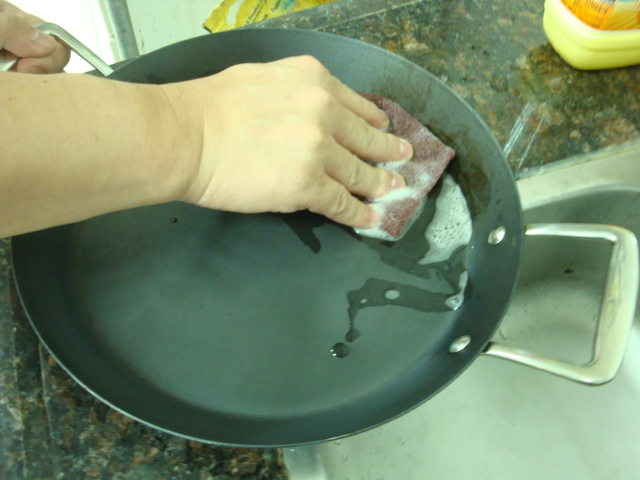
If either of the above two methods were used to clean a general non-stick coated pan then the pan could be made obsolete for further use: the coating could either peel off or crack.
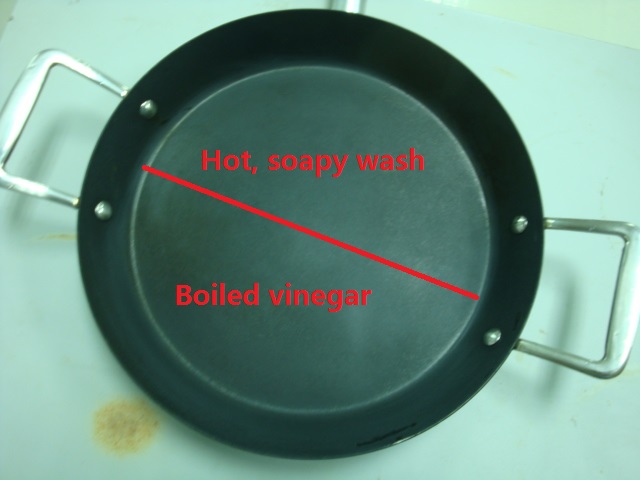
As you can see from the photo above, both methods cleaned this 34cm Lotus Rock paella pan with similar success. Although boiling vinegar over the pan did remove the staining, we would in most cases recommend just cleaning the pan with hot, soapy water and a general abrasive pad. If this does not remove all the staining, then the other option of boiling vinegar can be used.
May 4, 2025 / arnoldtnn / 0 Comments

If there is one word that has been over-used for marketing purposes in the last decade it is “green”. Within society increasing concerns about climate change, and whether economic growth is compatible with environmental protection, has led companies all over the world to market their products as eco-friendly and “green”. However, it has now reached the point where the inclusion of any recycled or natural resource in a product, no matter how small a part it forms of the whole, is used to justify the label “green”. This term for eco-friendly products has been used so frequently over the years that its meaning to most consumers has become quite vague and ambiguous. One way to consider whether a product is eco-green would not be so much its composition, but instead how durable it is. An item which needs to be replaced every year consumes five times as many resources as an item which lasts for five years. It is for this reason, its durability, that a cooking utensil such as a frying pan can be labelled and marketed as ‘eco-green’. All Lotus Rock pans are suitable for long-term use and for this reason are labelled as ‘eco-green’. Lotus Rock is highly durable for a number of reasons:
- Strong construction. With a heavy-gauge carbon steel substrate and a thick layer of enamel on both the interior and exterior of all pans, Lotus Rock pans will not warp or disfigure easily. Carbon steel is a very dense material, and the 2.0mm gauge used in all Lotus Rock pans makes them strong and long-lasting, unlike pans made with aluminum, a material with a very low density, which can be dented and disfigured quite easily, for example, if accidently dropped on the kitchen floor.
- Abrasion resistance. A common complaint about non-stick pans is that the coating often peels off quite easily, making the pan unusable and requiring its replacement. A Lotus Rock pan, in contrast, is metal utensil-safe. The coating is extremely hard and can withstand scrubbing with a 3M pad for a long period of time.
- Natural non-stick release. A non-stick coating with either PTFE or ceramic sol-gel technology will, depending on its quality, eventually become a ‘stick’ pan. Once the non-stick release has worn out the pan will become difficult to clean, and the consumer will most likely discard it. In contrast the natural non-stick coating on a Lotus Rock can be renewed by simply wiping oil onto the surface before each use. This method gives the pan a much longer lifetime than a general non-stick pan.
If the Stable Concave design is included a Lotus Rock pan’s lifetime is extended even further In addition to its durablity, a Lotus Rock pan can also because of its fast heating effect be labelled eco-green. Many professional chefs prefer carbon steel for cooking utensils such as stir woks, crepe pans, paella pans and frying pans because it heats up very quickly. This is especially so compared to other commonly used metal substrates such as aluminum or stainless steel. If the steel for a pan is produced at a thick gauge then it can heat up quickly, but also evenly across the pan’s surface. The main environmental benefit of a faster heating effect is that it saves energy from the stove top burner, thus reducing CO2 emissions. .