May 27, 2015 / arnoldtnn / 0 Comments
As was explained in the previous blog post, the sharp, protruding edges of a gas stove require a high quality cooking utensil to have a tough, strongly constructed outer coating to withstand chipping and highly visible scratch marks. However, cooking on a gas stove also necessitates a high quality handle because often the flame from the gas stove can, in certain cases, reach up the side of the pan and come into contact with the handle. This would be especially the case for high heat cooking methods, such as stir frying, or making a delicious, crispy crepe (all of which a Lotus Rock pan is very suitable for doing).
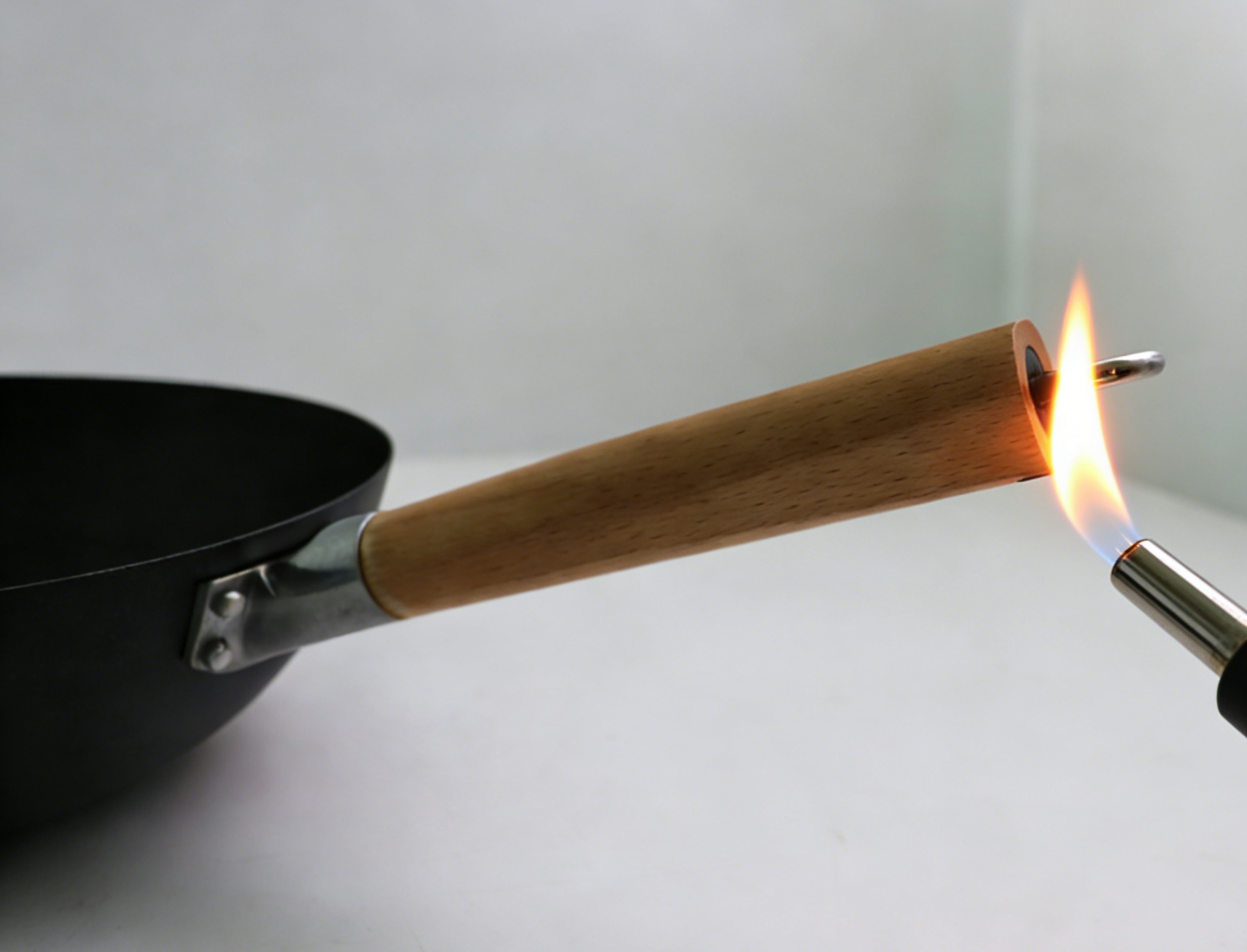
The kitchenware industry commonly uses a test, from BS EN 12983-1 2023 cookware standard regulations, to assess how flammable the material of a handle is to a candle flame set underneath it. For a pass to be awarded no visible sign of molten or burning material should have melted or dripped off the handle, after it has been heated for 30 seconds. In addition, once extinguished the handle material should not spontaneously re-ignite.
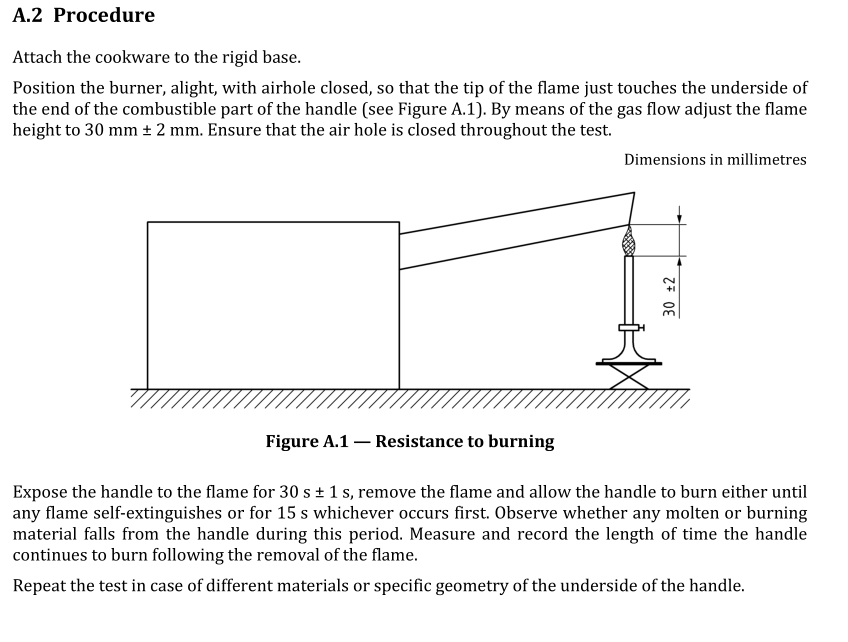
BS EN 12983-1 2023 Handle Resistance To Burning Test Procedure
Resistance to burningThe underside of the handle or any insertor inlay there, consisting of organicmaterial, shall not driymolten material orkeep burning when tested according toAnnex A. Any burning shall selfextinguishwithin 15 s of the removal of theflame. once extinguished the handlematerial shall not spontaneouslre.ignite.Each material shall be tested at itsposition.
The handle resistance to burning test procedure, according to BS EN 129831-:2023, is as follows: Step 1=Attach cookware to the rigid base.Step 2 = Position the burner, alight.with airhole closed, so that the tip ofthe flame just touches the undersideof the end of the combustible part ofthe handle. By means of the gas flowadjust the flame height to 30mm +2mm. Ensure that the air hole is
closed throughout the test. Step 3 Expose the handle to theflame for 30 s + 1s, remove the filameand allow the handle to burn eitheruntil any flame self-extinguishes or for 15 s, whichever occurs first. observe whether any molten or burningmaterial falls from the handle duringthis period.Step 4- Measure and record thelength of time the handle continues toburn following the removal of the flame.
Evaluation
On 15th on 15thJanuary 2025, in an Actontesting laboratory, the Lotus Rockbakelite Titlis handle passed theabove resistance to burningtest.This handle, , along with many others designed and patented by Lotus Rock, is safe to use over agas stove for numerous high heatcooking methods. Whether movinga crepe pan sideways to get the mixture spread around the pan for a delicious, crispy texture, or to quickly toss vegetables and thinly cut pieces of meat inside a stir wok, a Lotus Rock pan has the handles which are safe and non-flammable to do this.
May 26, 2015 / arnoldtnn / 0 Comments
A previous blog post described how a migration test can be done to test the surface reactivity of a cookware pan. The benefit of a non-stick coating on a pan is that it contains a substance called PTFE, which has very low reactivity with substances in contact with it. Even to this day, PTFE has been proven to have the lowest coefficient of friction (CoF) of any known solid. In other words, the majority of materials do not stick to it. Therefore, because of its excellent non-stick release and low reactivity to substances in contact with it, a PTFE-based non-stick coating should pass a standard BS EN 1186-1: 2002 migration test quite easily.
However, although PTFE does undoubtedly provide excellent non-stick release and low reactivity for a coating on a cookware utensil, it does have some significant disadvantages; one of these is a tendency of a PTFE-based non-stick coating to peel off. Within a non-stick coating PTFE does not bond well to itself, which means it can have a pinhole problem. This difficulty can be exacerbated not only through general scratching with a utensil and rubbing with a cleaning pad, but also when oil is heated on a pan to a high temperature for high heat cooking methods, such as stir frying or sautéing etc. For these types of high heat cooking methods, the molecules of cooking oil can decrease in size quite rapidly and then penetrate the highly porous PTFE coating. This can lead to the coating breaking up and peeling off – thus not only impairing the quality of the non-stick release but also creating a safety hazard as bits of the coating mix with the food on the pan.
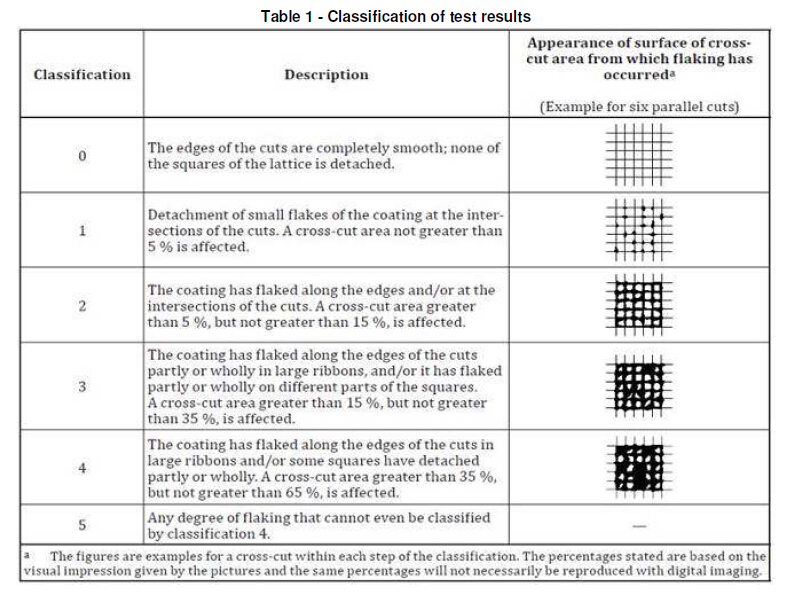
One method to determine the resistance of non-stick coatings to separation from substrates, such as aluminum or steel, is to utilize a tool by cutting a right angle lattice pattern into the coating, penetrating all the way to the substrate. This is called the Cross Cut Adhesion Test, otherwise known as ISO 2409-2013. Some coatings may have a multi-layer system, and so this test can also be used to determine the resistance to separation of different layers from one another.
The below table are the classification of test results for an ISO 2409-2013 Cross Cut Adhesion Test.
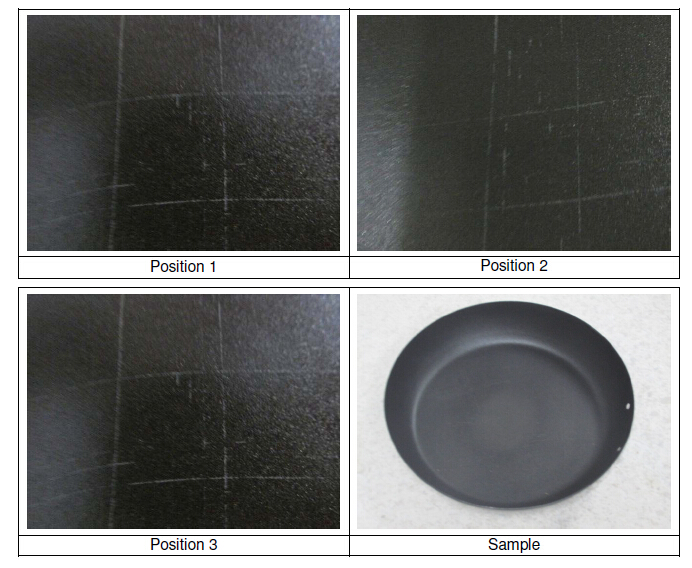
An ISO 2409-2013 test was conducted by SGS testing services, from 16th January 2015 to 21st January 2015, on a Lotus Rock frying pan. The test result was as follows.
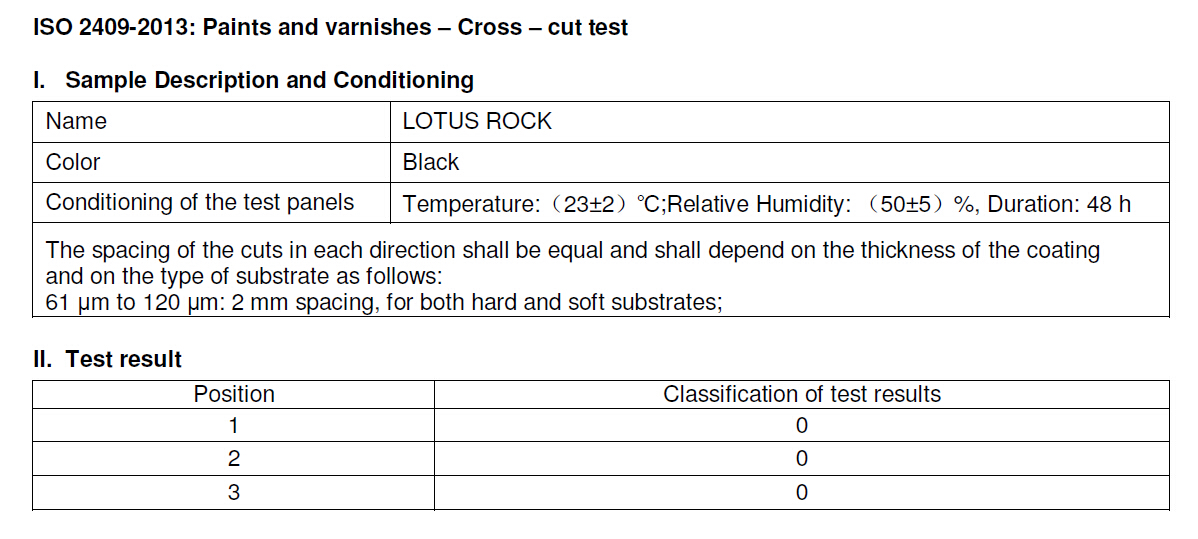
As you can see from the results above and the photos of the tested samples below, a Lotus Rock pan got a perfect score of 0; the edges of the cuts are completely smooth, and none of the squares of the lattice are detached. This excellent result is in part due to the fact that the coating on a Lotus Rock pan is not a standard PTFE based coating. All Lotus Rock pans have a very thick ceramic layer, up to 100 microns thick, on top of the heavy gauge carbon steel substrate. Nestled on top of the ceramic layer is a very thin silicon-oxide crystal coating which is so thin that it is very difficult for a utensil or other piece of equirement to dettach it from the ceramic layer below it. Therefore unlike a weakly bonded and thinly coated PTFE based coating, a Lotus Rock pan can, with its strongly constructed coating, be cooked on for an extended period of time without any fear that the coating will peel off or break up.
May 22, 2015 / arnoldtnn / 0 Comments
As has been noted previously on this blog, Lotus Rock cookware is a metal utensil safe product: stainless steel spatulas, knives and forks can be used on it without damaging the coating. In addition, a Lotus Rock pan can be scrubbed hard with a standard abrasive pad for cleaning without impairing the quality of the pan’s coating. The interior coating for all Lotus Rock pans has been tested and passed, by an independent testing authority, according to BS 7069 Abrasion and Scratch resistance testing standards.
However, although during cooking the interior coating of a pan does undoubtedly have to withstand a high degree of scratching from numerous kitchen utensils, what is not considered as much is the resistance to scratching of a pan’s exterior coating. When using some pots and pans for cooking, such as a stir wok or a crepe pan, it is often necessary to move them quite quickly to get ingredients around the pan or out onto some kind of serving dish. But if this is done over a cooking top surface such as a gas stove, with its sharp protruding edges, the exterior coating of a cookware utensil will, in all likelihood, need to withstand some heavy scratching. If the exterior coating is too soft or thin then these scratches will not only worsen the appearance of the pan quite considerably, but they might also expose the metal substrate beneath the coating to corrosion
A Pencil Hardness test has been used by the kitchenware industry for many years to determine the scratch hardness for the exterior coating of a pan. This test uses special pencils with different degrees of hardness to scratch the coating, which then determines its hardness.

A complete set will have the following pencil gradings, starting with the hardest — 9H, 8H, 7H, 6H, 5H, 4H, 3H, 2H, F, HB, B, 2B, 3B, 4B, 5B, 6B, 7B, 8B and 9B (the latter is the softest pencil; it contains the most graphite and the least amount of clay). The “H” stands for “hardness” and the “B” stands for “blackness,” which comes from the amount of graphite used in the softer pencils.
The simplicity of the pencil hardness test is its great advantage. The special pencils used for doing the test are made of various combinations of graphite and clays, baked in ovens to harden their compositions. By adjusting the amounts of these two organic materials, the pencils are either very soft or quite hard.
BS EN 12983-1-2000+AC:2008 Pencil Hardness Test Procedure
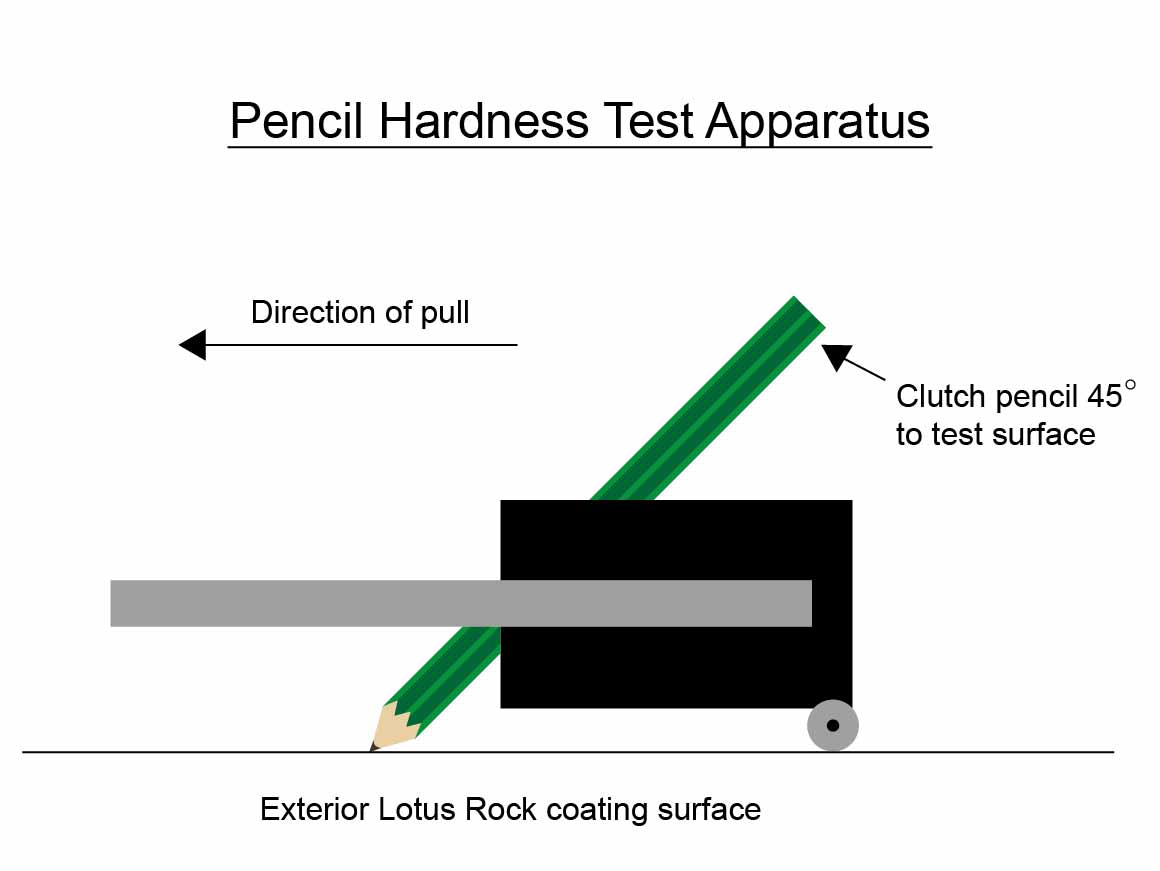
The Pencil Hardness Test procedure, according to BS EN 12983-1-2000+AC:2008, is as follows:
Step 1 = Set up apparatus with a 5H lead loaded to either 4 N or 8 N + 0,2 N.
Step 2 = Draw the apparatus across 25mm of an untouched area of the test surface.
Step 3 = If the lead has cut a clean path through the coating, repeats steps 1 & 2 reducing the grade of the lead by one step each time until it fails to cut a clean path through to the substrate.
Step 4 = Report the hardness of the coating as the hardness of the first lead which failed to cut a clean path through to the substrate.
Evaluation
Generally, even with the stricter standard of a fixed pressure of 8.0 Newtons (765g±2%) applied to the exterior coating, a Lotus Rock pan can pass a Pencil Hardness test with a standard of at least 8H hardness. In fact, more often than not, even if a Lotus Rock pan’s outer coating is scratched a bit from the sharp edges of a gas stove, the surface can still be scrubbed with a standard abrasive pad and the scratch will in most cases be removed. This excellent scratch resistance allows a Lotus Rock pan to be used for a much longer period of time, than say a non-stick coated pan, most of which only have a thin, silicone polyester coating on the outside of the pan. For a standard pencil hardness test, without any heat applied to the surface, then a silicone polyester coating can pass at a 4H hardness standard. If, however, the ambient temperature test is included whereby the surface temperature of the pan is increased to 200 degrees, then a silicone polyester coating is liable to become quite soft, and will then only pass a 2H hardness standard. To counter this problem some manufacturers use a sol gel technology ceramic coating instead of a silicone polyester coating, which is usually twice as thick, with a stronger bonded construction. However, even this type of coating can only reach a 6H hardness standard, still below the Lotus Rock scratch resistant quality of 8H.
May 16, 2015 / arnoldtnn / 0 Comments
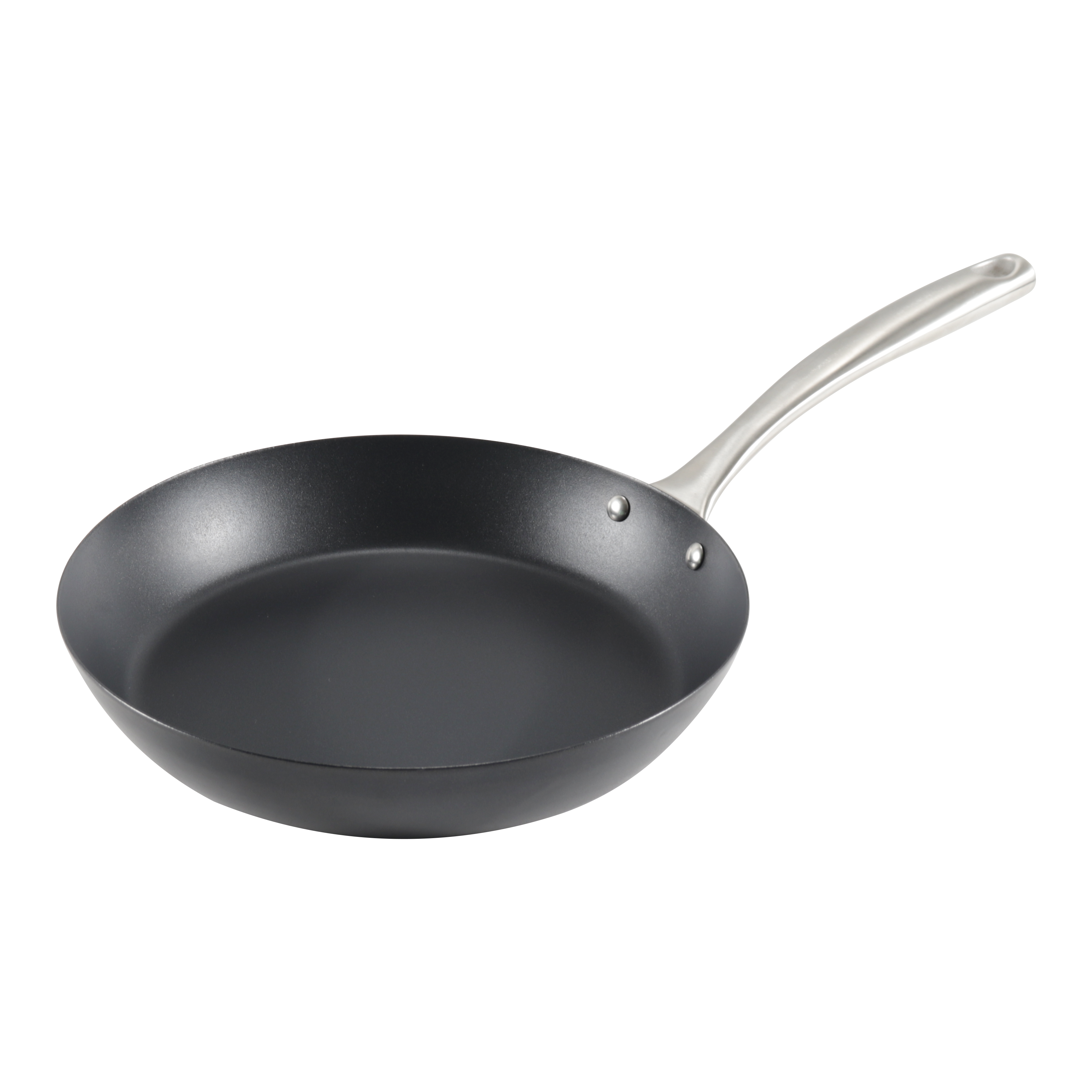
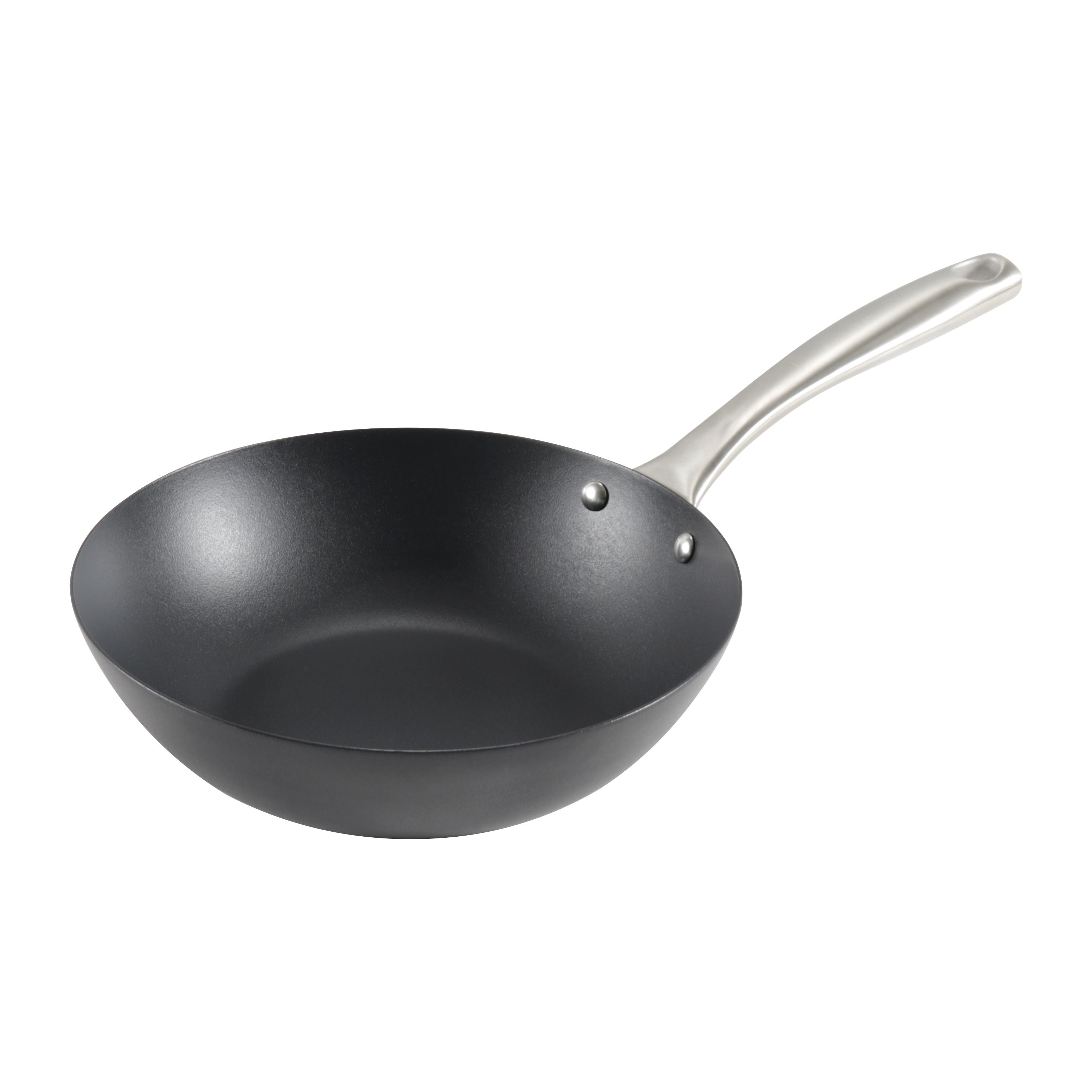
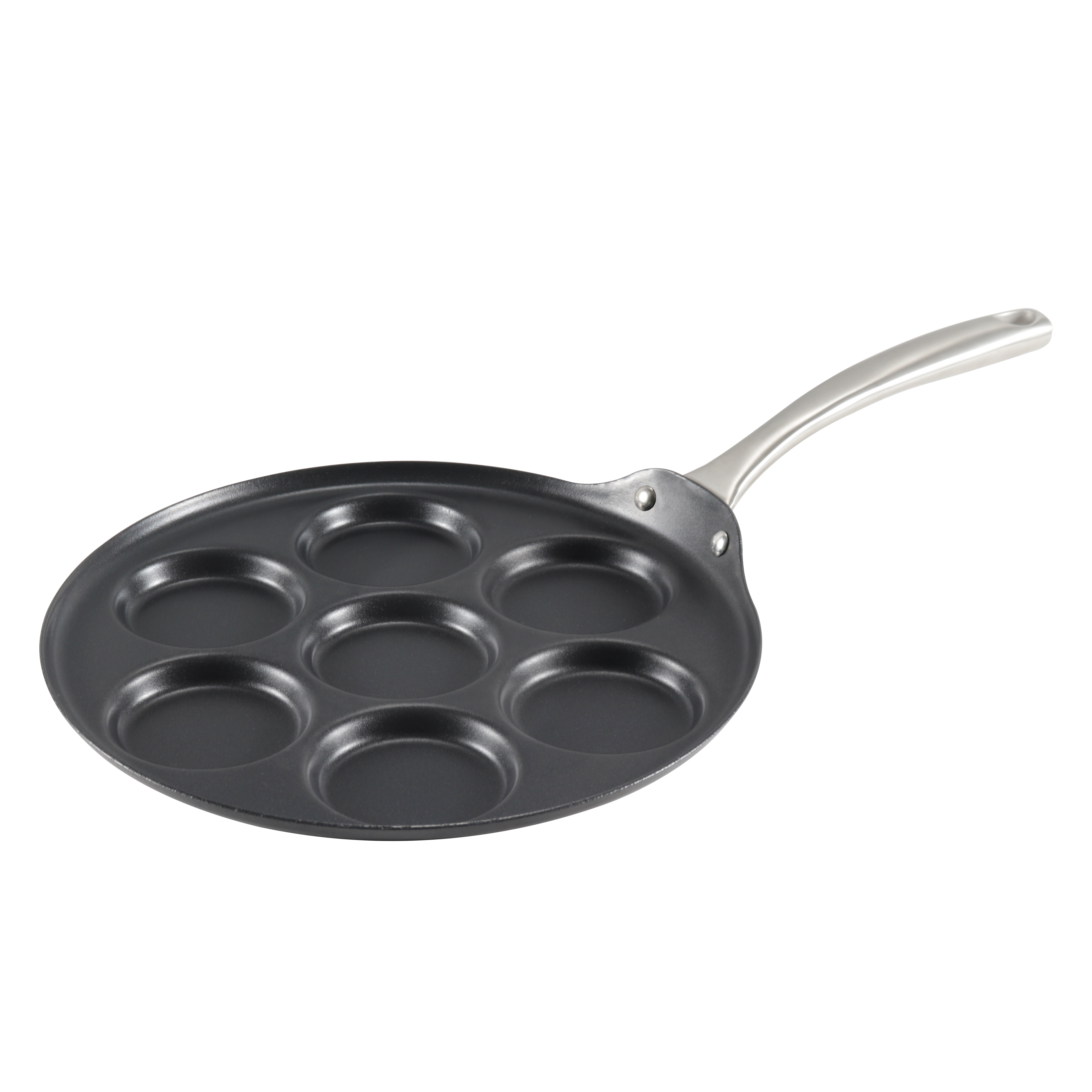
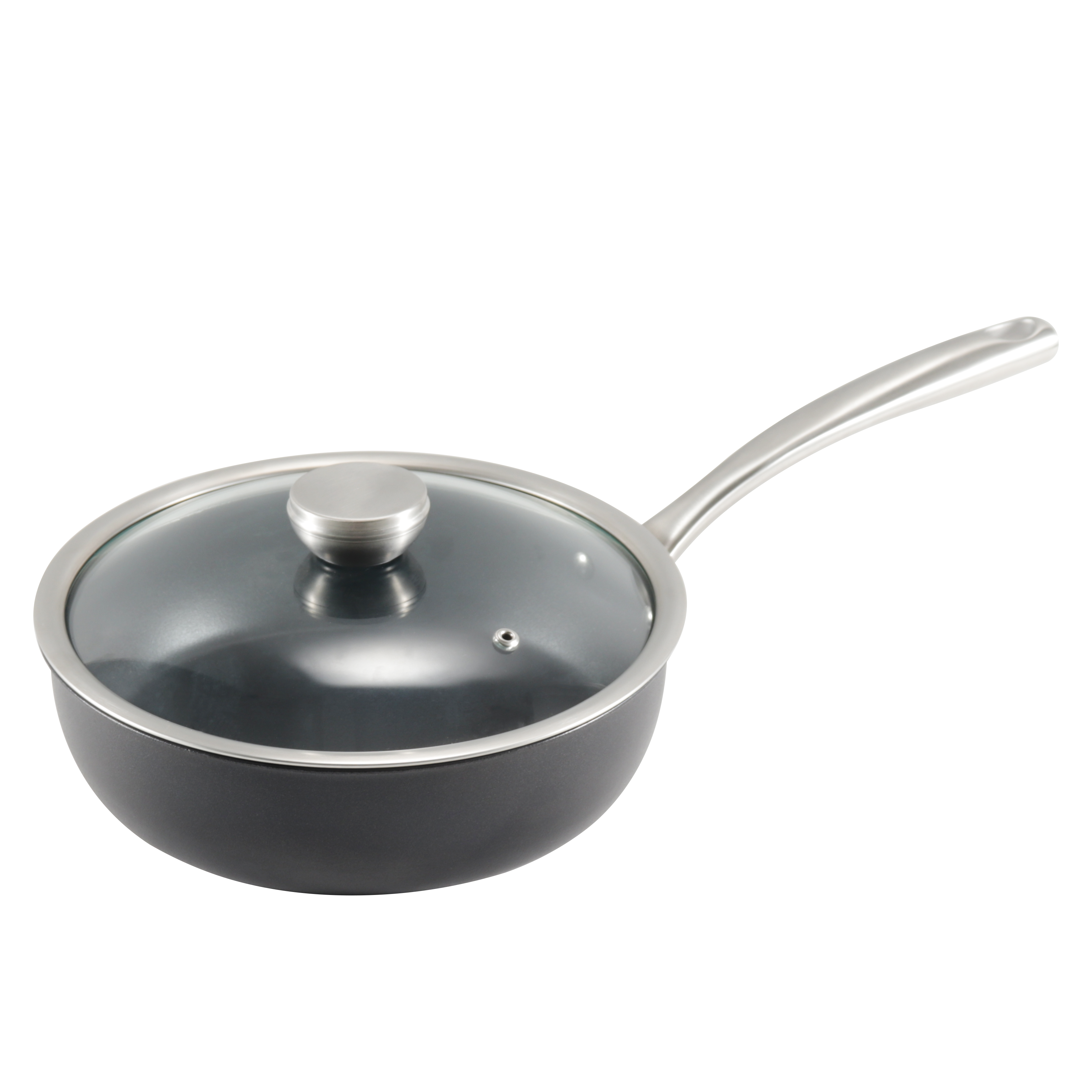

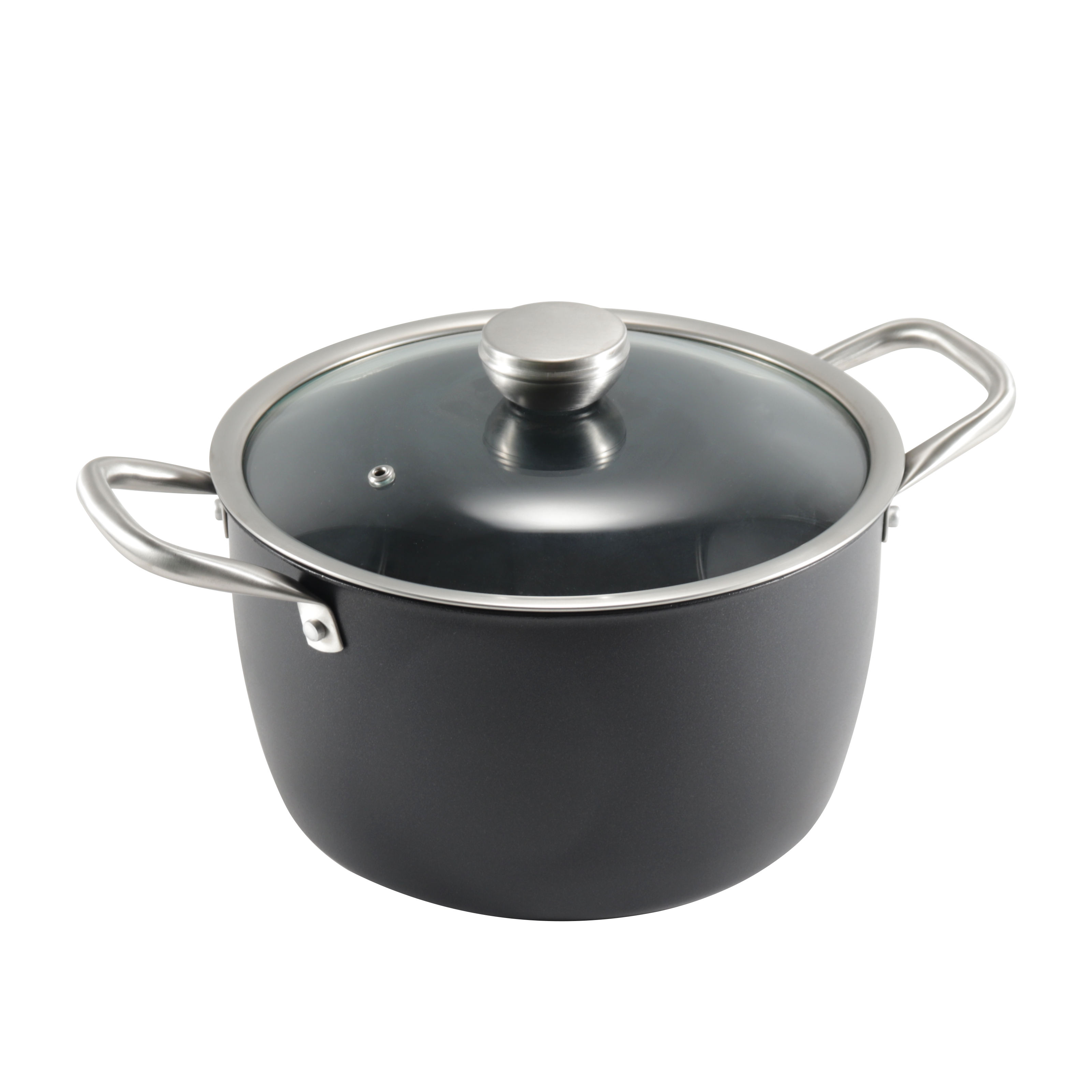
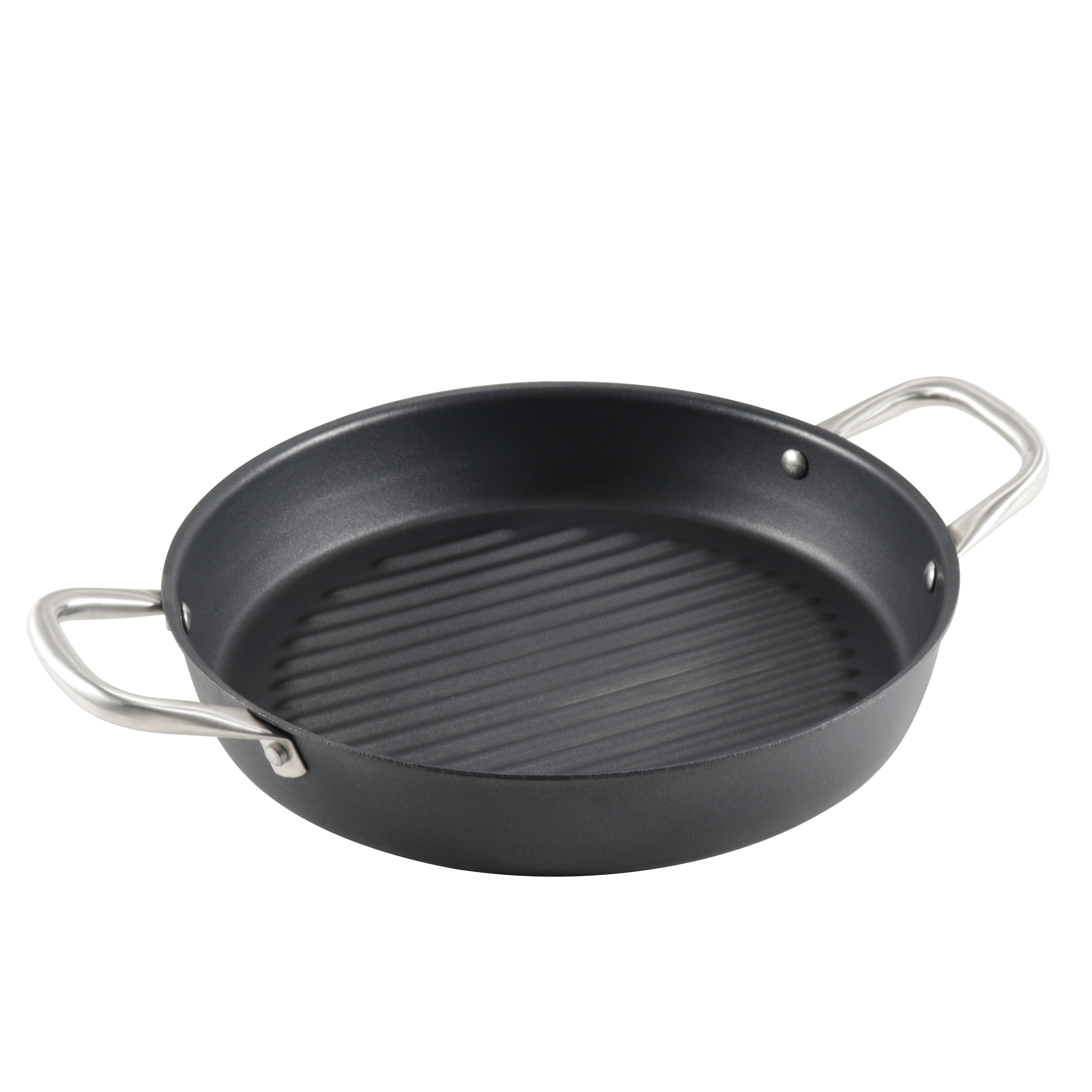
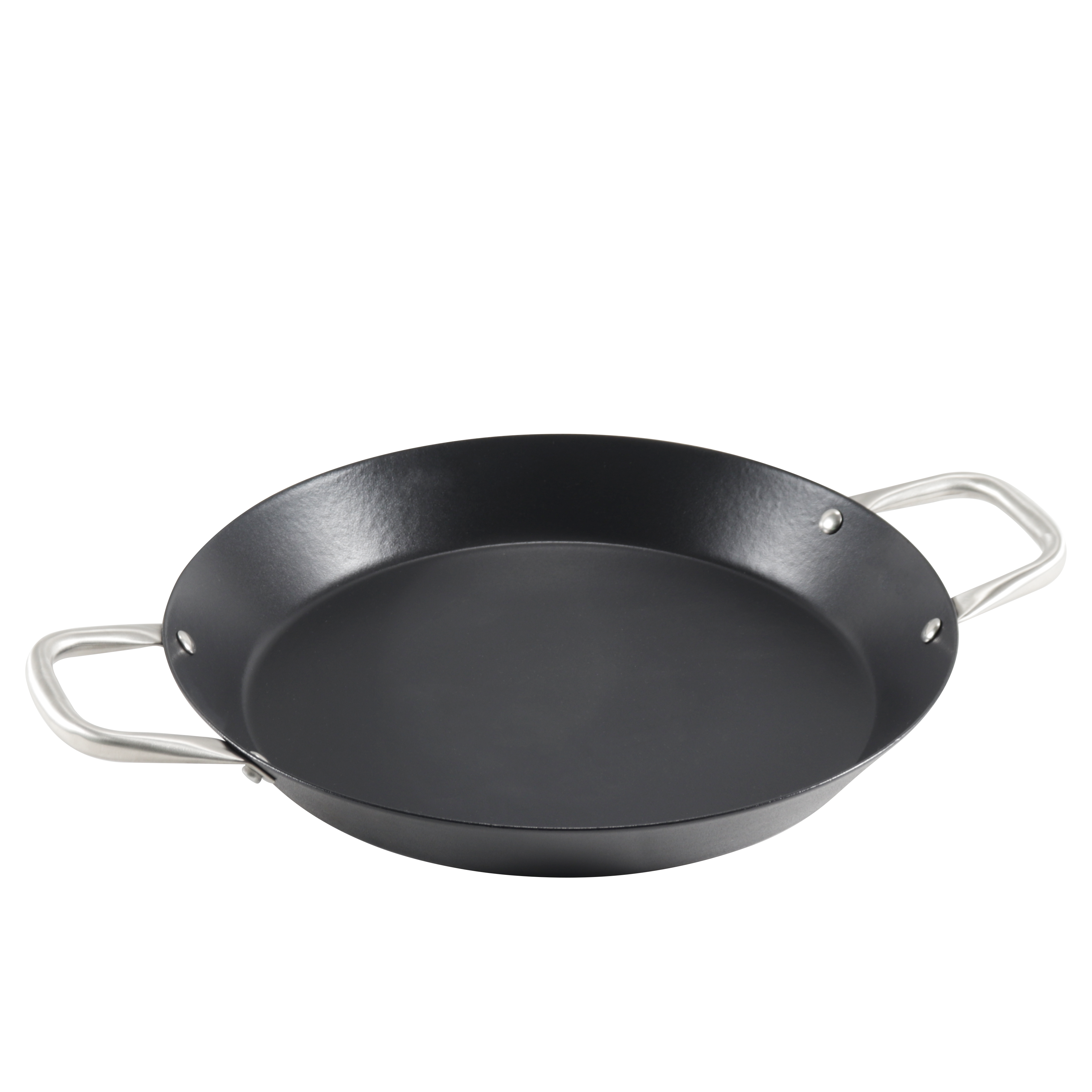
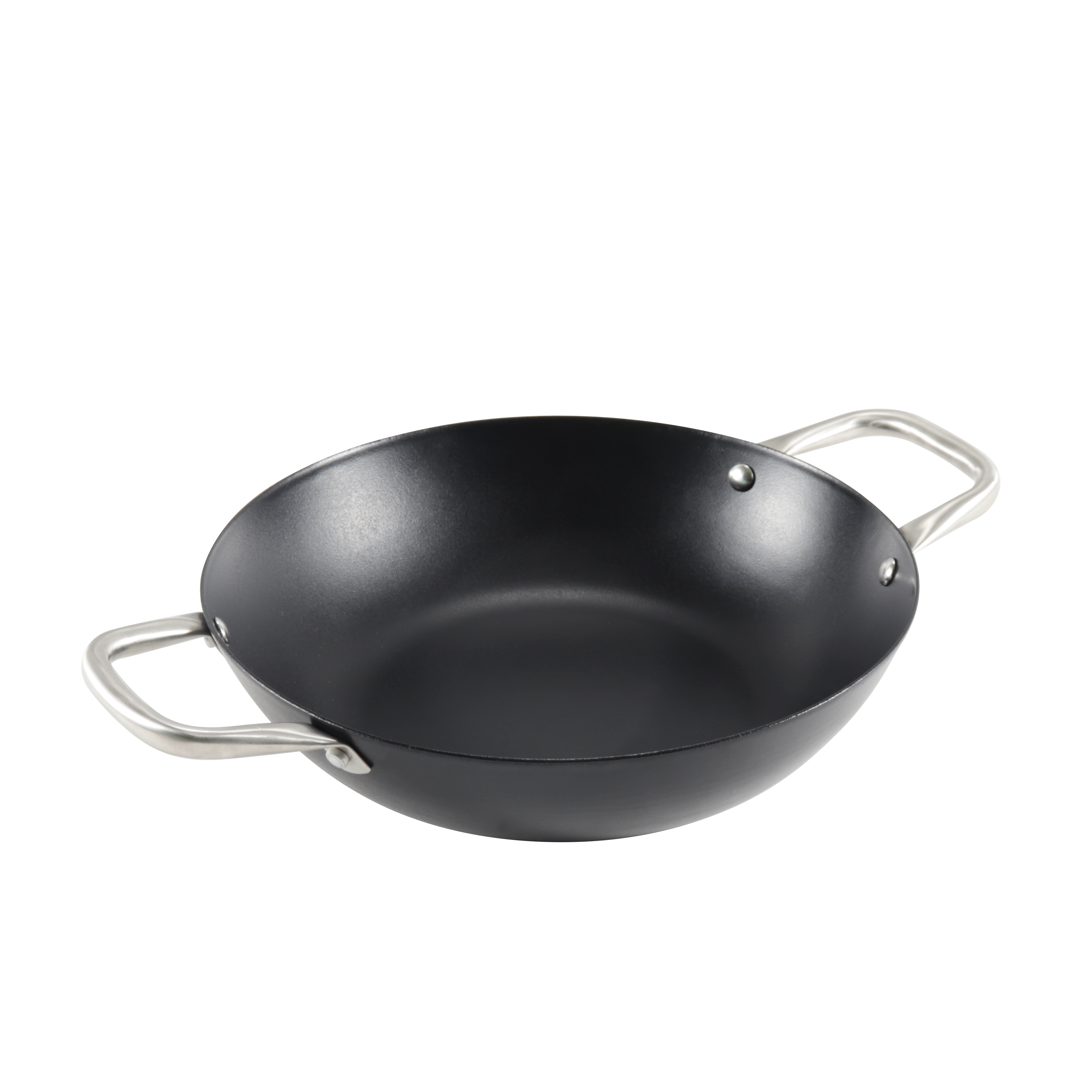
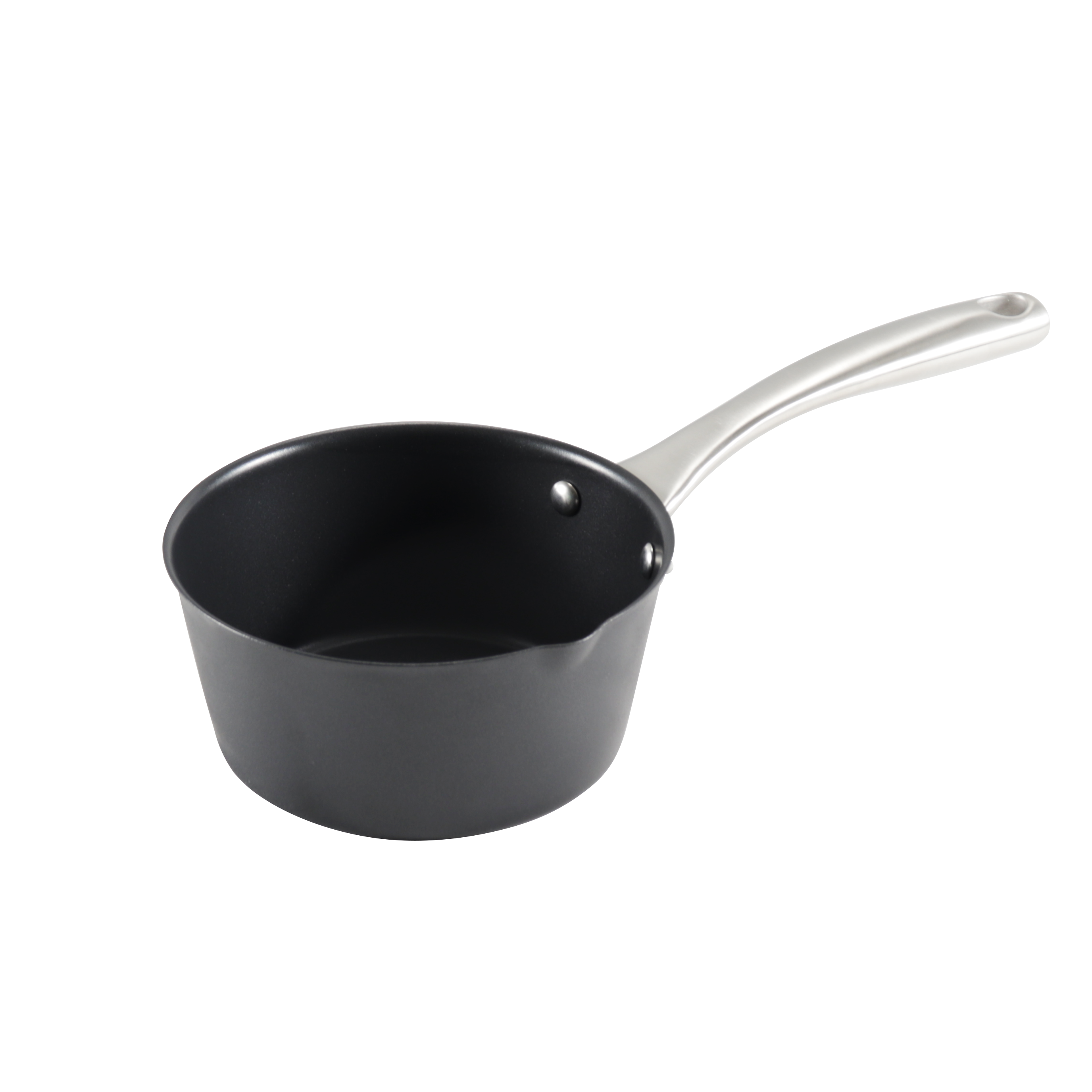
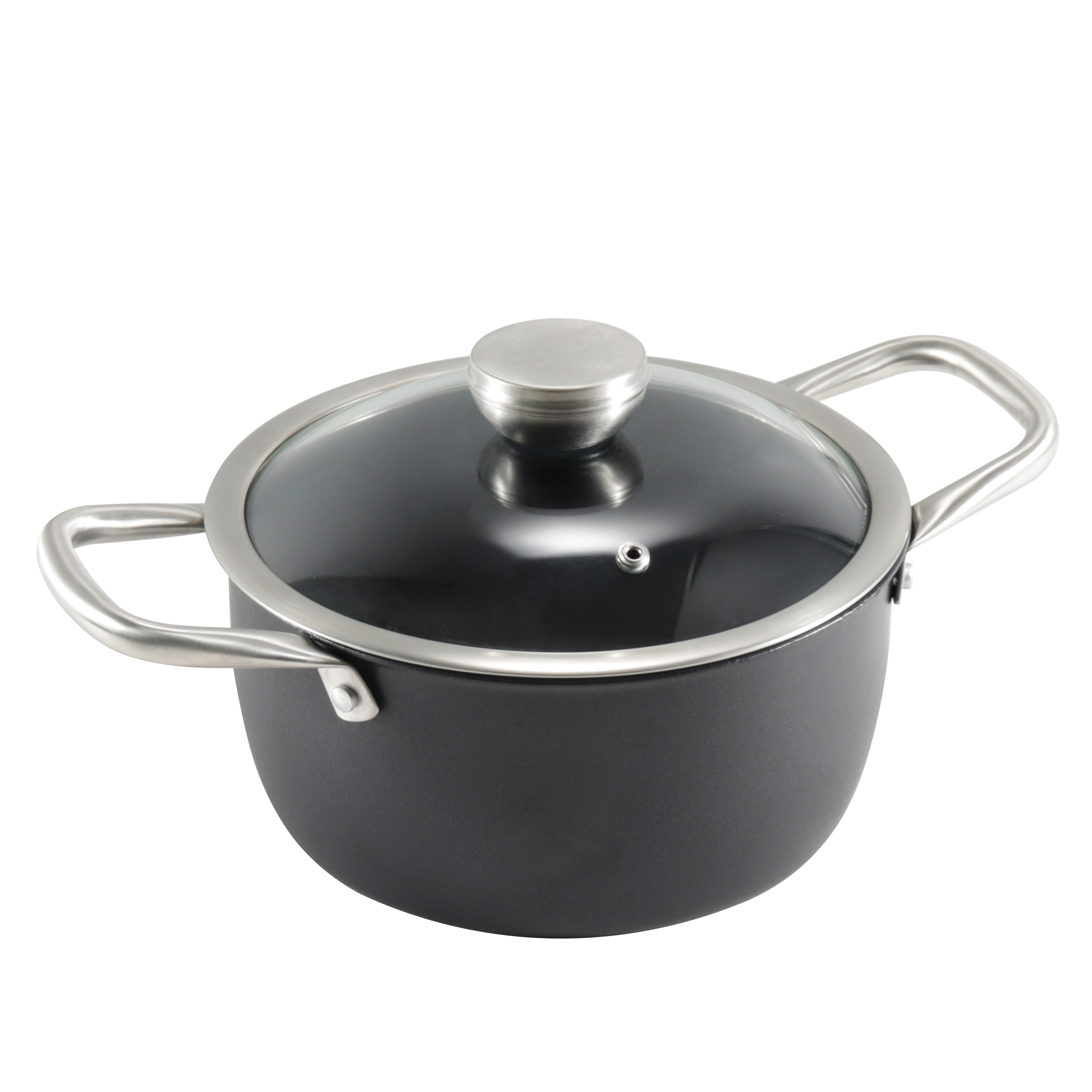
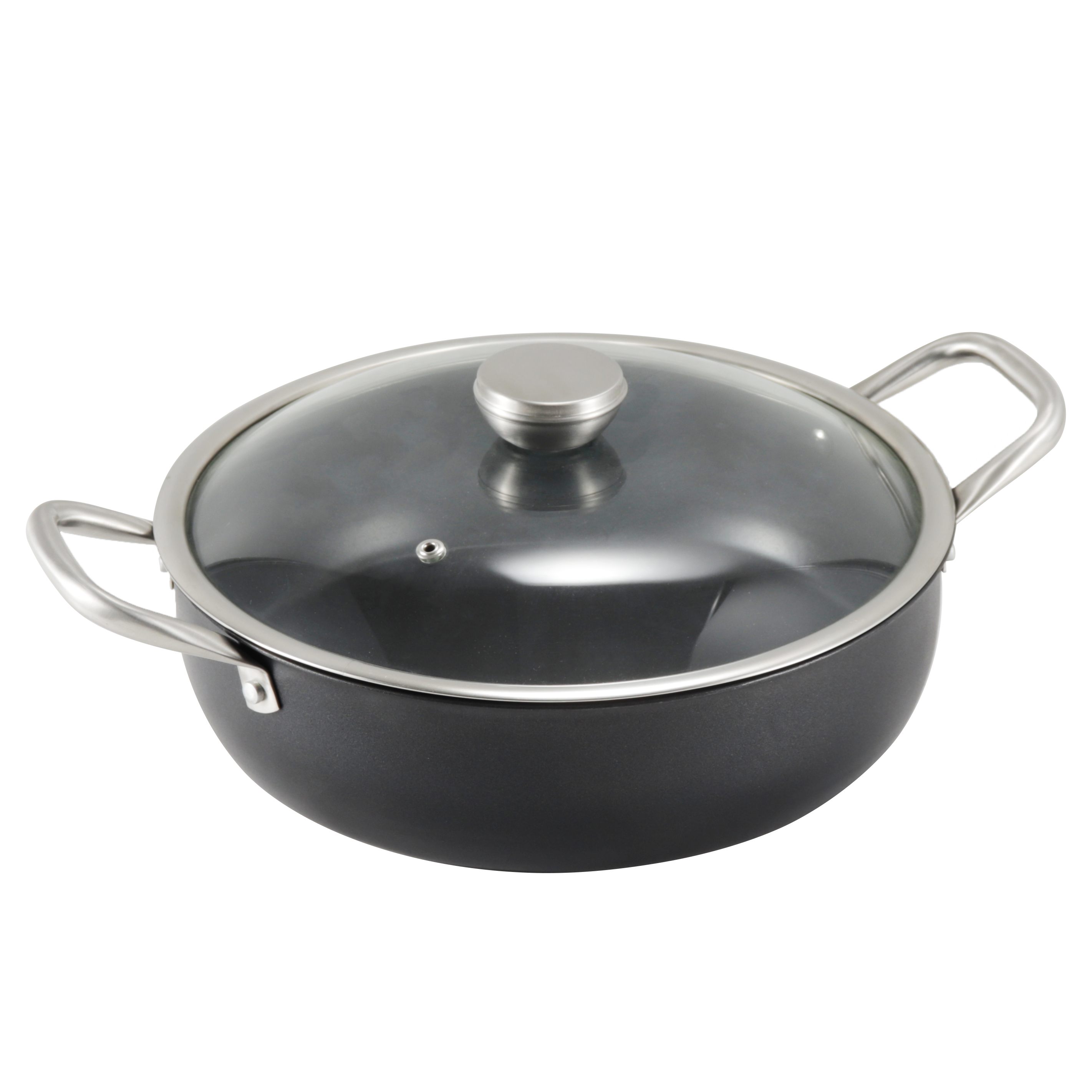
May 15, 2015 / arnoldtnn / 0 Comments
The term ‘heavy metals’, is most commonly used to describe metallic elements of higher atomic mass that are toxic at low concentrations. If a consumer product, which is used for contact with food, has high levels of a heavy metal then it can be hazardous to human health. The short term effects of heavy metal poisoning can range from skin irritation to vomiting, but high level exposure can cause anything from liver damage to renal failure.
In order to demonstrate that all Lotus Rock pans are free of heavy metals that can leach into cooked food and cause poisoning, an Extractable Heavy Metals Test was commissioned with SGS Testing Services Ltd. The testing standards were done in accordance with LFGB* (German food law) regulations.
*In September 2005, the new German Food commodity and Feed Law (Lebensmittel – Bedarfsgegenstandegesetz und Futtermittelegsetzbuch –LFGB) replaced the old German Food & Commodities Act (Lebensmittel und Bedarfsgegenstandegesetz–LMBG). Within the kitchenware industry LFGB is considered to have the most stringent test standards for assessing the level at which heavy metals can be extracted from a manufactured product.
LFGB Extractable Heavy Metals Test Result
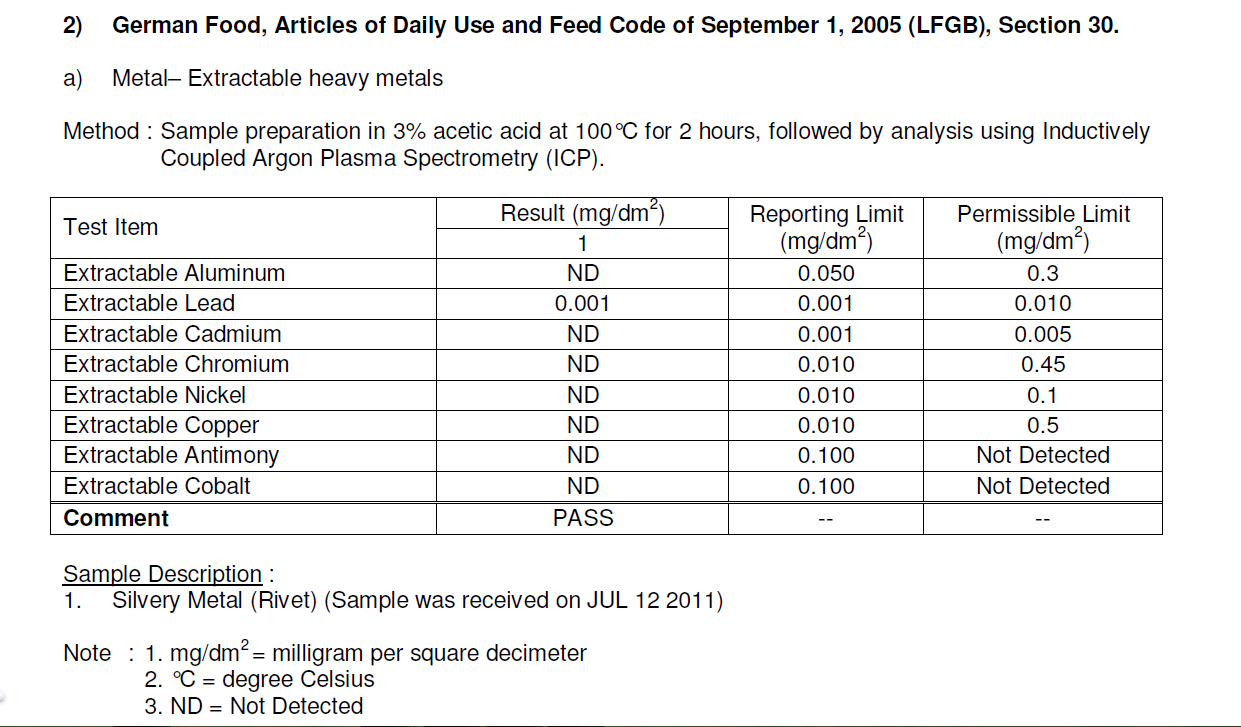
As is shown above, a number of heavy metals were tested for in the Lotus Rock pan using an acid solution, for example, similar to a recipe which might use tomatoes to make a sauce. Some of the heavy metals that were tested for included Cadmium and Mercury; these are toxic to the human body as they undergo bioaccumulation. This means that they are absorbed by the body at a faster rate than they can be removed, and, over a period of time, can cause chronic poisoning, even if the levels found in the environment are low. Other heavy metals, such as Copper, are essential to bodily functions, but at higher levels they begin to alter metabolic processes and become toxic. Other than Cadmium, the other heavy metal considered to be most toxic to human health is Lead. High levels of exposure to lead can have numerous, severe health problems. These include neurological damage and damage to organs such as the liver and kidney.
April 14, 2015 / arnoldtnn / 0 Comments
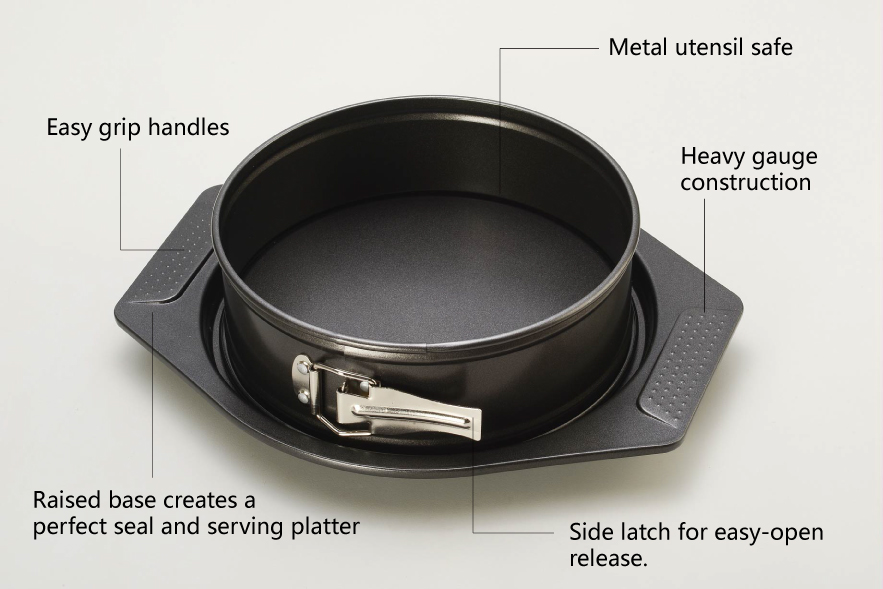
Professional-quality Lotus Rock spring form cake pan releases flawless cheesecake, torte, coffee cake and frozen dessert. The pan’s rim springs free from the base when the clamp is released, so you can remove baked goods without breaking. Easy to grip handles allow easy movement to and from the oven. 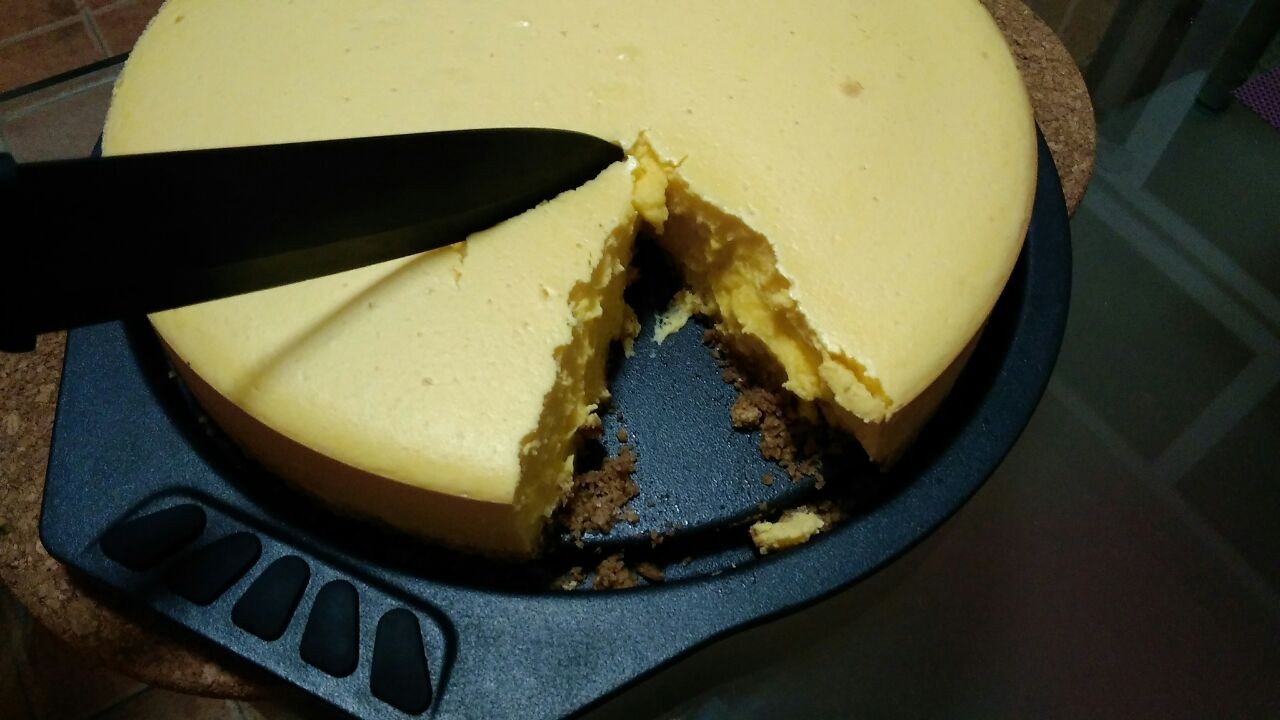 Natural, highly durable non-stick coating, with a metal utensil safe surface – suitable for carving a cake with a sharp, steel knife for serving directly on the table. Lotus Rock bakeware’s hydrophobic surface is easy-to-clean and with excellent colour stain resistance. Heavy gauge steel substrate, with a thick layer of ceramic on both the interior and exterior of the pan distributes heat quickly and evenly for consistent baking results.
Product features
- Easy-close latch creates a leak-resistant seal, keeping dessert intact.
- Spring form design is particularly helpful when releasing items that can’t be inverted, such as cheesecake, quiche, deep-dish pizza and layered frozen desserts.
- Rolled edges add rigidity to retain pan shape.
- Raised base creates a perfect seal and serving platter.
- Thick-walled construction prevents warping or bending.
- The premium Lotus Rock bakeware will not rust, chip, flake, peel or blister.
- Natural, durable nonstick coating ensures easy release and clean up.
- Ceramic coating on base is metal utensil safe.
- Lotus Rock bakeware is oven-safe to 550 F and broiler-safe.
- PTFE- and PFOA-free round springform pan is nonreactive to acidic or dairy ingredients and will not affect the flavors of foods or discolor over time like natural metals.
April 10, 2015 / arnoldtnn / 0 Comments
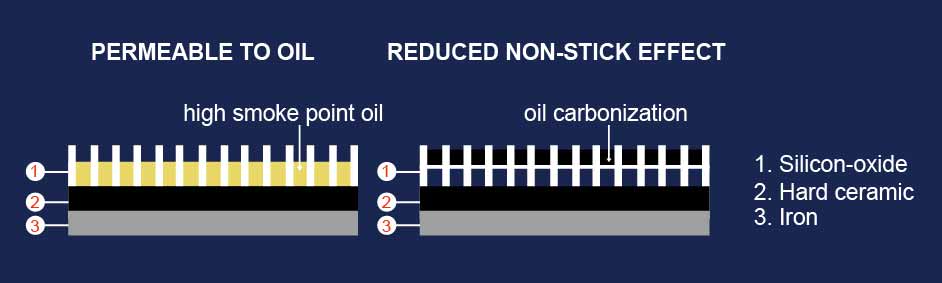
One of the significant benefits of a Lotus Rock pan is its amazing heating effect, for example, it is perfect for searing a delicious brown crust on meat and vegetables. However, if the wrong cooking oil is used for this heating effect then a dark build-up on the surface of the pan can appear, in most cases this is because of oil carbonization. This occurs over time when cooking oil is used above its smoke point – extra virgin olive oil or butter is the usual culprit. Oil carbonization can impart two particular defects to a Lotus Rock pan, first it makes it very difficult to clean, the pan no longer has a hydrophobic surface to assist for easy cleaning. The second difficulty with oil carbonization on a Lotus Rock pan is that it stops any cooking oil from permeating the lipophilic surface of the silicon-oxide crystal coating – thus making the pan no longer non-stick.
What to do?
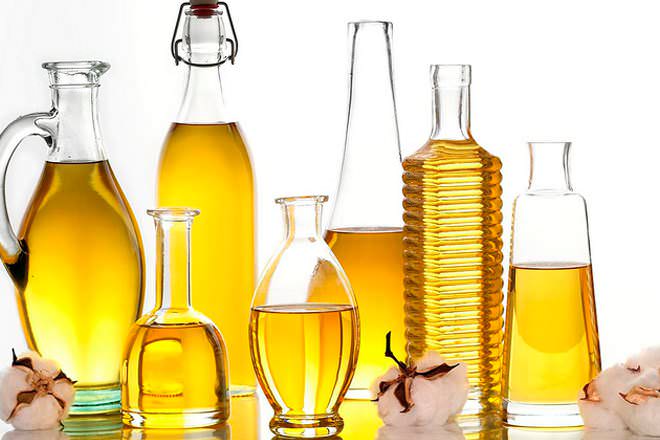
Using a cooking oil with a high smoke point is very important, as it can give the oil time to seep into the Lotus Rock pan’s surface and provide a non-stick release for cooking, before it can carbonize and scorch on the pan. Lotus Rock recommends vegetable, canola or extra-light olive oil for most cooking needs. Unlike olive oil, for example, which should never be used because it has a very low smoke point, these three oils have quite a high smoke point and so are more suitable for the fast and high heating effect of Lotus Rock pans.
In addition to using the correct cooking oil, after each use a Lotus Rock pan should be scrubbed thoroughly with a grease fighting dish soap. This will stop too much oil from remaining on the pan, which might later become quite sticky and therefore scorch the pan when it is next used.
What if my Lotus Rock pan already has an oil carbonization mark on it?
A lot of cookware manufacturers recommend using baking powder and water to remove oil carbonization marks on a pan. However, from our own testing we have found this to be not very effective at completely removing the marks from the pan. Instead we recommend using the procedure as described here to purify the pan and renew the non-stick release.
April 2, 2015 / arnoldtnn / 6 Comments
As was noted previously here, Lotus Rock does not have a chemical non-stick release. Unlike most other famous non-stick coated pans, such as Calphalon, Scanpan and Tefal, which contain a chemical compound called PTFE for non-stick release, a Lotus Rock pan has instead a natural, durable non-stick release, which is PTFE-free.
When a general, PTFE non-stick coated pan loses its non-stick release, it cannot be renewed – it becomes obsolete. With no non-stick release a PTFE-coated pan will become harder to clean and the coating may start to peel off, making the pan unfit and hazardous for further use. However, if after some use, food begins to stick to a Lotus Rock pan and it becomes harder to clean then it can, just like with uncoated cast iron or steel, be “re-seasoned”, or to put it in a more appropiate way for a Lotus Rock pan, the non-stick release can be ‘renewed’.
If your Lotus Rock pan does become hard to clean, with a reduced non-stick effect, then the below steps can be followed to remedy this.*
*Please note, that in addition to the steps shown below, the consumer must still wipe some oil onto the surface of a Lotus Rock pan before each use.
Lotus Rock non-stick renewal procedure
First step – boil water
- Fill a Lotus Rock pan half full of water and heat until boiling.

- Continue boiling the water for around 10-15 minutes, until the residual substances inside the surface of the pan are released.
- Some gentle scrubbing may need to be done to help complete this process.
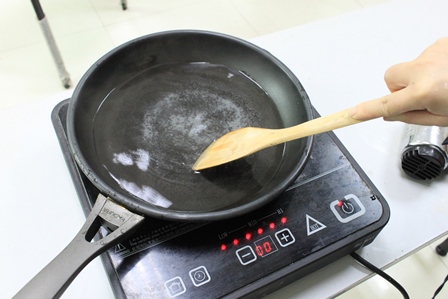
- Once finished, pour the water out of the pan, clean it and then dry.
Second step – heat oil
- Fill the pan with oil about 1cm deep and heat the oil until it starts to smoke.
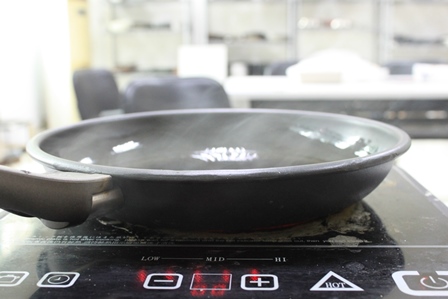
- Then, carefully pour the oil out of the pan into a suitable container.
- Clean the pot dry, and then start to use the pan again for cooking.*
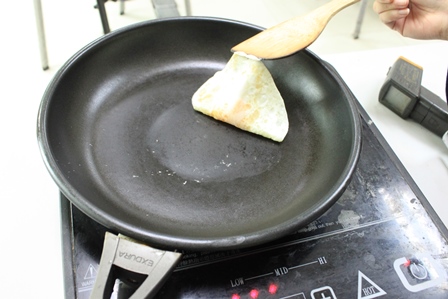
As is shown in the photos above, the Lotus Rock pan used in this test has a special feature included – the Stable Concave design. For more information about this please read here.
*Important! The pan must be washed after use. If too much cooking oil remains in the silicon-oxide crystal surface this will affect the non-stick release. Just like if oil is left around a jar it becomes sticky, which makes it uncomfortable to use
March 19, 2015 / arnoldtnn / 0 Comments
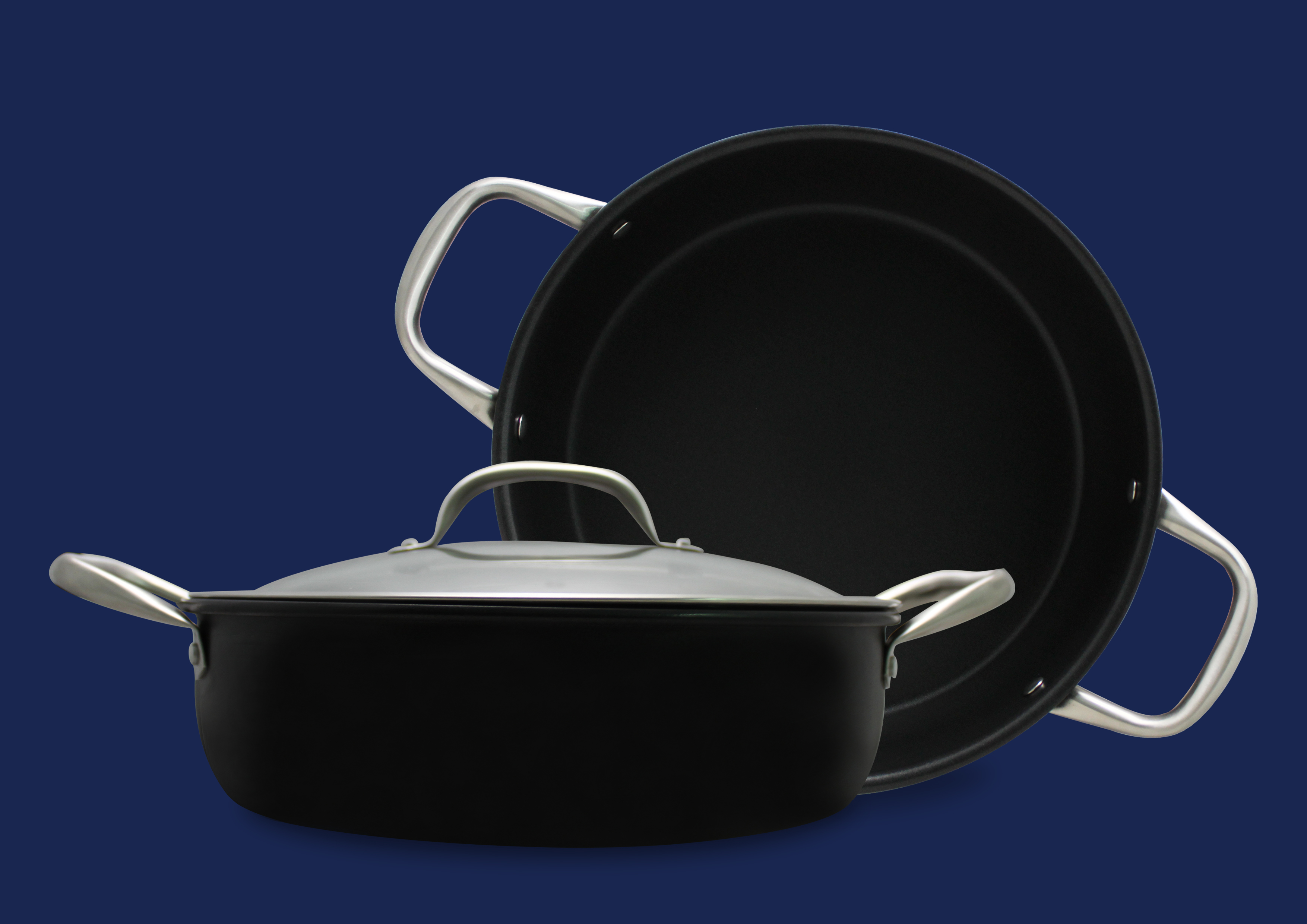
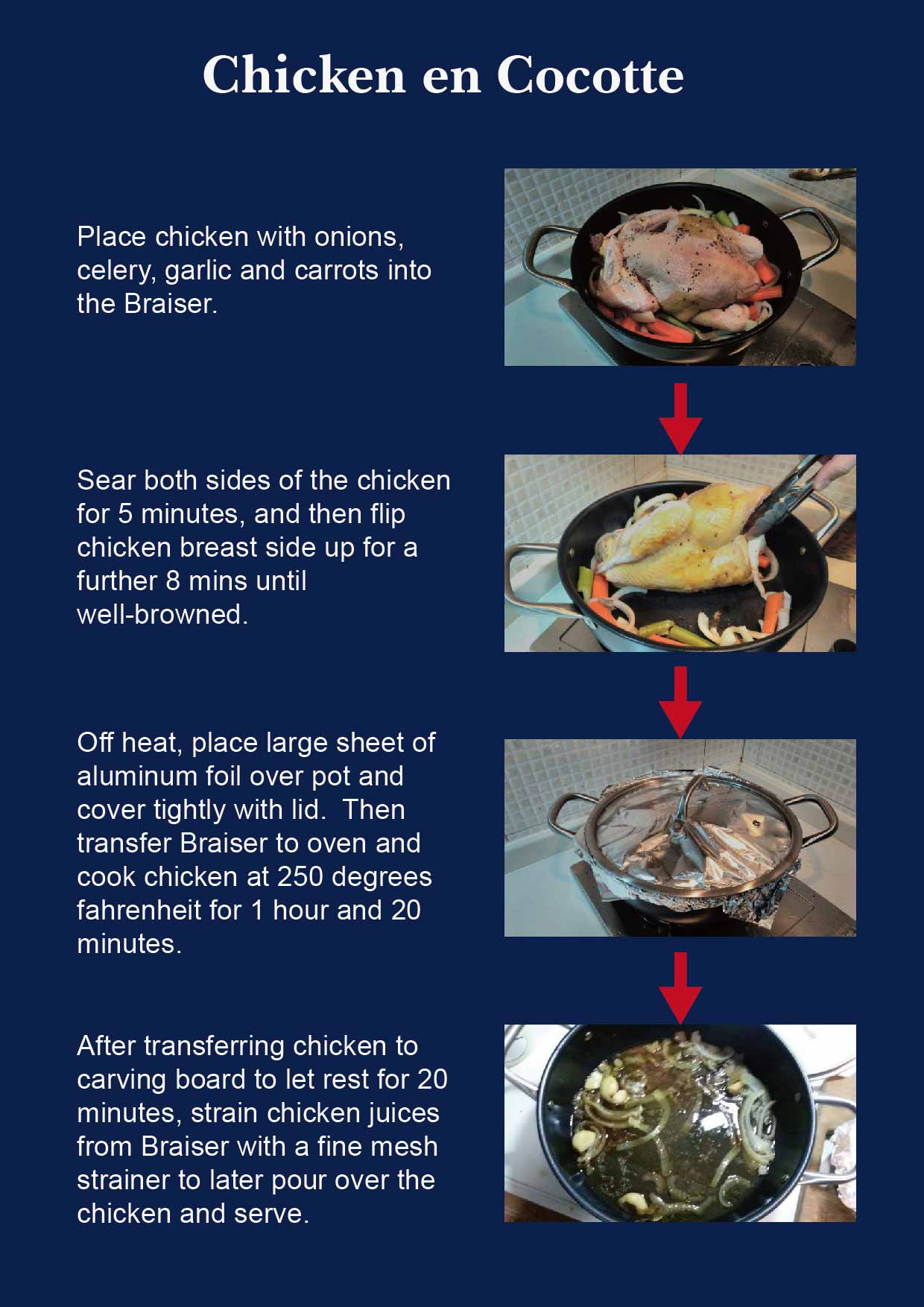
As was noted in this blog post, a Lotus Rock pan is excellent for braising meats or vegetables that need to be seared quickly in the open pan and then covered with a lid to cook slowly in their liquid and the moisture that is created. For this type of cooking method the whole process is done over the stove. However if a Professional Forged Stainless Steel handle is used, then braising can also be done in the oven as well.
One way to use a Lotus Rock Braiser in the oven is to cook en cocotte, or otherwise known as casserole roasting. This is a common cooking method in France that is typically used for chicken and lamb. It is similar to braising in that it:
- Utilizes a covered pot,
- Low oven temperature,
- Extended cooking time to yield tender, flavorful meat.
However, there is one big difference – with en cocotte no liquid is added!
With the en cocotte cooking method, juices are drawn from the meat into the pot. These juices create a moist-heat environment, so that the meat cooks gently – in effect braising it its own juices. The result is unbelievably tender and flavorful meat undiluted by additional liquid.
February 7, 2015 / arnoldtnn / 0 Comments

For more information please read here, and here, and watch here.
February 4, 2015 / arnoldtnn / 0 Comments
A Lotus Rock frying pan has an excellent high heating effect, and so because of this it is ideal for use on a stove top to give meat and vegetables a deep brown, flavorful crust. However, although this cooking method undoubtedly gives the meat a more delicious taste on the surface, it can be difficult to cook some foods evenly – steak, for example – and to preserve as much moisture as possible to keep it juicy and moist.
One of the significant benefits of a forged steel handle or silicone grip handle is that the pan can be transferred to the oven either before or after the meat is seared on the stove. Coupling these techniques prevents scorching and excess moisture loss.
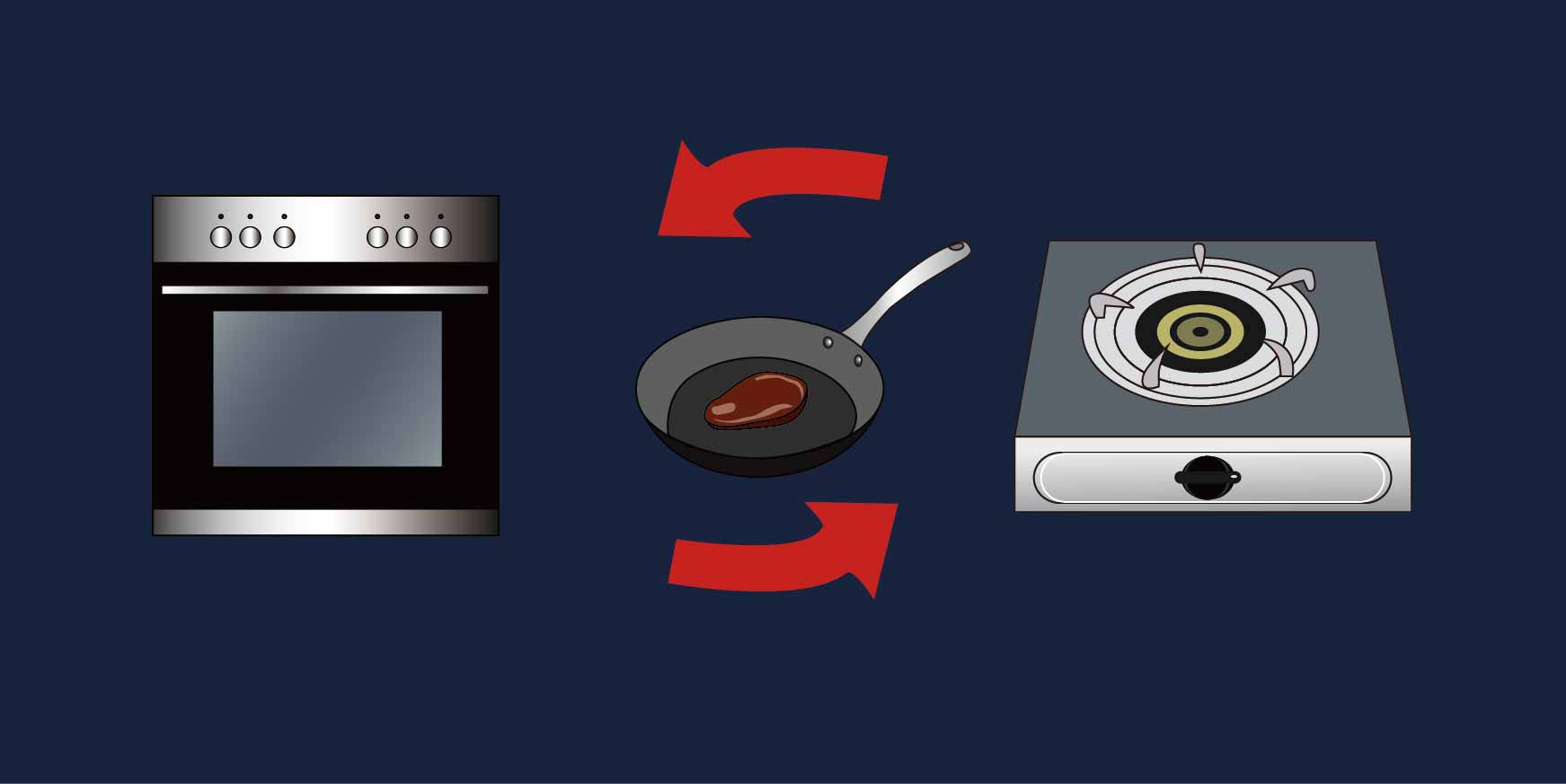
For chicken breasts, which must to be cooked very well done to be safe for human consumption, it is better to sear the chicken quickly first, to develop a crispy crust and then to put it in the oven to cook the inside.
A well-browned and juicy steak, on the other hand, requires the same process but in reverse order. It makes sense to put the steak in the oven first, to be heated indirectly, and then for it to be put on the stove later for a more efficient heat conductor, in order to develop a well-browned crust.
There are a couple of reasons for doing a steak this way, these include:
- Keeping the pan hot. A steak should not be seared too long in the pan, otherwise it will become too dry and tough to eat. If the pan is heated before the steak is added it will brown more quickly and so lose less moisture. Ideally the steak also should be heated in an oven before it is placed in the pan – a cold piece of meat will cool the pan slightly, and so delay the point at which the meat begins to brown (the Maillard reaction begins at 300 degrees) – though the heavy gauge and thick ceramic coating of a Lotus Rock pan gives it excellent heat retention and reduces this problem. The faster the steak is well-browned, the sooner it can be taken out of the hot pan and the more moisture it will retain, for a juicier, more succulent taste.
- Remove surface moisture. Oven warming the steak evaporates some surface moisture, so there is less to be converted to steam when the steak is added to the pan. Less moisture on the steak will reduce the chance of water vapor separating the steak from the pan while it is being seared. Consequently, the browning process can begin sooner and finish faster, for a well-browned crust and a juicy interior.*
*Another important factor that affects the juiciness of a steak is its resting period. Around 10 minutes after cooking is usually sufficient time for the moisture to be reabsorbed inside the meat. If the steak is cut immediately after cooking then a lot of liquid will spill out which would make the steak drier, chewier and less enjoyable.
December 30, 2014 / arnoldtnn / 0 Comments

Cutting your pizza directly on the non-stick pizza pan will mar the finish. Always slide your pizza onto a wooden cutting board, and then cut with a pizza cutter.
The above Use & Care instruction appears on almost all packaging for non-stick pizza crisper pans sold throughout the world. In order to avoid scratching the surface, and so damaging the pan’s non-stick release, pizzas must always be moved, with some difficulty, from the pan onto another surface for cutting and then serving. This can be quite inconvenient for the consumer, especially as pizzas taste best when just out of the oven and sizzling hot, so some care must be taken when moving them.
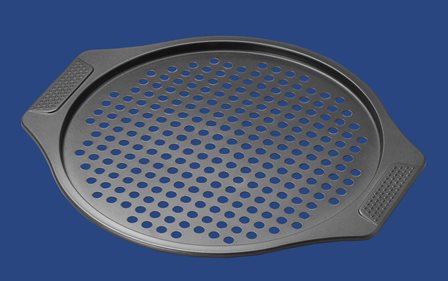 The Lotus Rock Pizza Crisper Pan, on the other hand, has no such Use & Care instruction on its packaging because, like all other Lotus Rock cookware and bakeware, it is metal utensil safe. A standard stainless steel pizza cutter, or an all-purpose knife, can be used to cut and serve pizza directly from the pan, without any damage to the pan’s appearance or its long term non-stick release.
Another significant benefit of the Lotus Rock Pizza Crisper Pan is its high heat resistance and heavy-gauge steel construction. Not only can it be used in a standard kitchen oven for a number of years, but because it has no chemical non-stick coating, such as PTFE, it can be used over an intense flame, such as an outdoor charcoal grill, without any damage to the pan’s quality. Moreover, because of its 2.0mm thickness the pan is very durable, will not warp easily and will hold its shape for long term use.
In addition, a Lotus Rock Pizza Crisper Pan has an excellent heating effect which produces a pizza with a golden, light, crispy crust. The heavy steel gauge, with its dark matte, thick ceramic interior surface, retains and disperses heat within the pan extremely well to bake with a pizzeria-style texture and flavor.
Lastly, the Lotus Rock Pizza Crisper Pan can also be used to bake other food, such as French fries, with uniform browning and crisping. Oven baking is considered a much healthier option than deep-frying, which allows large amounts of fatty oils to permeate the crust.
November 11, 2014 / arnoldtnn / 4 Comments
In association with the Serious Cook range, Lotus Rock cookware is now sold in South Africa in all Woolworths’ stores. Items currently sold include a 30cm Frying Pan, an 8″ Stir Wok, 14″ Stir Wok, and a 28cm Grill Pan.
October 8, 2014 / arnoldtnn / 0 Comments
“Outstanding! heats evenly and cleanup is a breeze. I’m done with all the stainless grill pans!”
The above quote was written by a consumer in the USA who has purchased and used the Lotus Rock Outdoor Grill Roaster. Previously this person had grilled over either a charcoal or gas-fired grill with a stainless steel utensil of some sort, and for good reason because in the market place today most outdoor grill pans are made with stainless steel. Undoubtedly stainless steel cookware is useful for grilling, for instance it has excellent corrosion resistance and it is metal utensil safe. However, as the quote from the American consumer clearly demonstrates, a Lotus Rock outdoor grill pan has some significant advantages over a stainless steel pan. It is because of these numerous benefits that an increasing number of consumers in the USA, who take their grilling very seriously, are switching from stainless steel to Lotus Rock BBQ cookware.

October 7, 2014 / arnoldtnn / 0 Comments
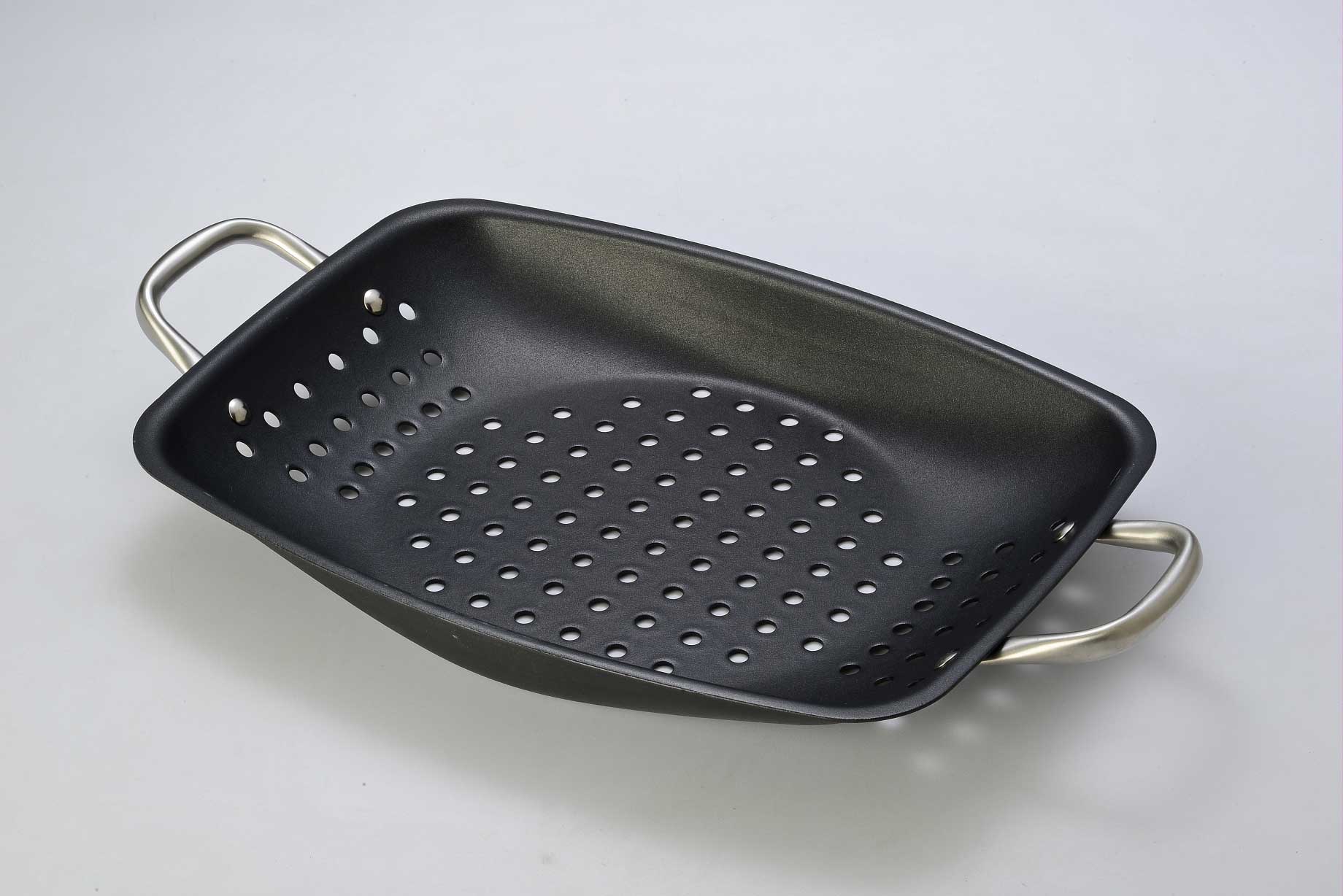
If there is one country in the world that loves to do outdoor grilling, it is the USA. Americans don’t just grill for a special occasion, they grill all year round, and many of them do so as part of their daily cooking. This widespread, intensive enjoyment of outdoors grilling demonstrates that many Americans have a good understanding of which BBQ cookware utensils are good and which not so good.
Earlier this year the Lotus Rock Outdoor Grill Roaster was introduced into the USA market, and so far has been a very popuar product. The Roaster is sold on a high-end kitchenware catalog/ website, where it currently has a 5-star rating. Many of the website’s customers write reviews of its products on the website, and so the popularity of each product is strongly related to its performance quality.
Reading the numerous reviews, three particular benefits stand out: the pan’s easy-to-clean quality; its excellent non-stick release; and its high suitability for cooking delicate foods such as vegetables and fish. I have copied and pasted some of the reviews below
Like lots of other outdoor cooks, I had been using pans, baskets, and trays to make barbecue cleanup easier and to cook delicate food, but nothing was ideal. The pans and baskets weren’t easier to clean and the trays tended to warp. This product solves all problems. It handles high heat without warping and it truly is non stick. Cleanup is a snap.
Eugene, OR, USA
My husband and I are trying hard to lose weight and eat a lot of fresh veggies. This pan is wonderful to cook them on the grill which gives us a variety of ways to cook besides the oven or stovetop. Also is easy to clean.
Jan, Kansas, USA
We have tried several pans purporting to easily grill veggies or seafood with an easy clean up. There was no easy cleanup and the food often stuck to the pan or burned up on the grill. This pan grilled the veggies perfectly and the clean up was really easy. I would recommend it to anyone. I sent one as a gift after we had such a great experience with ours.
Cabin John, MD, USA
I have used this 3 times already. I just bought this about 10 days ago. I have marinated squash and zucchini with Olive Oil and my favorite seasonings and then grilled them in the roaster. Nice size for my grill and allows room to stir and toss the veggies! No sticking and it cleaned up in a flash. I have used less expensive equipment in the past and found this worth the price i paid. Only negative comment but it is not a flaw but just and 1′-1 1/2″ smaller would be perfect fit on my grill.
Anonymous
This grill is the best heavy duty grill I have ever used. I can use my regular metal utensils with this unit and with the handles I can serve the vegies on the table using the grill unit.
Fresno, CA, USA
It works great clean up is a snap with Ceramic Nonstick surface. I use it every time I grill 2-5 times a week.
Broken Arrow, OK, USA
I love this gril roaster! I have done veggies,fish,shrimp and lettuce on this and turned out perfect! I have told a bunch of people about this and where to get it! This is a must item if you love to grill!
Kathleen, Waukesha Wi, USA
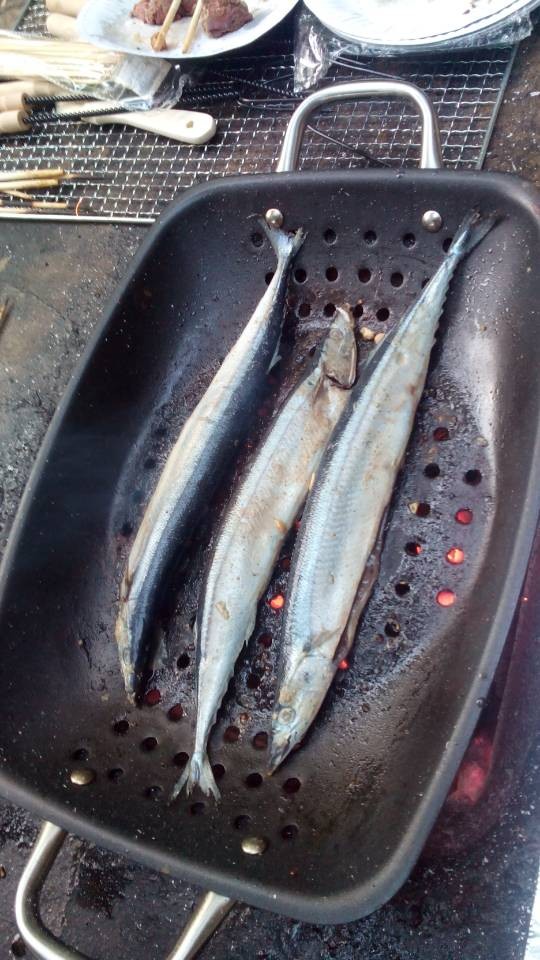
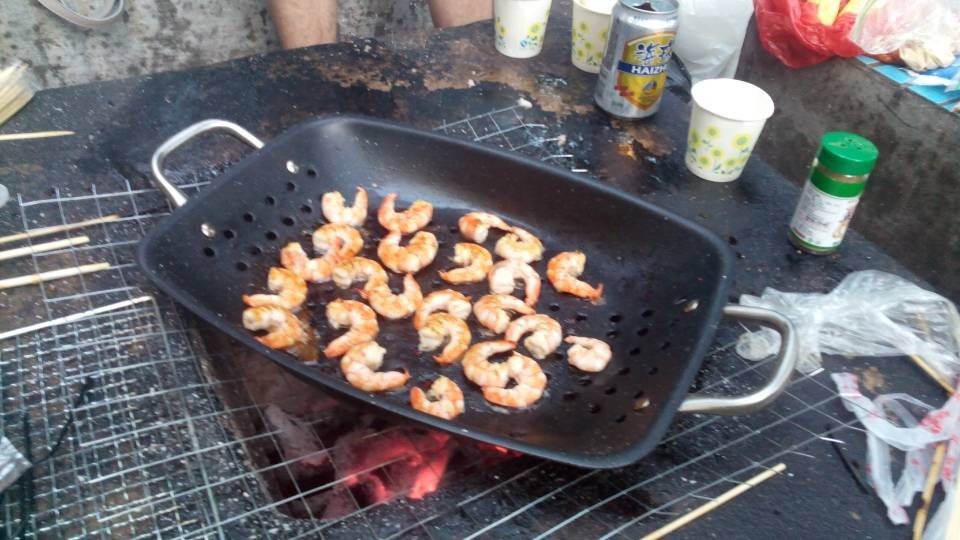
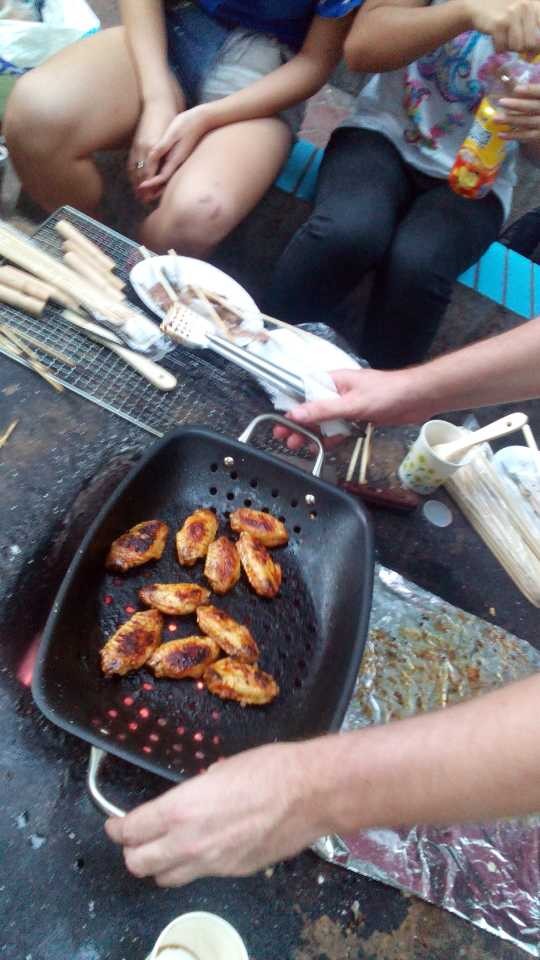
I have recently used the Lotus Rock Outdoor Grill Roaster, below are some of my own photos of it:
Grilling Fish
Grilled Prawns
Grilled Chicken
September 25, 2014 / arnoldtnn / 0 Comments
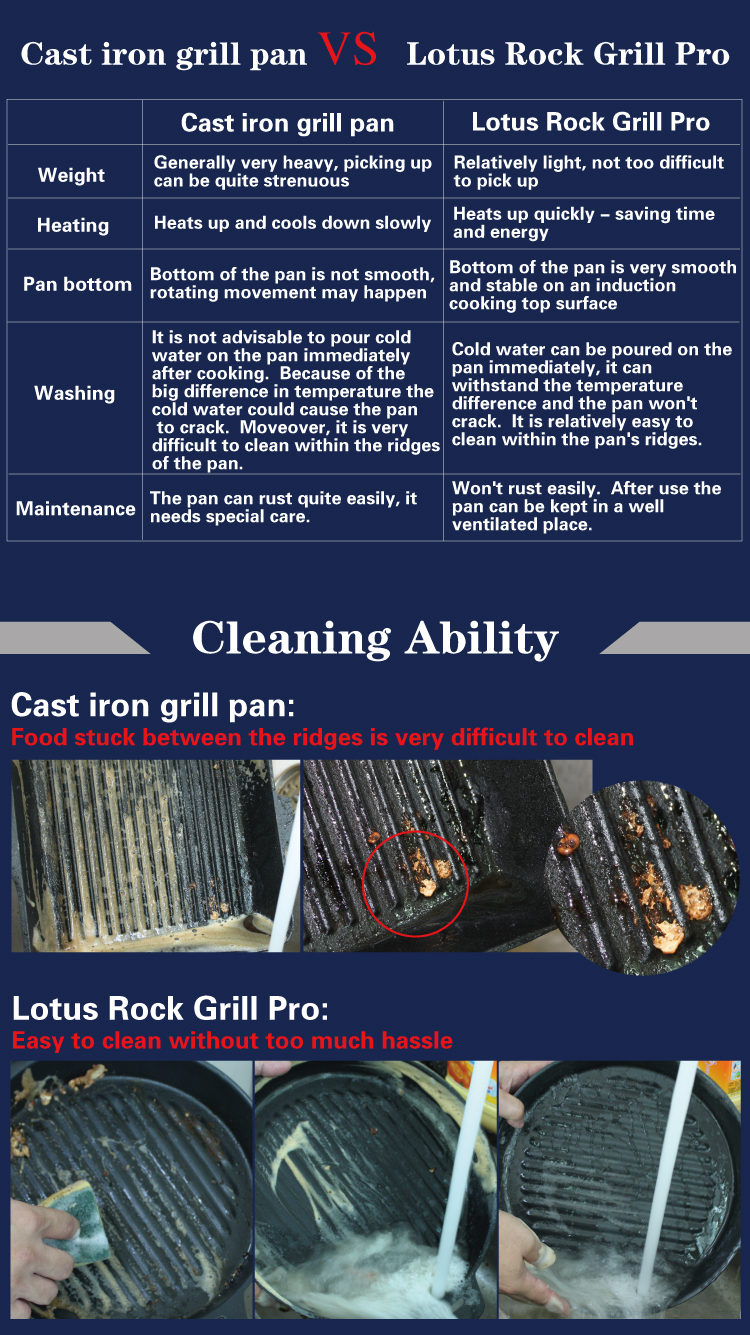
In the market place today some of the most commonly used indoor grill pans are made with cast iron. Famous cookware suppliers, such as Le Creuset of France and Lodge of USA all use this type of material for their grill pans, and for numerous other cookware items as well. Undoubtedly cast iron does have a number of benefits for use as a grill pan, for example it does a good job of making those black chargrilled marks on steaks and burgers etc. However, the Lotus Rock Grill Pro can perform this function as well, as outlined in the previous blog post, and compared to cast iron grill pans, the Grill Pro has other significant advantages, as explained below.
September 19, 2014 / arnoldtnn / 0 Comments
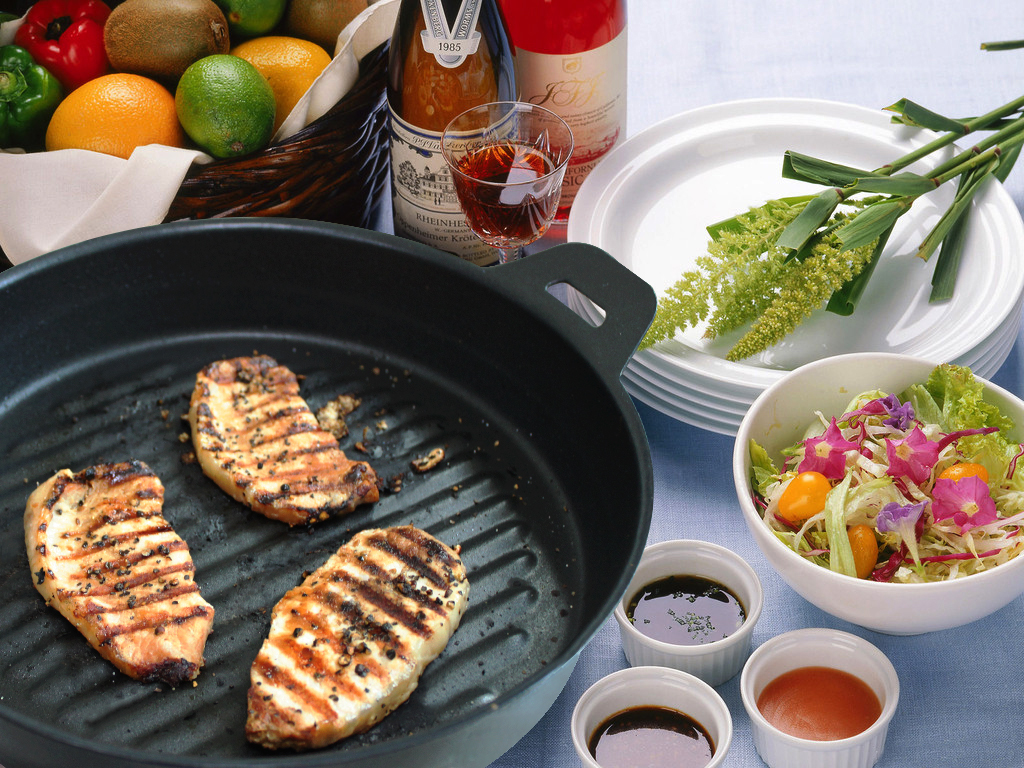
Made from high quality, heavy gauge carbon steel the Lotus Rock Grill Pro is an excellent choice for those consumers who love chargrilled, smoky flavored meat or vegetables. The Grill Pro is especially convenient for those who don’t want to deal with the hassle associated with outdoor grilling, but instead want to enjoy grilling in the comfort of their own home.
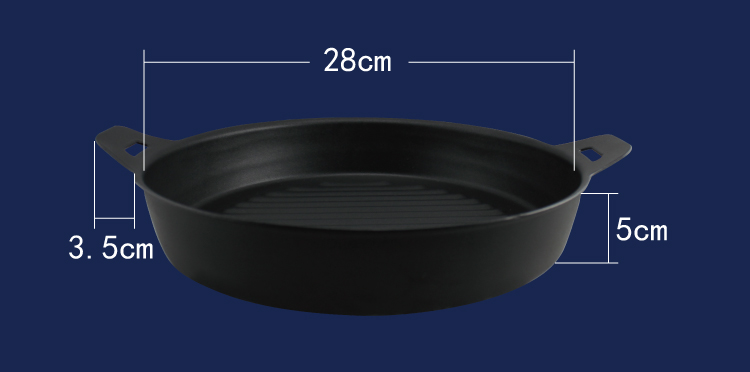
If a small diameter pan is used for grilling then the congested area would trap the moisture and poach the meat instead of grilling it. With a wide base, the Grill Pro provides enough room for each piece of meat to grill properly, without jamming too much of it together.
Higher edges of the Lotus Rock Grill Pro retain more dry heat within the pan for a better grilling effect on the food. Moreover, at 5cm in height the high edges protect your oven’s surface from grease and food splatters while you cook.
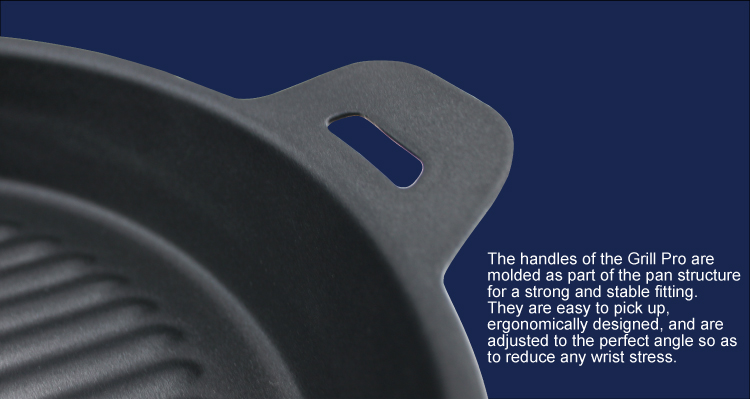
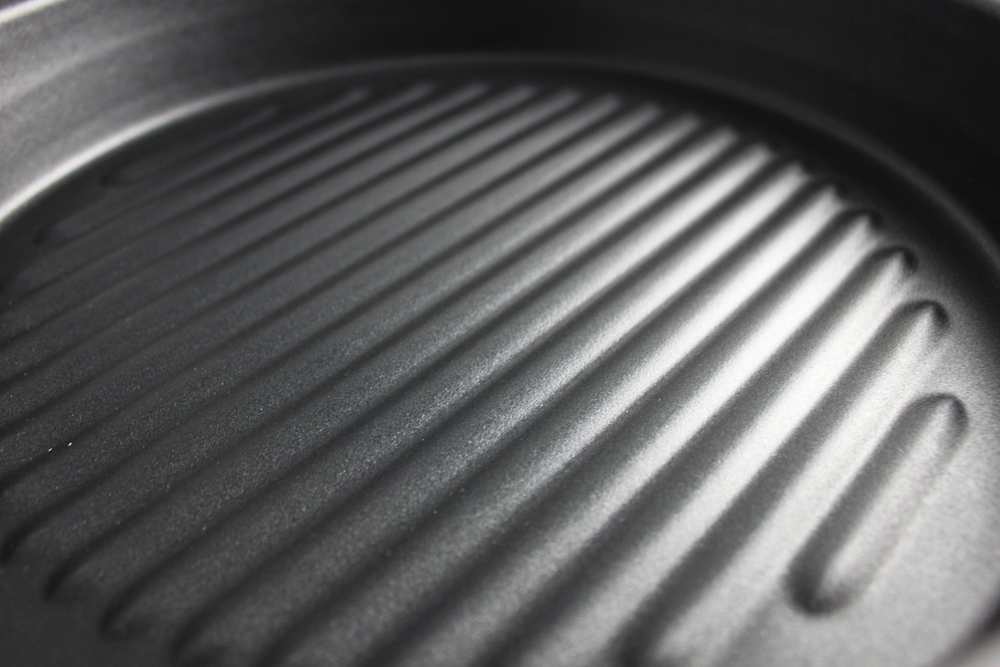
The Lotus Rock Grill Pro has high ridges within the pan which are important for the black chargrilled marks that give the meat that smoky, tasty aroma.The ridges allow fat to flow off the meat, just like it would drip between the grates of a grill, so a burger doesn’t sit and boil in its own juices.
The Lotus Rock Grill Pro has a natural, non-stick release which is free of PFOA/ PTFE and other harmful chemicals. This makes it healthier than most other general non-stick pans, nearly all of which contain either PTFE or some other chemical substance. The Lotus Rock Grill Pro is also more durable and more suitable for grilling than general non-stick pans. A high temperature is essential for good grill marks. If a general non-stick pan is continually heated at a high temperature the non-stick release will gradually impair and will quite soon become redundant. It is precisely because a Lotus Rock Grill Pro doesn’t have a chemical non-stick coating that it has very high heat resistance, and so therefore can be used in a kitchen for a long period of time.
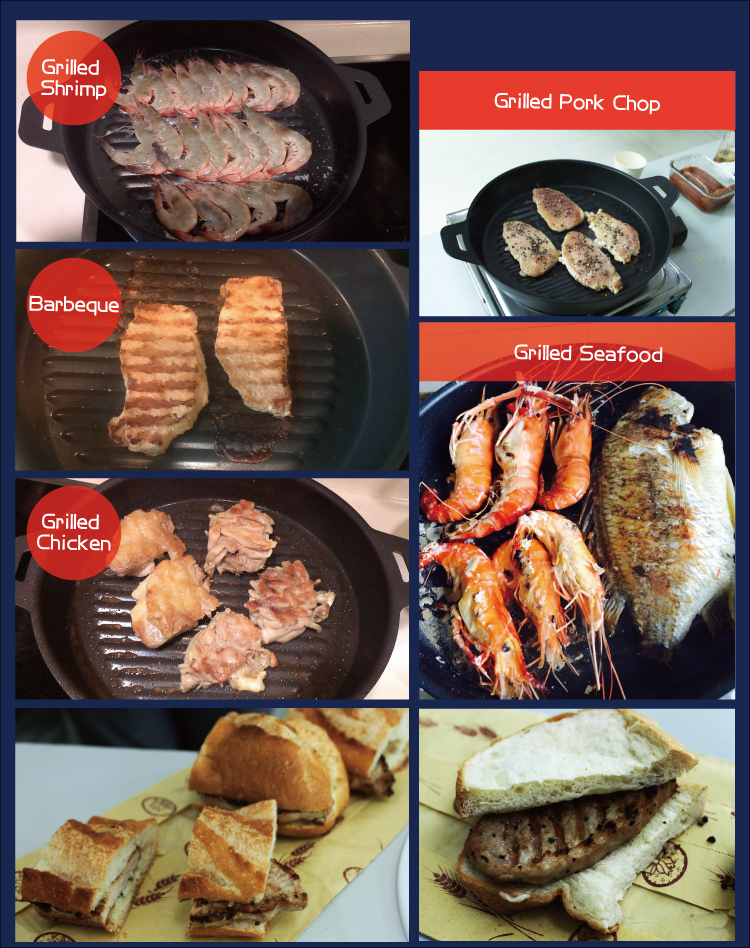
Examples of grilled food with the Lotus Rock GrillPro
September 18, 2014 / arnoldtnn / 2 Comments
As was previously explained in the blog post Why does Lotus Rock use carbon steel instead of aluminum?, the metal substrate used for all Lotus Rock pans is carbon steel. In this post we would like to look in more detail at the different grades and types of carbon steel; the type used can affect the quality and performance of carbon steel cookware in numerous different ways.
All Lotus Rock pans are made of a high quality grade of carbon steel with a plain and heavy shape. Elements such as Sulfur, Manganese, Phosphorous, and Chromium are all removed from this the steel prior to production, leaving them with a high iron content. Some of the benefits of this high iron content carbon steel include: strong acid corrosion resistance and excellent resistance to abrasion from metal utensils and steel wool.
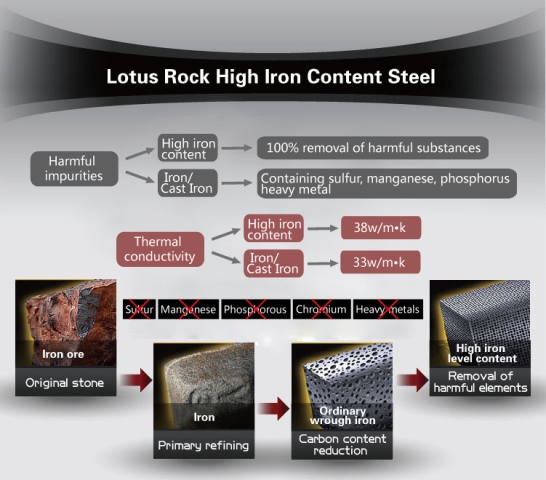
Compared to cast iron or to carbon steel which has not had the above harmful impurities removed, Lotus Rock’s purer carbon steel has much better thermal conductivity. This type of high-iron carbon steel heats up food more quickly, and the thicker gauge used for Lotus Rock pans, compared to most other carbon steel pans on the market, means that heat is spread more evenly around the pan, so that foodstuffs such as meat can be seared very much faster. Meat that is not cooked for too long has a more succulent taste, and also retains a higher vitamin content, leading to a healthier diet.
September 16, 2014 / arnoldtnn / 0 Comments
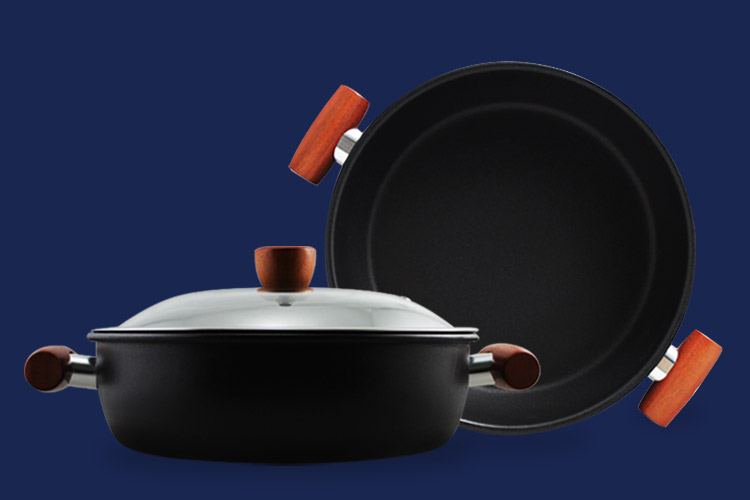
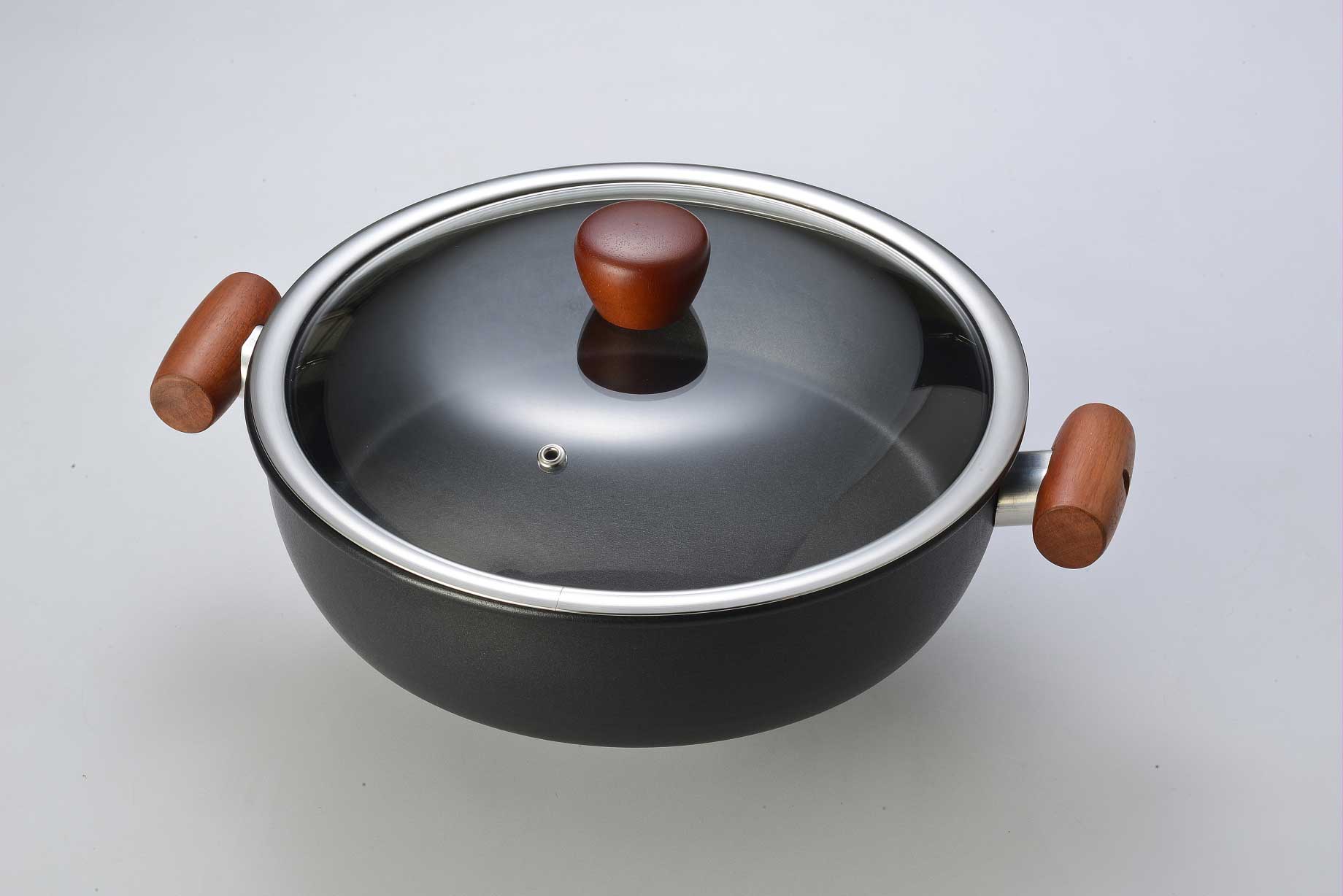
A Lotus Rock Braiser is best used for recipes which require meats or vegetables that need to be seared quickly in the open pan and then covered with a lid to cook slowly in their liquid and the moisture that is created. Both at the bottom and at the sides, a Lotus Rock Braiser has a heavy gauge 2.0mm carbon steel substrate, with a thick ceramic coating on both the interior and exterior of the pan. This strong construction along with the dark, black coating with a low-gloss matte finish ensures high durablity and heat resistance.
Moreover, high moisture retention is very important for braising so every Lotus Rock Braiser pan includes a tight fitting lid so that the liquid does not evaporate. The lids and pan can either come with a wooden handle (such as in the photo above), or with a bakelite or stainless steel handle (the latter is suitable for oven use).
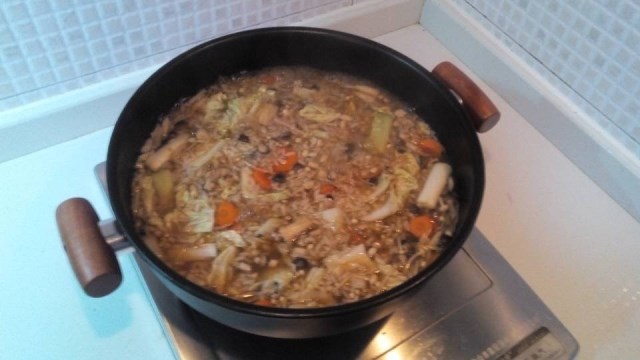
As well as stews (such as the Japenese beef stew shown above) other common dishes that can be prepared in a braiser pan include paella, pasta, potato and enchilada dishes.
Product Features
- This Braiser, with a glass tight-fitting lid, helps food retain moisture and emerge juicy and tender.
- Rain forest effect continuously showers juices, maintaining moistness of foods
- Circulation of juices and even heat distribution ensures uniform roasting of meats and al dente vegetables
- Optimized for steady, even heat, Lotus Rock’s reinforced ceramic interior resists staining, dulling, and wear and tear.
- Black ceramic interior is exceptional for high-heat searing, plus braising and caramelizing
- Lipophilic nano-silica coating, seasoning naturally, without maintenance
- Durable ceramic interior is scratch-resistant; will not chip, discolor or rust
- PTFE and PFOA-free
- Suitable for all cooktops, including induction
- Oven-safe to 500 F and broiler-safe (if with SS handles)
- Dishwasher-safe, but hand washing recommended
- Limited lifetime warranty
September 1, 2014 / arnoldtnn / 0 Comments
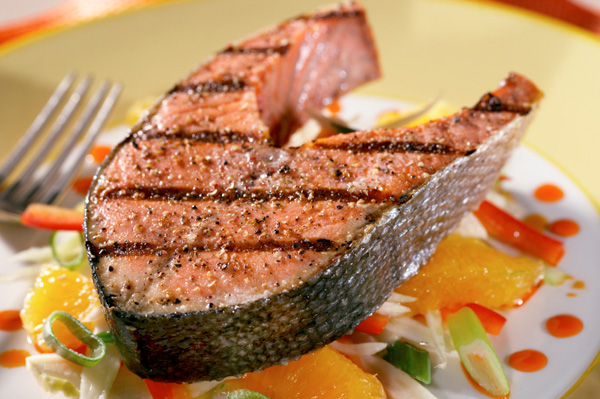
For health conscious consumers who want a highly nutritious diet, fish is generally quite a popular meal because it has both a very high protein content and is very low in fat. Although oily fish like salmon do contain about the same amount of fat per pound as ice cream, it is a type of fat which is in fact very healthy. The fat in salmon — and in all fish with dark flesh and a high oil content, such as mackerel, tuna, sardines, anchovies and bluefish — contains omega-3 fatty acids, which our bodies need to function properly.
However, although fish does undoubtedly have a lot of health benefits, if there is one dish that a consumer generally doesn’t like to cook it is fish. Why? The main reason is that once heated the high protein content of fish makes it stick to a pan very easily. In addition, fish skin is very flaky, so when a fish is turned over during cooking it can easily tear apart, visibly impairing the appearance of the dish.
Why does the high protein content of fish make it liable to stick on the pan so easily? If proteins are allowed to denature – chemically unravel – slowly, they stick firmly (glue is made of proteins which have denatured). Since proteins stick when they unravel slowly, you have to make sure they cook quickly. This means that the heat must be high enough to start setting the proteins immediately.
However, other foodstuffs such as meat also have a high protein content, why aren’t they just as difficult to cook as fish? Well, the main reason is that meat is denser than fish: it consists primarily of long fibres arranged in longitudinal bundles, held together by connective tissue called collagen. Fish, on the other hand, is very flaky because it consists of short fibres separated by large, thin sheets of collagen. Not only does the flesh of fish separate into its short fibres much faster than meat, but the collagen in fish is also more fragile and will convert into gelatin much more quickly.
Lotus Rock Construction
Lotus Rock’s Fish Pan is made of carbon steel, which heats up much faster than either aluminum or cladded stainless steel. This type of metal is particularly ideal for cooking fish because, if used properly, its quick heat conduction can ensure that the proteins inside the fish are cooked too quickly to have time to denature and stick to the pan.
Moreover, because the gauge of the carbon steel substrate of a Lotus Rock fish pan is very thick, at 2.0mm, the fish doesn’t heat up too quickly and burn. Instead the heat is retained well within the pan and fish is heated evenly without any hot spots. Why is this important? For fish to be cooked well an attractive and delicious browning texture needs to be seared on to it, but that won’t start until around 320° F, so the surface of your pan must be at least that hot before you add the fish. When the fish is added the cooking temperature of the pan will drop, but because of Lotus Rock’s strong, thick construction this reduction in heat will be significantly less compared to other more commonly used cooking utensils. A Lotus Rock fish pan can therefore cook, say, salmon not just quickly – so the protein won’t denature and cause it to stick – but also evenly, and with an excellent heating effect, giving the salmon a delicious, browned appearance and succulent taste.
Lotus Rock Coating
Besides its strong construction, there is a second reason why a fish doesn’t easily stick to a Lotus Rock pan: the lipophilic silicon-oxide crystal coating. When cooking oil is added on a Lotus Rock Fish Pan before use it seeps through the permeable coating and creates an excellent, natural non-stick surface.
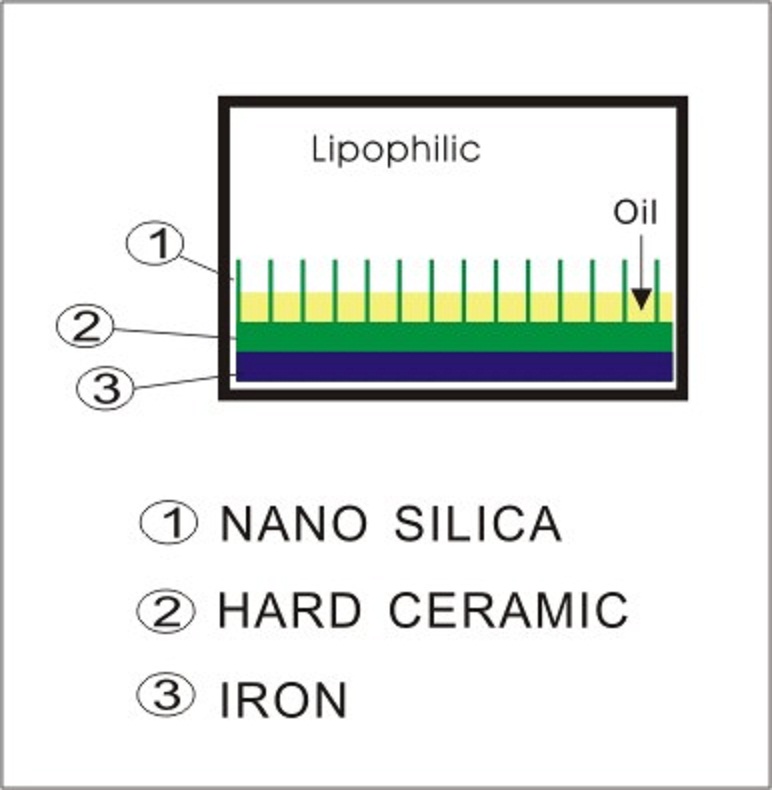
So in addition to the great heating effect from the strong, carbon steel construction, the highly innovative silicon-oxide crystal coating ensures a fish can be turned over easily, without it breaking up on the pan and becoming flaky.
The Lotus Rock fish pan has a further advantage. Condiments or sauces are often used to add flavor to the fish while it is cooking, and after the fish is removed from the pan the remaining liquid is sometimes served on top of the fish to keep it moist and give it a juicy and more flavourful taste. However, because fish is cooked quickly and at a very high temperature, these sauces can sometimes scorch the pan and be rather difficult to remove. The Lotus Rock pan’s hydrophobic (water-hating) silicon-oxide crystal coating prevents these liquids, or any other dirty substances, penetrating its surface, making it much easier to clean than normal non-stick coated pans.
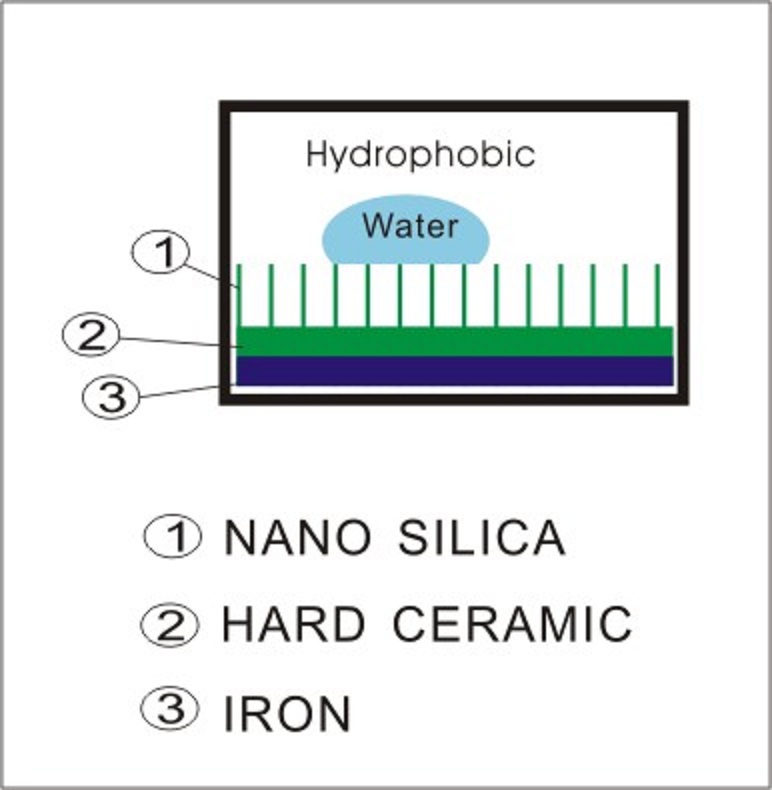
Lotus Rock fish pan shape
The last, and most obvious benefit of the Lotus Rock fish pan is its shape. The head and tail of an average-sized fish will often hang off the sides of a ordinary frying pan, so that not all of the fish will be properly cooked or absorb the sauces in the pan. The Lotus Rock fish pan is 37cm wide, making it easier to cook larger fish and increasing the chances of a better tasting dish.
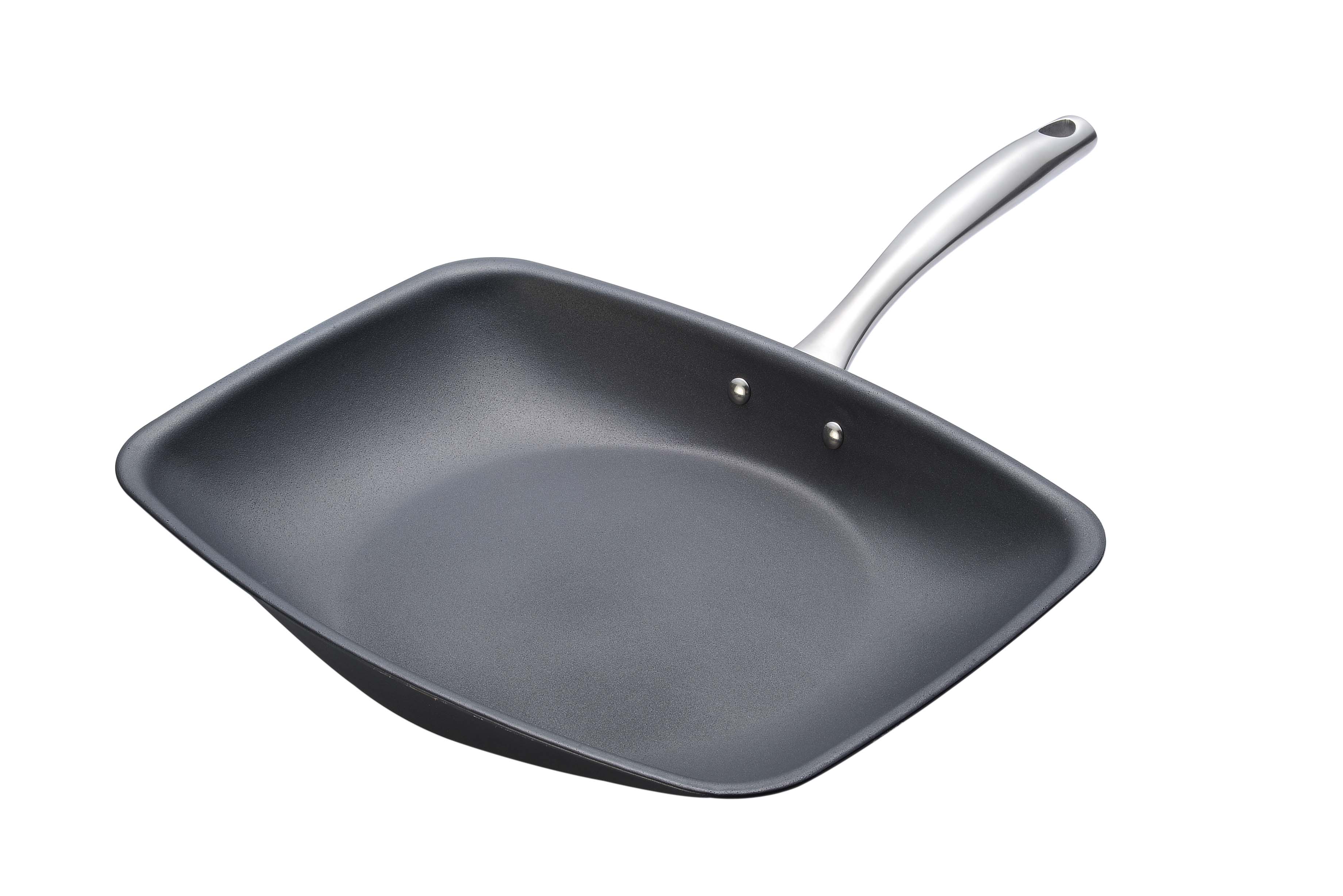
September 1, 2014 / arnoldtnn / 0 Comments

http://shop107434023.taobao.com/?spm=a230r.7195193.1997079397.164.W7q4H7&v=1
August 12, 2014 / arnoldtnn / 4 Comments
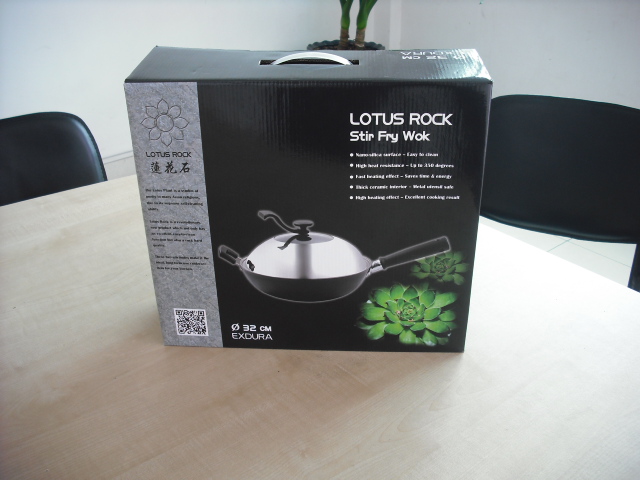
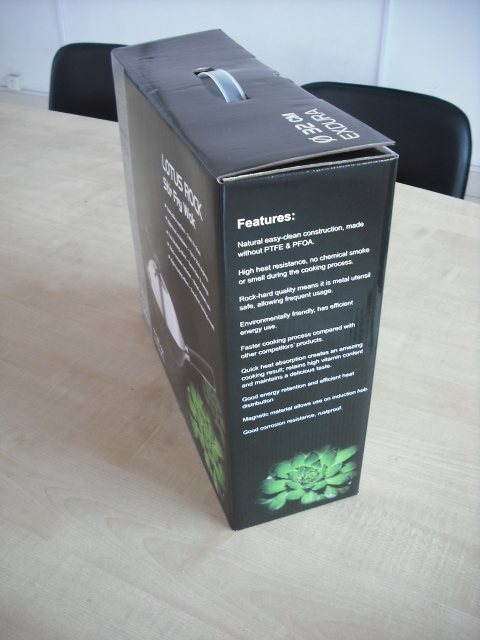
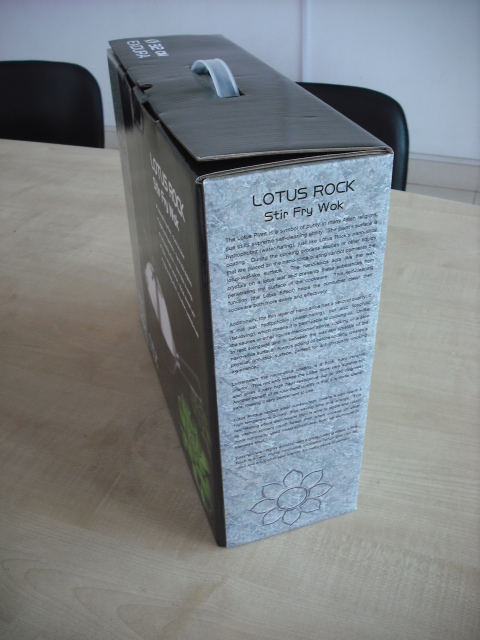
Lotus Rock is sold throughout the world in all 6 major continents. Below are some examples of the different types of packaging that is used for Lotus Rock.
Colour sleeve packaging
Lotus Rock is sold in a number of countries in the Central American region and Venezuela. All of these items have the soft-touch bakelite Titlis handle. Below is a photo of the packaging used for a frying pan.
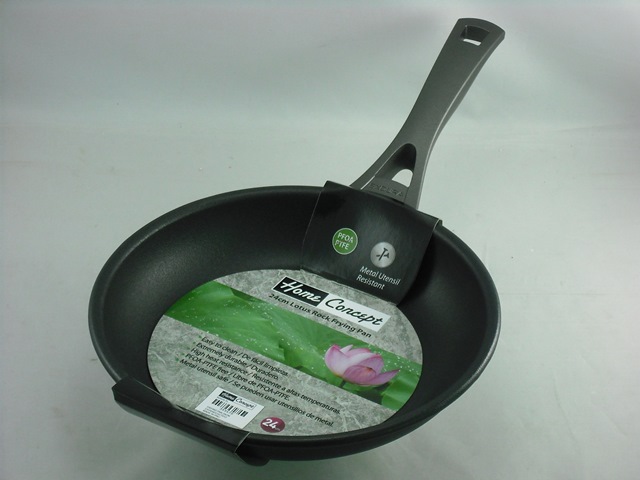
Colour Box Packaging
Lotus Rock stir woks are sold in both Singapore and Hong kong. Below are some photos of the box packaging used for a 13″ stir wok with a stainless steel dome lid. The wok comes with the secure detachable Penguin handle.
August 11, 2014 / arnoldtnn / 0 Comments

http://blog.aldaindia.com/2014/lotus-rock-carbon-steel-perfection-redefined/
August 9, 2014 / arnoldtnn / 0 Comments
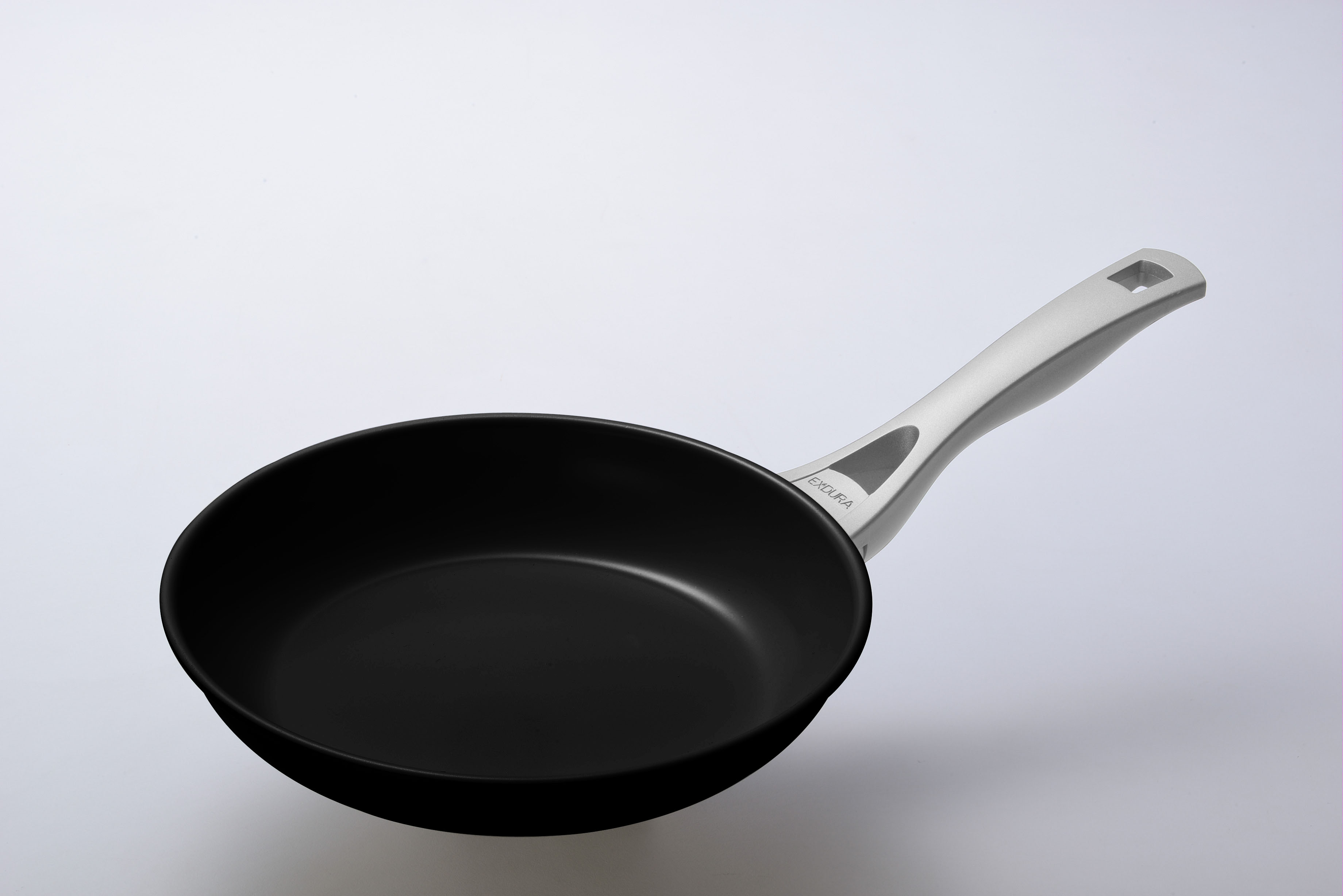 Frying pans are one of the most essential pans in the kitchen, and with good reason. Lotus Rock fry pans are carefully designed to give you exceptional results, whether you’re cooking a delicate omelette, searing a chicken breast, or sautéing garden-fresh vegetables. The secret is in Lotus Rock’s quality construction and design details. Here’s what you should be looking for:
A thick, flat bottom. This allows you to use a medium-high heat to cook eggs quickly without scorching. Thickness also prevents pans from warping, which can result in uneven cooking.
Superior conductivity. Lotus Rock’s thick carbon steel construction, 2.0mm, distributes heat evenly and responds to subtle changes in heat level, so the cook (not the pan) controls the cooking process.
The right cooking surface. Lotus Rock, with its excellent PTFE-free non-stick nano-silica coating, is ideally suited for use with a frying pan. Easy-to-clean, metal utensil safe, with 350 degree heat resistance, a Lotus Rock frying pan can be used in a kitchen for as long as a cast-iron pan.
Long, stay-cool handles. Long, well balanced handles give you room for a firm grasp when maneuvering a pan over heat, or when swirling or flipping food. Lotus Rock’s stay-cool stainless steel, wooden, and soft grip handles keep their cool when you’re working on the stovetop, too.
Cut or rolled sides. Cut edges make the pan lighter and easier to maneuver for quick movement over a high heat source. Rolled sides help guide food, such as an omelette, as you move it around the pan, and facilitate perfect swirling and flipping too. Moreover, rolled edges encourage food to easily slide out the pan and onto a plate, without breaking.
Size availability. Lotus Rock frying pans come in a wide range of sizing, from 18cm up to 30cm – choose the right size for best results. Small 20cm diameter pans are perfect for single servings, sautéing small ingredients such as mushrooms, or making pan-sized pancakes. Medium 26cm diameter pans are good for omelettes and all-purpose sautéing, as well as grilling sandwiches or frying bacon. Large 30cm pans are ideal for crepes, preparing steaks or filets, or sautéing larger amounts of food at one time.
July 28, 2014 / arnoldtnn / 0 Comments
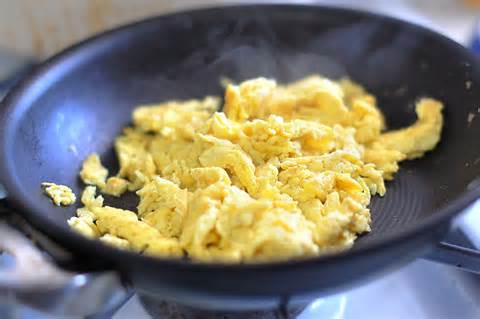
I purchased the small pan for my husband. He cooks up scrambled eggs every morning as part of his breakfast ritual. The stirring he does for those eggs every single morning was too much for every other pan I have purchased. This pan appears to be the one. Very well built with a great surface and instructions on how to keep it in great condition. First cooking experience was perfect only time will tell how it will hold up, but I am very pleased.
The above quote is from a review by a lady in South Carolina, USA, of the 20cm Lotus Rock frying pan. She had purchased it from the website of a well-known and highly respected kitchenware company which sells high-end items, including the Lotus Rock frying pan with the Zurich handle.
As can be seen from the quote the lady was quite clear that other fry pans she and her husband had purchased before could not match the quality of the Lotus Rock fry pan. She was specific about the reason: Lotus Rock frying pans were superior because of their ability to cook scrambled eggs well, and to do this on a daily basis over a long period.
But why did other non-stick pans have difficulty cooking scrambled eggs? And why did this particular couple from South Carolina, who quite evidently have a lot of experience in cooking scrambled eggs, come to the conclusion that a Lotus Rock fry pan is ‘the one’?
Egg Science
In order to answer both questions it is relevant first to understand the science behind cooking eggs. Eggs are primarily made of protein molecules, and these are made up of many strands. Before an egg is cooked these strands are bound up very tightly, just like a bundle of angel hair pasta.
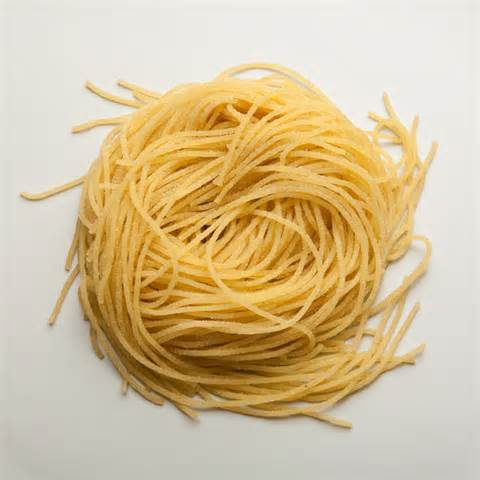
However, when the egg is cooked these protein strands begin to unwind, and although when they bump into each other again they do stick, they do so much less tightly. So while heat is being applied to the pan, the strands of the egg form another structure, with an appearance much like a spider-web. This web is dense enough to prevent light from passing through, which is why cooked eggs whites are white in color. The web also traps moisture, which is why eggs cooked to just this point are moist and tender.

However, if you keep cooking the eggs too long, the protein strands once again become unstuck from each other, the web dissolves, and all the moisture flows out. Therefore, in order to cook delicious tasting scrambled eggs, the eggs must be cooked just long enough to make them tender and solid, but not so long that they lose their moisture and become tough.
Lotus Rock Fried Egg Test
Earlier this year a fried egg test was conducted to compare a Lotus Rock frying pan and an aluminum PTFE frying pan. The test showed that the Lotus Rock frying pan, made from carbon steel, cooked the egg much faster than the aluminium pan. Cooking with the Lotus Rock fry pan not only saved time and energy, but also meant the egg’s protein strands were able to transform from an angel hair pasta-like bundle into a spider web-like structure much more quickly, making it crispier and more succulent to eat than the aluminum pan fried egg. By the time the aluminum pan egg had been fried it had passed the optimum time period during which the protein strands were most like a spider web (i.e moist & tender). The extra cooking time and the subsequent resulting moisture loss gave this egg a more rubbery texture, less appetizing to consume, than the Lotus Rock fried egg,.
Q&A
A Lotus Rock pan might cook scrambled eggs much faster than an aluminum pan, but doesn’t that mean it might heat the eggs too quickly and cause them to burn?
It is true that when eggs are heated too quickly or with too hot a flame, the proteins in the eggs bond together too extensively and form clumps, curdling the mixture. However, all Lotus Rock pans are produced with a thick carbon steel gauge, 2.0mm, which means that as long as a low-medium heat setting is used, the fast heating effect will be dispersed, but also retained within the pan, creating an excellent all-round heating effect for delicious scrambled eggs.
But since eggs have a high protein content, won’t they easily stick to the Lotus Rock pan?
One of the significant innovative features of Lotus Rock is that it has a natural non-stick release, with no PTFE or other non-stick chemical on the pan. As long as the consumer adds cooking oil before each use, which will permeate the silicon-oxide crystal coating, the eggs will fry quickly but without sticking to the pan.
If the silicon-oxide crystal coating is permeable to cooking oil, won’t the egg mixture get inside the coating and make the pan difficult to clean?
No, because although the nano-silica coating is lipophilic (fat-loving), it is also hydrophobic (water-hating). This extremely innovative, high quality coating means that the pan is less hassle for a consumer, as it can be cleaned easily after each use. The reduced amount of scrubbing also increases the pan’s durability.
June 7, 2014 / arnoldtnn / 0 Comments
For some Lotus Rock products, if the customer requests it, then a highly innovative design called Stable Concave can be added.
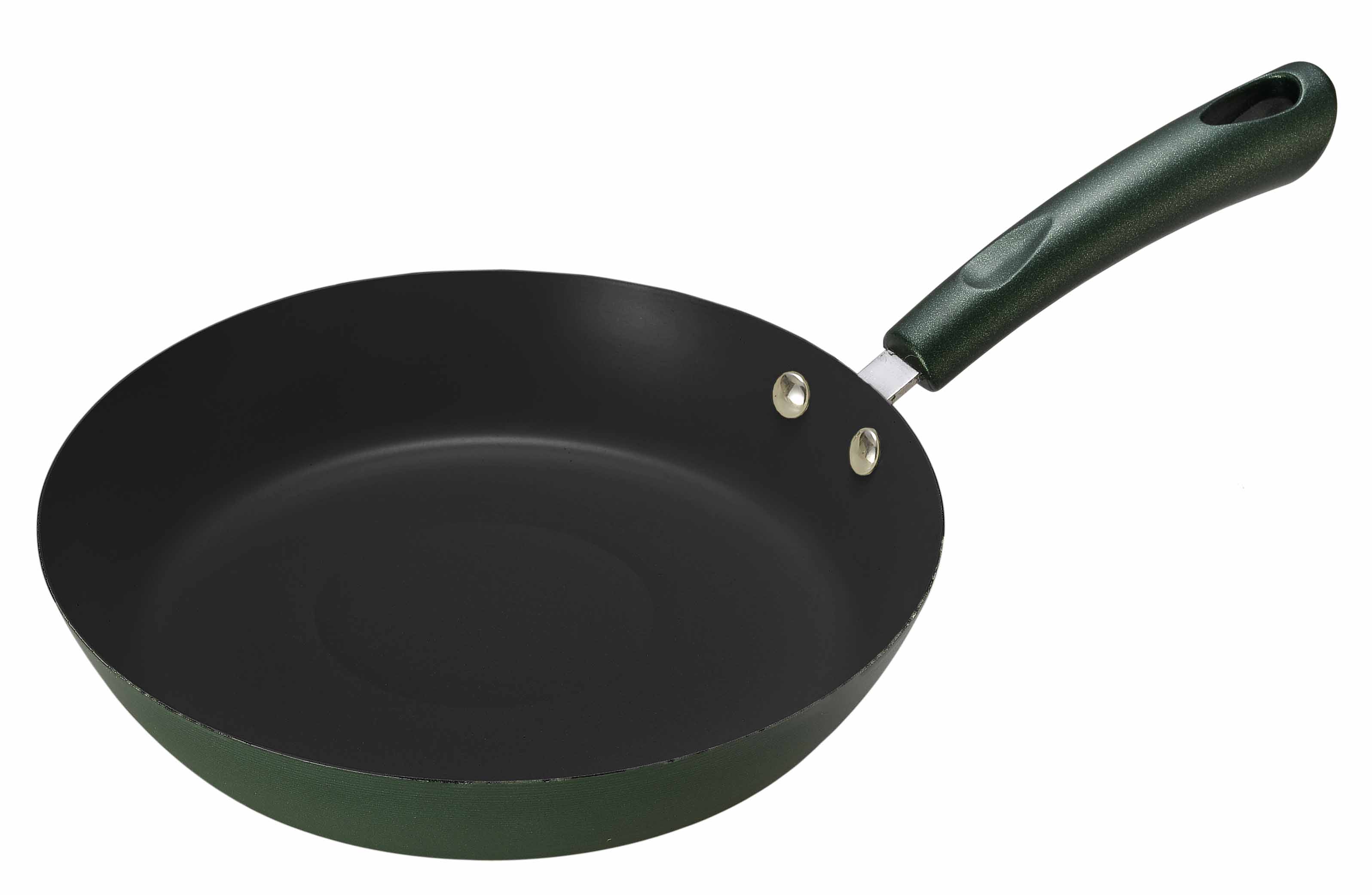
Generally, because Lotus Rock is produced with a strong construction, 2.0mm gauge, along with a thick ceramic coating on top of that, the Stable Concave design is not as necessary than for cookware utensils produced with a thinner thickness, such as 1.0 or 1.2mm. However, because carbon steel does have different thermal conductivity properties compared to pans which use aluminum, then it is possible that a Lotus Rock pan may, if the pan is continually over-heated for a long period of time, start to warp into a convex shape. If the pan is being used on a flat top cooking surface, such as induction, this could cause the pan to spin around when it is heated. Alternatively, long term over-heating might deform the pan’s bottom into more of a concave shape, which would cause the cooking oil in the pan to move to the side.
Therefore, in relation to the above problems, the benefits of Stable Concave are summarized as follows:
1) Stable bottom. Innovative design stops the pan spinning around, even after long heat exposure.
2) Oil displacement. The cooking oil always stays in the centre of the pan.
3) Strong base. The bottom will not become deformed over time. For long term use.
4) Heat control. The design of this base ensures that the pan does not become over-heated too easily (this is for use on Induction cooking tops).
General cookware base problems
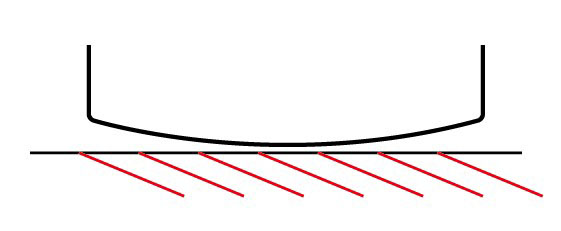
A common problem experienced by cookware suppliers around the world is that over time the base of the cookware, often, under the pressure of intense heat from below, forms a highly indented convex shape which renders the cookware obsolete for use over flat surface cook tops.
Common Response
A solution used by a lot of cookware suppliers is to create a concave shape at the bottom of the pan to balance out the effect of the intense heat from below.
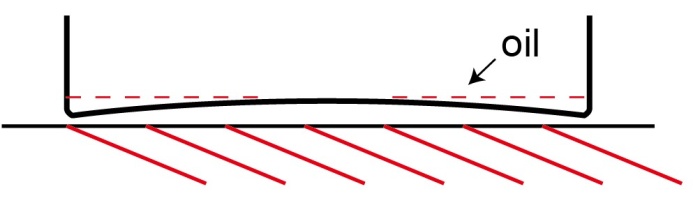
However, this curved shape cannot go above a certain height: if it does then the cooking oil does not concentrate in the centre of the pan. On the other hand if the height of the base of the pan is not set high enough then an undesirable convex shape will result.
Solution
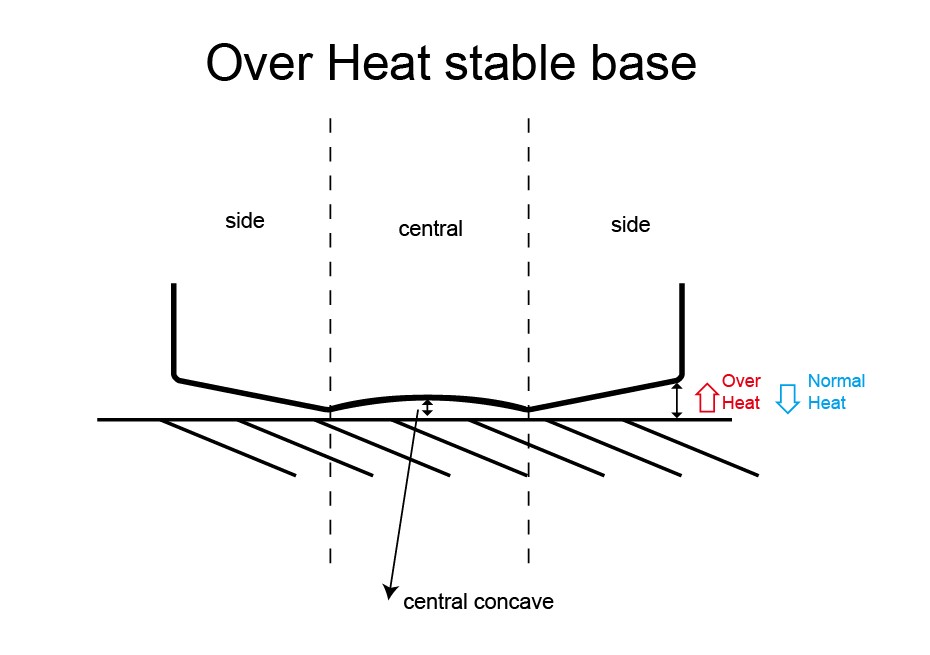
The R&D team that created Lotus Rock have also developed an innovative design to counter this problem. As you can see below, the concave shape is placed in the middle of the base only, with the sides of the pan bottom arranged at a much flatter angle.
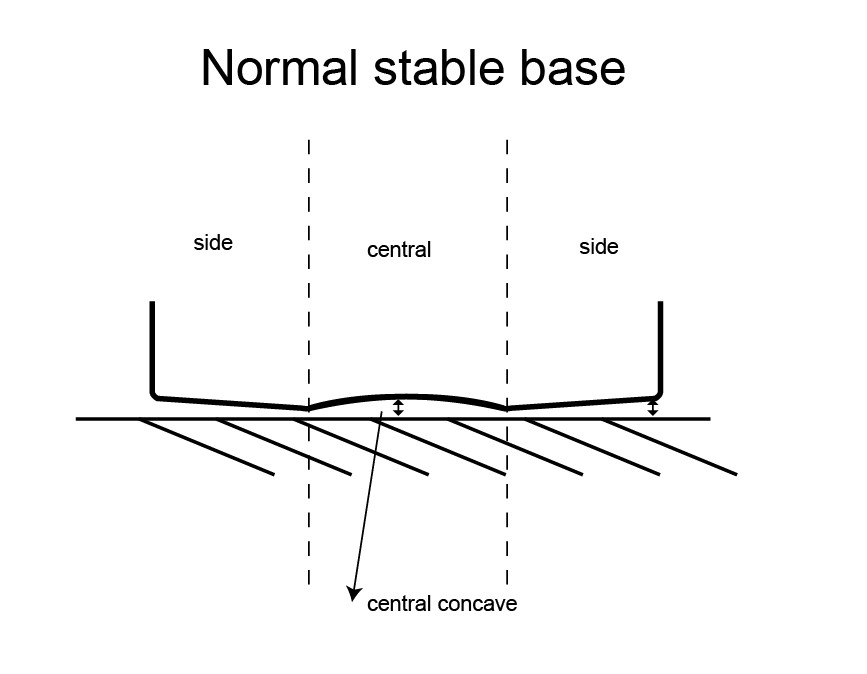
The smaller concave shape in the middle of the pan is still able, like the more general concave-shape design shown previously, to withstand the upward pressure emanating from the cook top. Conversely, the sides of the pan, which do not have the concave shape, respond to the increase in heat and do rise up (although this has the added benefit in that it keeps the oil in the middle of the pan). However once the cooking process is finished and the pan has cooled down, this area then lowers and returns to its original position.
Conclusion
Stable Concave deals with the twin problems mentioned above:
- A curved bottom.
The innovative design and strength of the base maintains a flat, stable bottom. This is good for long-term use.
2. Oil displacement.
The cooking oil stays in the centre of the pan throughout the cooking process. This means the food is cooked quickly and at a high quality.
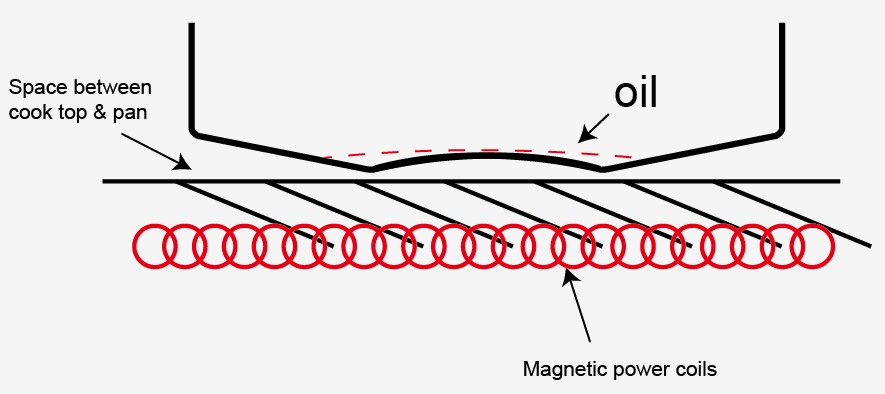
An advantage for use on Induction cooking tops:
Temperature control. The magnetic coils inside the Induction cook top are not so close to the pans bottom. This means that the body of the cookware will not over-heat so easily.
May 31, 2014 / arnoldtnn / 0 Comments
Convenient and functional, a grill pan is used to cook food with little to no oil and to give vegetables and meat classic barbecue grill lines at any time of the year. Grill pans are generally recommended for firm vegetables, fish and seafood, poultry, burgers, franks, sausages and steaks that are not too thick.
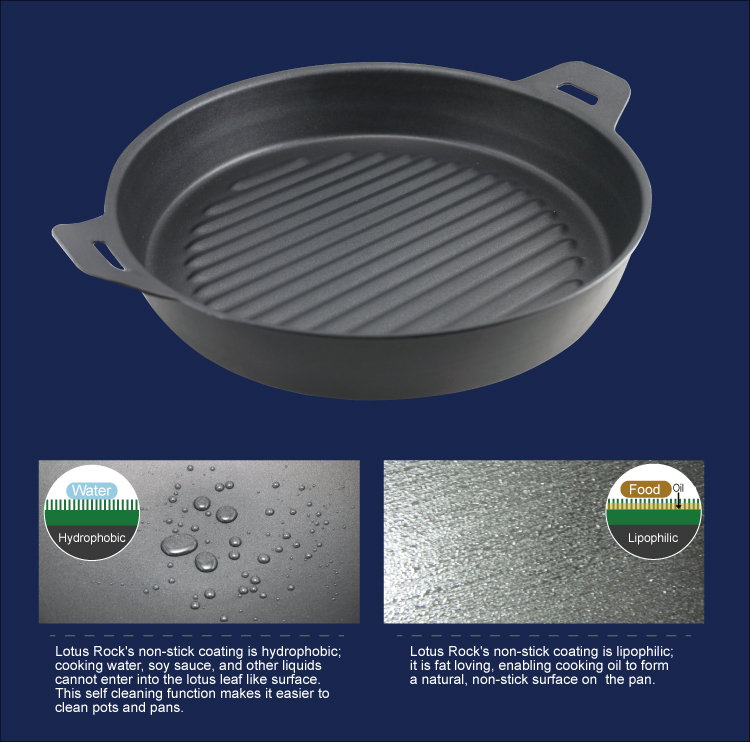
The 28cm Lotus Rock Grill pan, as shown below, is the perfect cooking utensil for those who, whether for weather reasons or just for greater convenience, want to enjoy the experience of eating great-tasting, grilled food without having to cook it outdoors.

What are the significant benefits of this Lotus Rock product compared to other indoor grill pans on the market today?
Compared to cast-iron pans
- Easy-to-clean. A big difficulty with using cast iron is that although it does have an excellent heating effect for grilling, it is very difficult to clean. Lotus Rock’s excellent hydrophobic nano-silica coating makes cleaning the areas in between the ridges of a grill pan much easier than on a standard cast-iron pan.
- Weight. A cast-iron grill is very heavy, which for the average consumer makes it cumbersome and difficult to use around the kitchen. The Lotus Rock grill pan is made with a 2.0mm gauge – still quite heavy for carbon steel, but much less so than cast iron.
- Seasoning. Some people find the process of continually re-seasoning the pan troublesome and too time-consuming. Cast-iron grill pans cannot be rubbed too hard during cleaning as this can remove the natural non-stick patina, which means more food sticks between the ridges, making the pan harder to clean.
In contrast, the lipophilic nano-silica coating on Lotus Rock grill pans allows cooking oil to seep inside the top of the coating, so that they can be cleaned vigorously without removing the non-stick release, and do not need to be re-seasoned as frequently as cast-iron grill pans.
- Temperature control. Griddles made from cast iron start slowly, but if not used properly can rapidly became uncontrollably hot (reaching well over 500 degrees), causing food to burn. Cast-iron pans also cool down very slowly, which can be a safety hazard for anyone in the kitchen who is unaware of this.
Lotus Rock has a thick carbon steel construction, which allows the pan to heat up quickly, saving time and energy for the consumer, but also allows it to cool down quickly, making burnt food less likely than on cast iron.
Compared to aluminum pans
- Ridges. Carbon steel is a much stronger metal than aluminum, so during the production process deeper ridges can be produced. This creates a better all-around grilling effect, with the black lines on the food and smoky aroma which are associated with outdoor grilling on a barbeque. Below is an example of grill marks produced by a Lotus Rock Grill pan.
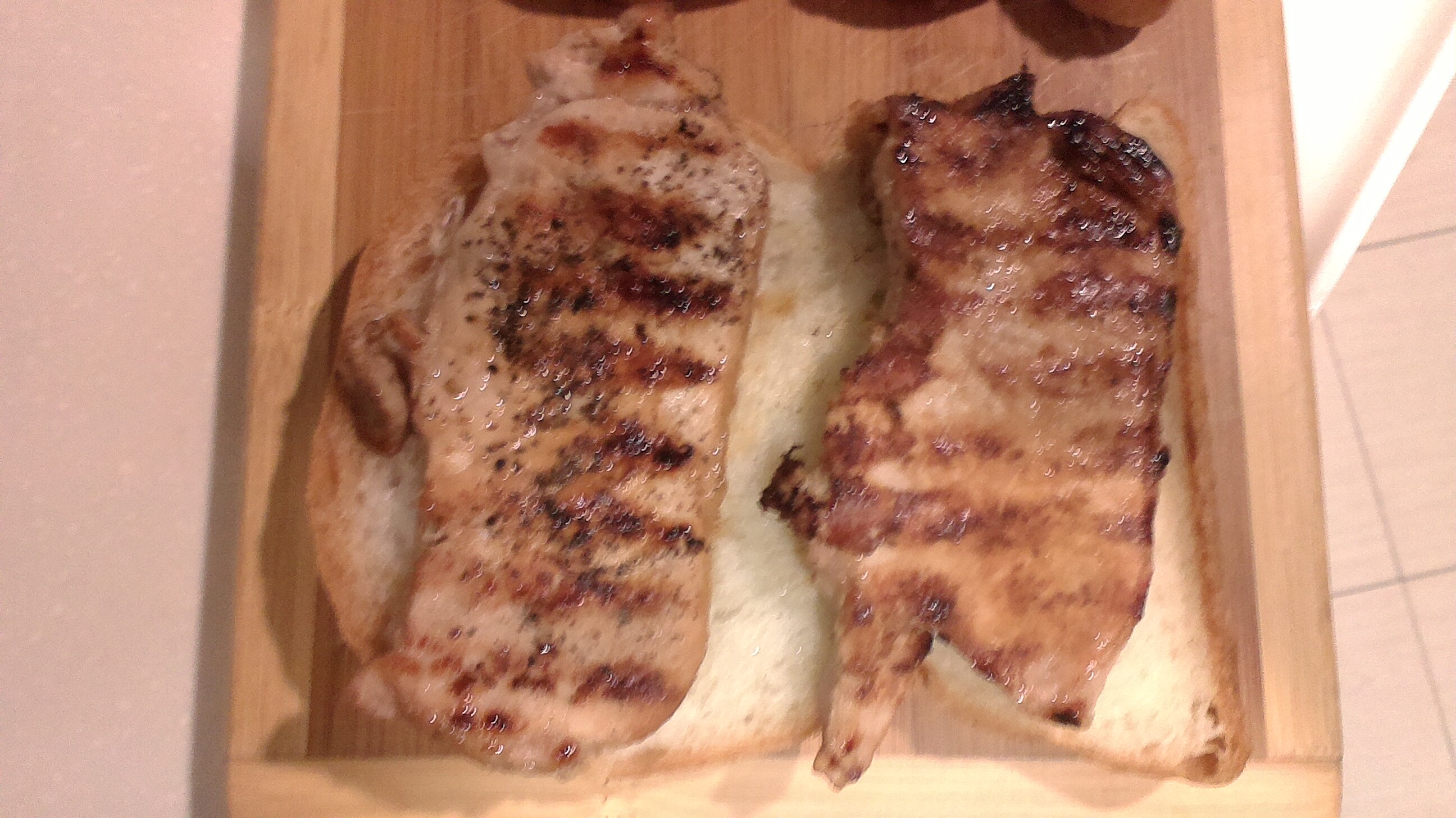
Another purpose of the ridges is to allow fat to flow off the meat, just as it would drip between the grates of a grill, so that the meat doesn’t sit and boil in its own juices. However, the shallow ridges of an aluminum grill pan mean that although the first side of a burger might get the black lines mentioned above, by the time it is turned over the fat pouring out of it will have combined with the cooking oil to fill the gullies between the ridges, so that the food will be fried instead of grilled – defeating the purpose of buying the grill pan in the first place.
- Non-stick effect. Nearly all aluminum grill pans have a non-stick coating, making it easier to cook with the pan and to clean it. However, the coating contains PTFE, which can be hazardous to human health. For example, to create good grill marks the pan needs to heated to a high temperature, but if it rises above 350 degrees it may produce smoke which is toxic to human health. Moreover, all non-stick coatings will degrade over time, making the grill pan harder and harder to clean.
On the other hand, Lotus Rock grill pans have a ‘natural’ non-stick coating which contains no PTFE and, because it is natural, is also highly durable. This Lotus Rock the non-stick effect will not wear off as quickly as general PTFE non-stick coatings.
- Durablity. A Lotus Rock grill pan is 2.0mm thick. This thick gauge is induction- and metal utensil-safe, and, unlike aluminum, will not dent or warp easily.
Conclusion
The Lotus Rock Grill Pan has a round shape, with a diameter of 28cm. This large size is important for a grill pan because the key to grilling is dry heat. It is generally agreed among grilling experts that one-and-a-half to two inches of space should be left between pieces of food. Putting too much meat in the pan traps moisture and causes it to be poached instead of grilled.
This grill pan has deep ridges for excellent grill marks, and high edges to keep more of the rising heat inside the pan to enhance the grilling process. Many grilling experts advise the use of a lid to protect your oven’s surface from grease and food splatters while you cook. However, the high edges of the Lotus Rock grill pan reduce the need for a lid. It also has a very strong construction, with 2.0mm-gauge carbon steel and a thick coating for excellent heat retention and a fast but dispersed heating effect.
Lastly, Lotus Rock’s nano-silica coating makes the grill pan easier to clean, especially compared to cast iron grill pans. Moreover, the lipophilic surface enables the cooking oil to permeate the surface and create a durable non-stick release which will not wear off prematurely because of prolonged use or over-heating.
April 19, 2014 / arnoldtnn / 0 Comments
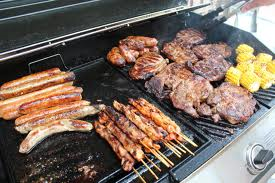 Traditional outdoor grilling was all about putting some burgers, steaks or sausages on a charcoal grill and then serving them in a bun, with condiments such as tomato ketchup or mustard.
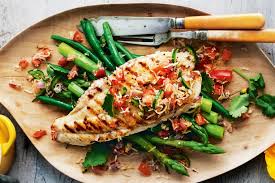 Yet, in recent years it has become fashionable to barbeque other foods, such as fish, vegetables and other small-sized and delicate items.
However, the wide gaps in BBQ grills mean special utensils are needed to cook small or delicate items like fish and vegetables. Barbecuing these foods using special perforated equipment, such as frying pans, stir woks and grill grids, prevents them falling through the grill and makes it easy to transfer them onto and off the BBQ, but retains the distinctive cooking effects of barbecued food. The perforations allow heat to rise evenly into the pan and add the smoky aroma of outdoor grilling and rich flavor to kebab meats, vegetables, seafoods and fruits.
Benefits of using Lotus Rock for BBQ cookware
As readers of this blog will already know, Lotus Rock has numerous advantages for use on standard cookware utensils, and these can also be appled to BBQ items as well. Benefits of Lotus Rock for barbequing include:
- Thick carbon steel construction keeps food the ideal distance from heat
- Excellent heat retention to keep food hot for longer, while retaining natural flavours of foods for superb tasting dishes
- BBQ cookware is notoriously troublesome to clean, however Lotus Rock’s hydrophobic nano-silica coating reduces the problem.
- BBQ-ing requires the use of metal tongs or spatulas; the Lotus Rock non-stick coating is metal utensil safe
- Lotus Rock has a durable, natural non-stick release which will neither expire nor release toxic fumes when overheated.
Lotus Rock BBQ Collection
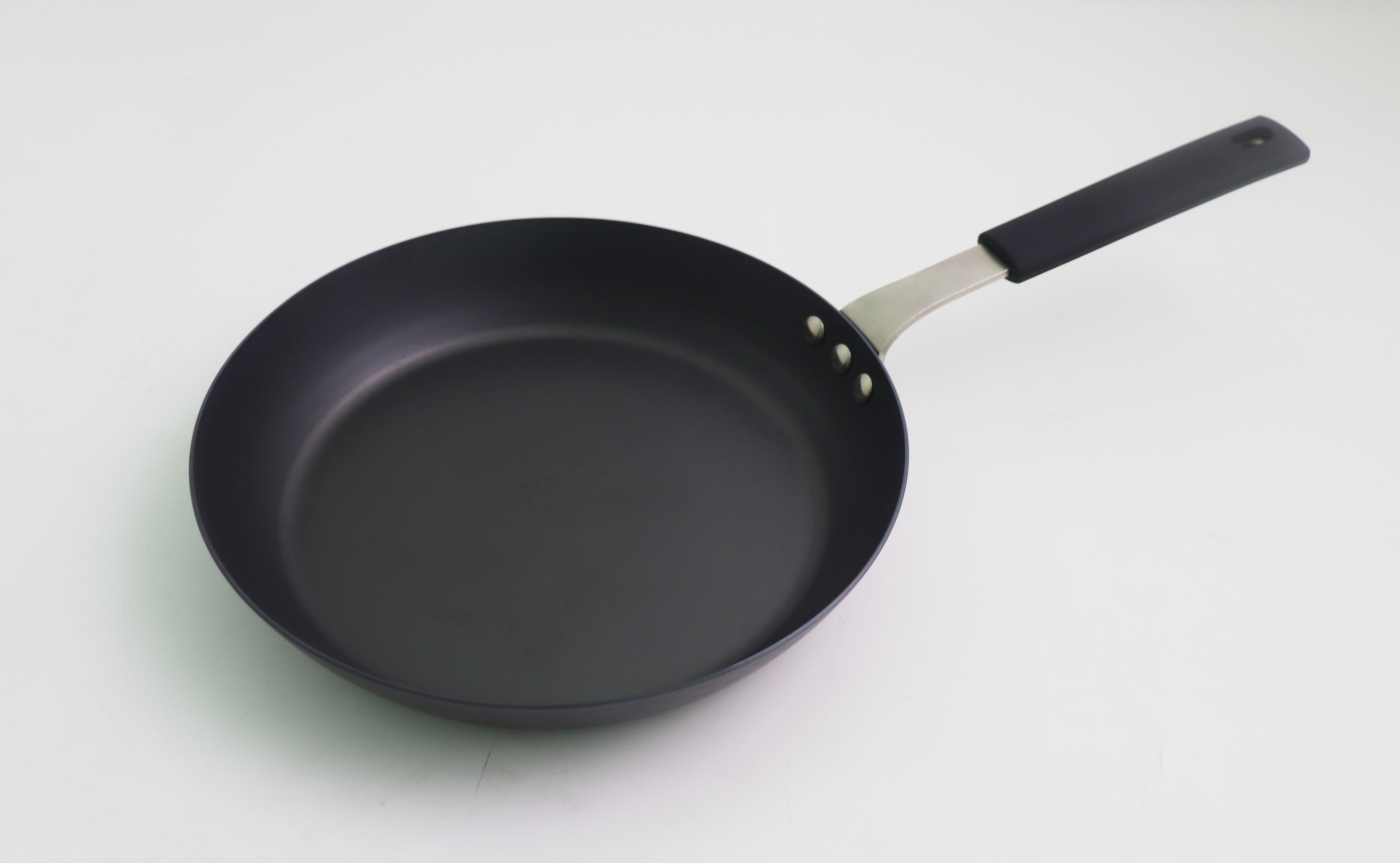
BBQ Frying Pan with soft-grip handle 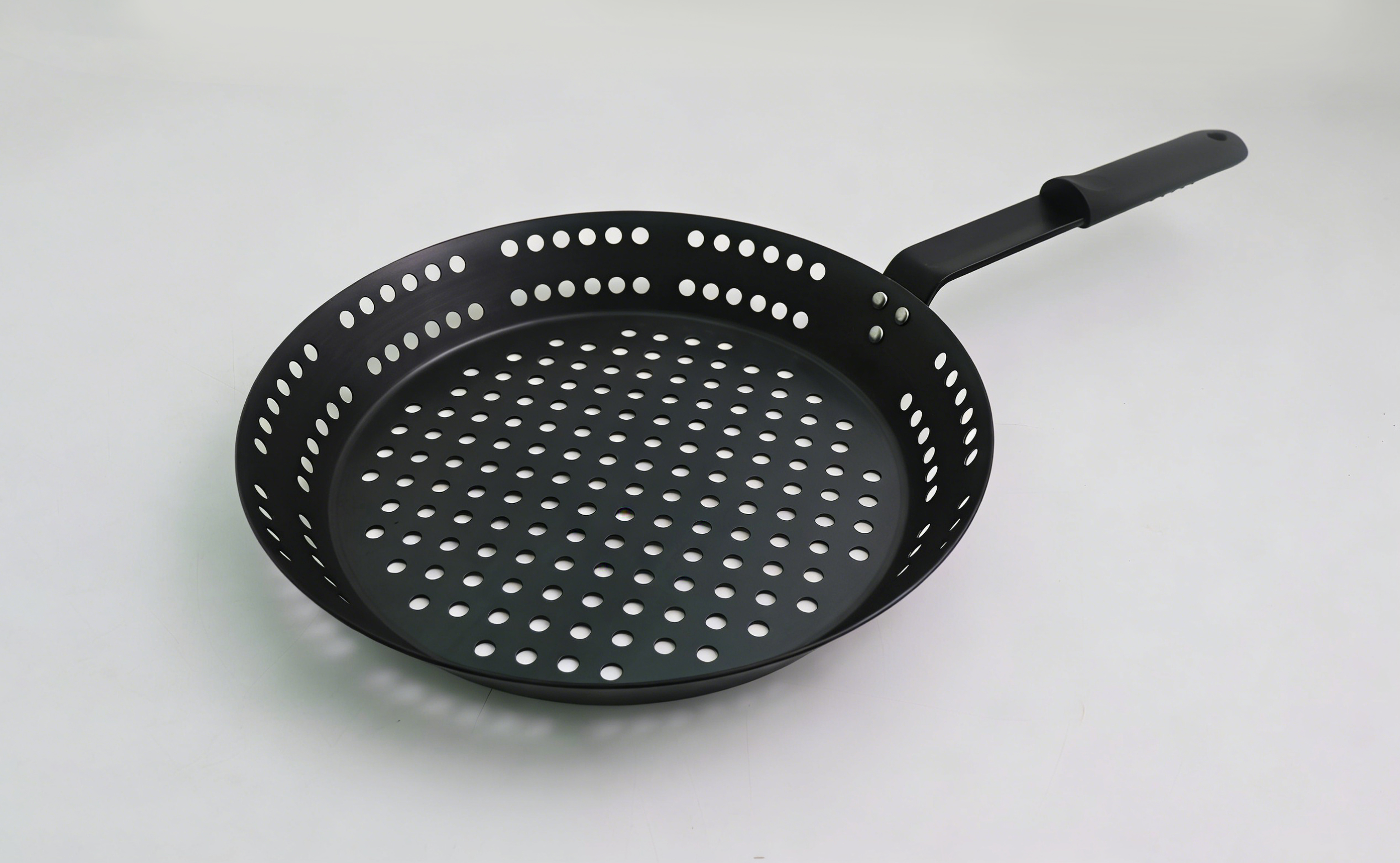 Open design and sloped sides prevent foods from falling into grill and allow easy removal of foods from the grill
Comfortable silicone grip handle is easy to grasp and remove safely from a hot grill
30cm Dia. (51cm L w/handle) x 6cm H
Base: 25cm Dia.
Weight: 1.06kg
BBQ Stir Wok with soft-grip handle
 The sloped pan sears and browns beautifully, and its smooth surface makes it easy to stir and toss ingredients.
Shake basket to rotate foods, without turning each piece
In a wok different foods can be mixed together, under intense heat from the grill, the juices from meats or other fattier foods can permeate the mix.
Comfortable silicone grip handle is easy to grasp and remove safely from a hot grill
12″ Dia. (20 1/2″L w/handle) x 4″H
Base: 8″ Dia.
Weight: 1.43kg
BBQ Grill Roaster with twin hollow cast stainless steel handles
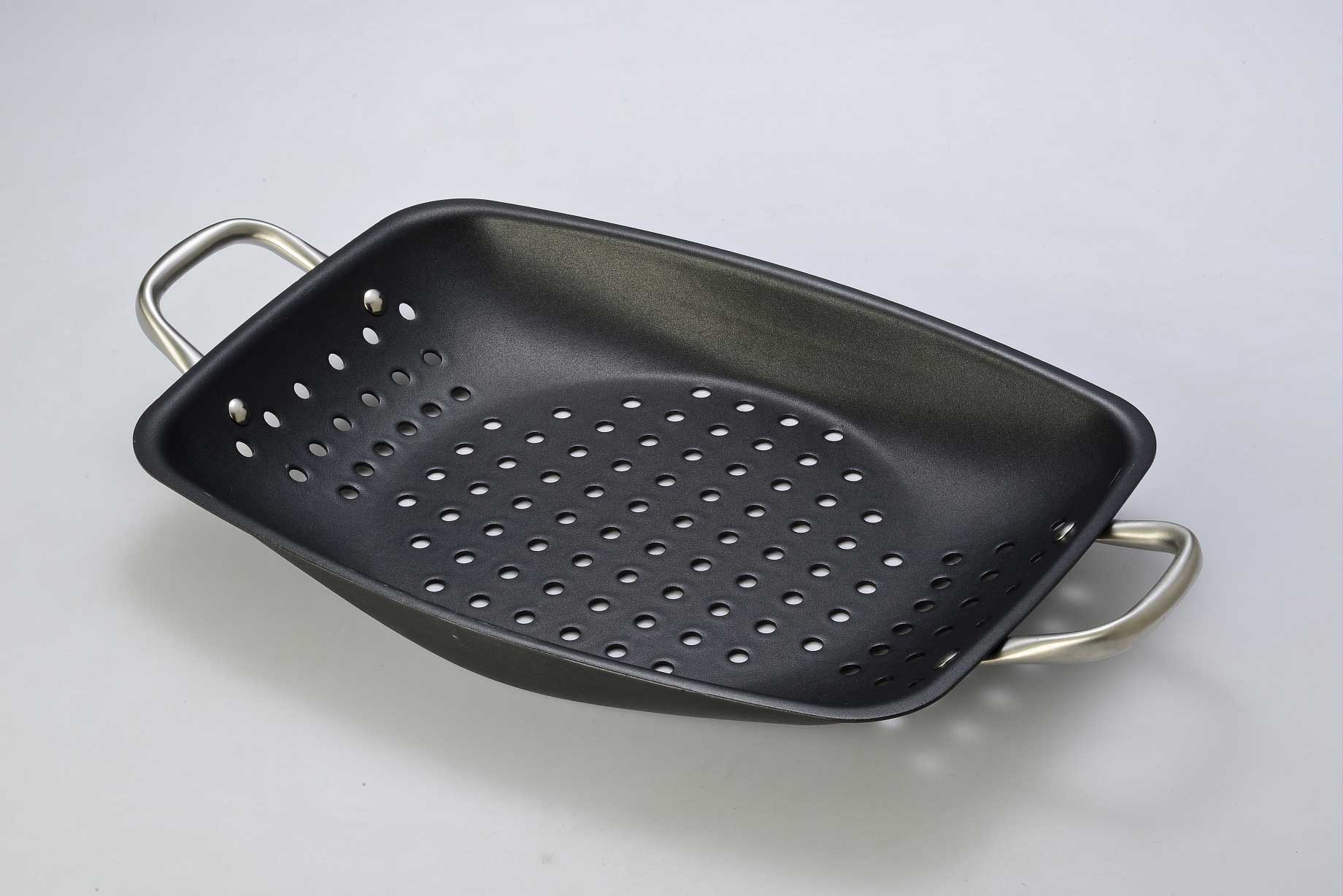 With the open curvature design and sloped sides, this grill pan prevents foods from falling into fire and allows easy removal of foods.
Sets flat on grill grate Grill shrimp, scallops, or beef tenderloin or poultry, without skewers Handles make the transition on/ off grill super easy 15 1/4″L (19 1/2″ w/handles) x 11 1/4″W x 2 1/2″H (3″ w/handles) Weight: 4-lb., 6-oz.
BBQ Grill Grid x2
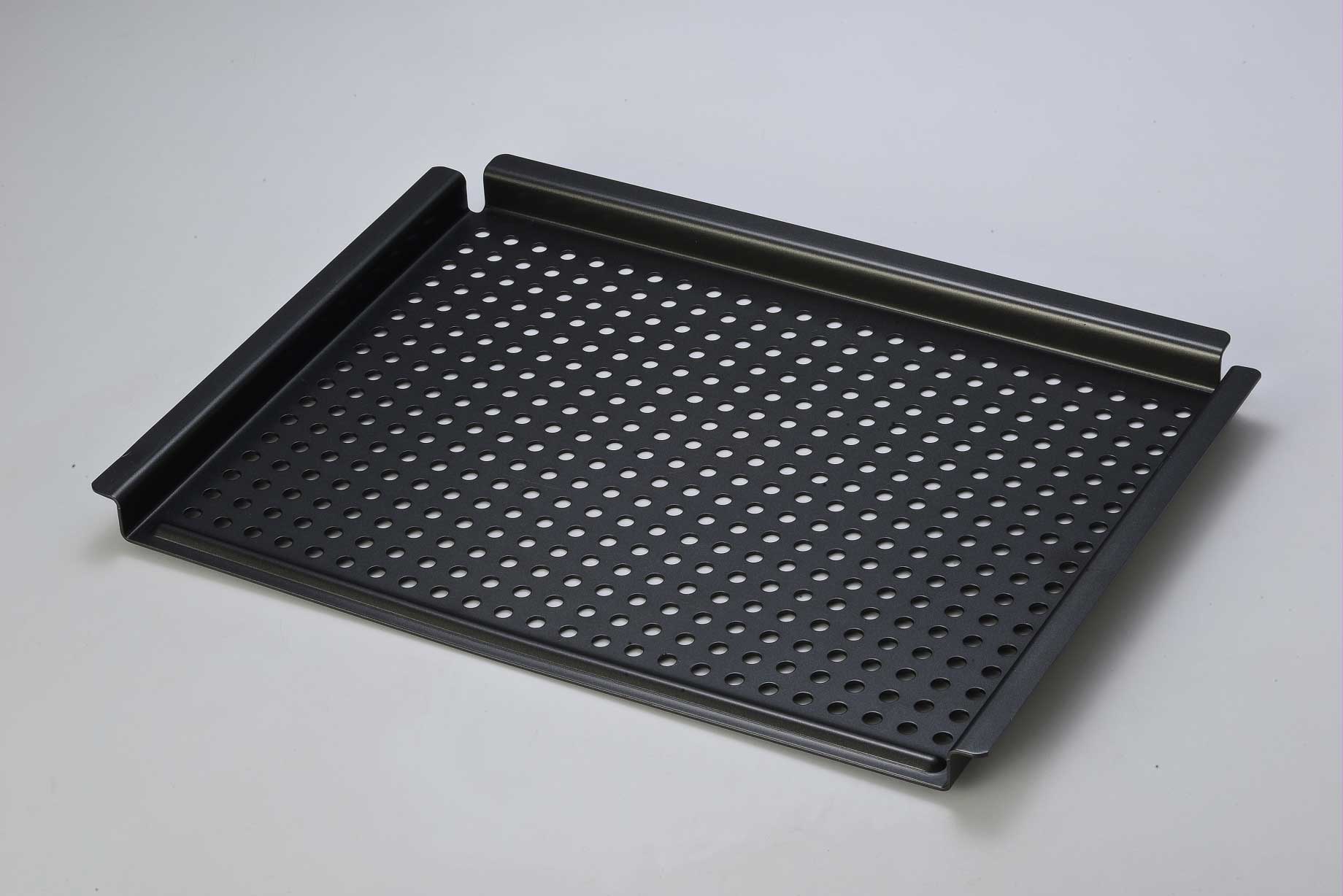

This grid can cook a variety of foods on your outdoor grill, from sandwiches and flatbread to small pieces of meat, chicken, seafood and vegetables.
Efficient design makes it easy to cook different types of food simultaneously while keeping them organized on the grill.
43.5cmL x 32.5cmW x 2″H
Weight: 2.22kg Weight (with ribbed section): 2.28kg
Basting Pot
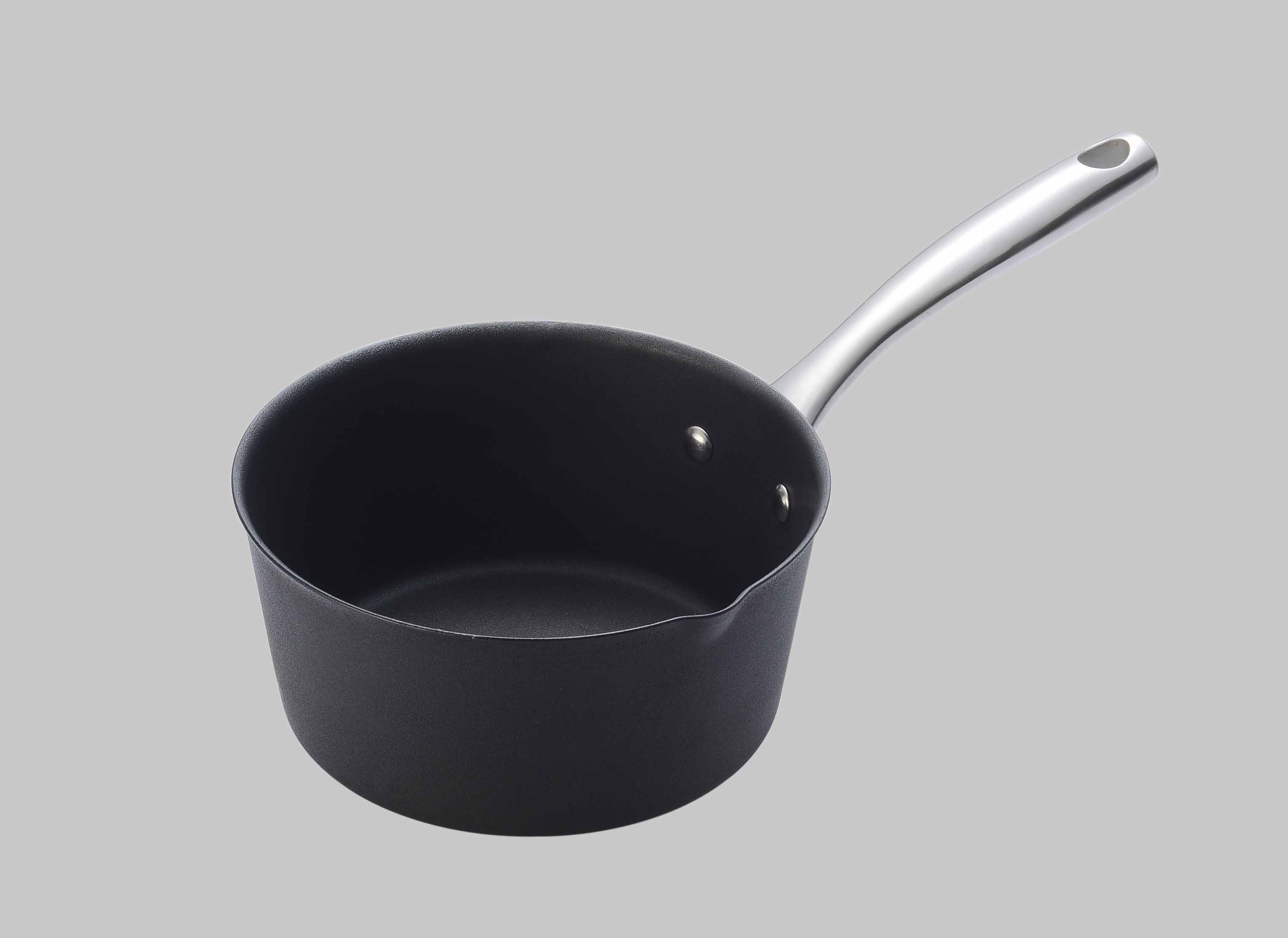 Perfect for slathering a slow-cooking rack of ribs with barbecue sauce, basting a roasting turkey with melted butter, or applying a glaze of maple syrup to grilled peaches.
Heavy gauge steel pot, with innovative PTFE free Lotus Rock non-stick coating.
Basting pot is heat safe to 650 degrees and can be placed directly on the grill or in the oven to keep basting liquids hot.
Easy-pour dual spouts to heat and serve soup, gravy or sauce
Ergonomic double-riveted stainless steel handle for comfortable grip
5 1/2″ Dia. (5 3/4″L w/spouts [12 1/4"L w/handle]) x 3 1/2″H (4 1/4″ with handle)
Base: 4″ Dia.
Capacity: 1 quart
Weight: 1 lb.
Summary
A common complaint with grilling outdoors is that the high heats of the open flame can make it difficult to control the temperature, and tender vegetables like asparagus can char and overcook easily. However, this problem is significantly reduced with Lotus Rock BBQ items because they all have a thick carbon steel construction (2.0mm) which keeps all food an ideal distance from the fierce heat below. As well as creating a buffer between the food and the flame, the thick carbon steel gauge of Lotus Rock also conducts heat evenly and retains heat well to keep food hot for longer.
The handles of the Lotus Rock BBQ stir wok, fry pan and the grill roaster are easy to grasp and make it simple to transfer the pan on and off either a charcoal or gas griill, even when wearing bulky grilling mitts. This makes the process of outdoor grilling safer and it reduces the chance of the food being burnt or overcooked because the food can be removed from the grill quickly.
Lotus Rock’s durable non-stick release, strong construction, and easy-to-clean coating mean these BBQ utensils can be used for a number of years, and not just for one summer. Lotus Rock BBQ pans don’t have to be re-seasoned, and as long as they are always kept dry and cleaned after each use no rust should appear on them.
April 14, 2014 / arnoldtnn / 0 Comments
The modern day consumer is often a person with a busy and hectic life who after a hard day at work enjoys the experience of cooking. However, once all the cooking is finished no one likes to spend too much time cleaning the pots and pans. Having an easy-to-clean cookware utensil not only lessens the stress in cooking for a consumer, but also maintains and prolongs its quality.
Popular materials for cookware include stainless steel, cast iron, copper and aluminum, but while each of these does have significant advantages for cooking, they also have particular disadvantages for cleaning.
Stainless steel cookware
Easy to clean? Difficult: because there is no natural or artificial coating on the surface, food tends to stick easily, making cleaning quite hard.
Cleaning issues
- Stainless steel is prone to stains from heat and hard water. To remove them, the consumer should apply white vinegar with a soft cloth and rub.
- Stainless steel always needs to be dried thoroughly after washing to prevent a film from forming.
- Occasionally stainless steel may exhibit a rainbow-like discoloration; lemon juice should be used to remove this.
Cast-iron
Easy to clean? Difficult: avoid using the dishwasher, soap or steel wool, as these may strip the pan’s seasoning.
Cleaning issues
- Rust; this can be removed with steel wool or by rubbing it with half a raw potato and a sprinkle of baking soda
Copper cookware
Easy to clean? Very difficult: copper cookware should be cleaned regularly, inside and out, to retain the cooking properties and looks of the shiny copper.
Cleaning issues
- Abrasive materials or scouring pads cannot be used as they will scratch the lining on the copper. Copper is toxic, so copper pans are lined with a metal to prevent the food touching it. Scratching the lining off can be harmful to your health.
Anodized aluminum cookware
Easy to clean? Moderate: some consumers have complained that after a certain amount of use dark ‘blotches’ appear on the bottom and are very difficult to remove.
Cleaning issues
- Anodized aluminum cookware is generally not dishwasher-safe, and steel wool and other hard abrasives cannot be used on the surface.
PTFE Non-stick cookware
Easy to clean? At first yes, but over time it becomes more difficult as the non-stick coating begins to fade and food begins to stick on it.
Cleaning issues
- It is important to wash pans thoroughly after each use.
- Steel wool and other abrasive cleansers cannot be used when cleaning non-stick cookware.
As is demonstrated above, the main materials for cookware in the market today all have significant problems with cleaning; none of them, apart from non-stick coatings when still new, is easy-to-clean. One of the important benefits of Lotus Rock cookware is that it is very easy to clean. The nano-silica coating on Lotus Rock pans, like a Lotus leaf, is hydrophobic – it repels water.

The Lotus Effect
Although the surface of the Lotus plant looks smooth, it is in fact very rough and is covered in micro-lumps and bumps of protruding epidermal cells, which in turn are covered by wax crystals. These wax crystals are hydrophobic (water-hating), which means that the water only makes contact with the leaf at the top of the lumps. This forces the water into spherical droplets (as the picture below shows). At even a slight angle these droplets roll and tumble taking dirt particles along with them. This self-cleaning process is called the Lotus Effect.
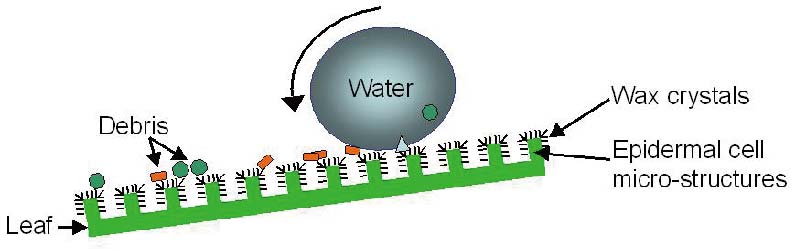
Using the same technique ETAC has developed its own patented technology, called Lotus Rock, which can be applied on cookware and bakeware surfaces. Sauces or other liquids that are added during the cooking process cannot permeate the lotus leaf-like surface. A thin layer of nano-silica acts like the wax crystals above and prevents these substances from entering the surface of the cookware. This self-cleaning ability
(the Lotus Effect) helps the consumer clean their cookware both more easily and
more effectively.
Summary
Because there is no protective layer on the surface it is very easy for food to stick to stainless steel and copper cookware, so the consumer needs to scrub the food off quite vigorously. Large blotches have been known to appear on both the interior and exterior of anodized aluminum pans, which have been difficult for consumers to remove. Lotus Rock, however, is very easy to clean because of its hydrophobic nano-silica coating, and neither hard scrubbing nor use of a dishwasher should be necessary.
When cleaning cast iron cookware, consumers have to be careful not to rub off the seasoning which protects the pan from rust. Lotus Rock’s hard ceramic interior and its nano-silica coating are steel wool-resistant and difficult to scratch or damage while cleaning.
PTFE non-stick coatings do provide a great surface for easy cleaning, but with intensive use the coating will gradually lose its non-stick release and food will stick on it, thus making it harder to clean. Lotus Rock in contrast has a durable non-stick release which will not fade over time, because the nano-silica coating is not only hydrophobic but also lipophilic – fat loving. Each time the consumer adds cooking oil to a Lotus Rock pan (as shown below) the coating’s non-stick release will renew itself.

April 11, 2014 / arnoldtnn / 0 Comments
Introduction
Despite the health risks of PTFE-based coatings and the distinct problems associated with the long-term quality of the coating, as was explained in a previous blog post ‘Lotus Rock vs other non-stick coatings’, PTFE is still the most popular non-stick coating used today. Lotus Rock has numerous advantages compared to PTFE, and in order to demonstrate some of them we have carried out a fried-egg test using two pans, side by side, one from our Lotus Rock collection and another from a well-known, widely sold pan which uses a PTFE coating.
Test Objective
The purpose of the test was not to demonstrate that Lotus Rock has a better non-stick release than the PTFE non-stick pan. PTFE non-stick coated pans have been used in households all over the world since the 1960s; the quality of the non-stick release is not doubted. The test did not use more than two eggs per pan because we know that PTFE would easily win a contest to determine which pan could cook the most eggs before sticking. Instead the aim of the test was, first, to demonstrate that the Lotus Rock pan’s non-stick release could, for two fried eggs, match that of the PTFE-coated pan. Second, to show that Lotus Rock could fry an egg much faster than a PTFE-coated pan. And third, to examine the quality of the fried egg to see whether there was any discernible difference between use with a Lotus Rock pan and that of a PTFE pan.
Test Methodology
Both pans were 24cm in diameter, with a bakelite handle welded to the pan. Neither had been cooked with beforehand; they were both brand new. A ceramic cooking-top surface was used for both pans. It is generally agreed among cooking experts that the optimum temperature for cooking is between 140-180 degrees, so it was at this temperature that each egg was first released into both pans.
Test Demonstration
The test can be seen in the video below.
For China: http://v.youku.com/v_show/id_XNjk3NTE1MTE2.html
For the rest of the world: http://youtu.be/6IwEF9klkkA
Conclusion
As the video clearly demonstrates, the quality of the non-stick release of the Lotus Rock pan for two fried eggs was equal to that of the PTFE pan. A hairdryer was used on both pans to show that the egg had not stuck to the pan. Even when the hairdryer could not easily lift the egg away from the pan, a spatula could be used without any of the egg sticking to the pan.
The test also demonstrated two more distinct advantages of the Lotus Rock pan over the PTFE coated pan:
- Heating effect. A normal PTFE coating is sprayed on either an aluminum or a stainless steel substrate. Neither of these conducts heat as quickly as carbon steel. In this test the PTFE coated pan used an aluminum substrate. As you can see in the video, the eggs fried more quickly on the Lotus Rock pan, because carbon steel, which is the substrate used for Lotus Rock, conducts heat faster than aluminum. This demonstrates one clear benefit of Lotus Rock – it not only saves time and energy, but also has a superior heating effect compared to PTFE – the egg can fry and sizzle much faster, meaning that it is crispier and tastes better. In the video the fried egg on the PTFE coated pan has heated evenly and looks good, but because it was heated more slowly it is not as crispy and well-cooked as the egg on the Lotus Rock pan. A faster and better heating effect also enables the egg on the Lotus Rock pan to retain more of its vitamin content than the one cooked on a PTFE-coated aluminum substrate.
- Scratch resistance. In the test a metal utensil was used with the Lotus Rock pan, but not with the PTFE pan. A big difficulty with PTFE is that over time the coating has been known to peel off – if a metal utensil was used daily on a PTFE pan than this would increase the likelihood of the coating peeling off. Lotus Rock however has no non-stick PTFE coating to be damaged, so the customer can use any type of utensil, metal, plastic or wooden, without worrying about impairing the surface of the pan.
Evaluation
When promoting their best PTFE non-stick coating many coating manufacturers boast about how many eggs their coating can fry before one of them sticks. One of them has written the following:
“In the Dry-Egg test, xxxxx’s nonstick/release lasted 26 times longer than a leading brand, and 10 times longer than the premium nonstick tested.”
However, what most of these marketing advertisements don’t promote is the durability of their non-stick release. Their coating may well be able to release 60 or so eggs without sticking when the pan is first used, but what about after 6 months or a year? Can a frying pan with a PTFE non-stick coating still maintain the same non-stick quality after lengthy use, and after daily, intensive washing and scrubbing?
When a customer first buys a non-stick frying pan it is unlikely that they will cook more than 3-4 eggs during its first usage, so being able to cook a dozen or more without any sticking is not really that useful. What most consumers want from a pan is an excellent non-stick release not just at the beginning of a pan’s usage, but over a number of years. It is exactly because a Lotus Rock pan doesn’t contain any PTFE, or any other chemical coating that gives an artificial non-stick effect, that Lotus Rock can claim its non-stick release is so durable. There is no non-stick chemical in the pan’s coating which can be damaged by either intensive cooking or a tough clean-up. If a Lotus Rock pan’s use & care instructions are observed its non-stick quality should still be the same 5 years from purchase.
April 3, 2014 / arnoldtnn / 0 Comments
Introduction
As was demonstrated in the blog post ‘Lotus Rock vs Other Non-stick coatings’, because Lotus Rock’s silicon-oxide crystal coating is lipophilic – fat loving – it has a highly durable, excellent non-stick release. However, just as with stainless steel, copper and cast iron cookware, the absence of a PTFE non-stick coating on Lotus Rock pans means the type of fat used should be an important consideration.
What are fats?
Fats can be liquid or solid at room temperature. If liquid they are called are oils. Oils come from plants and fish. They are not a food group, but they do provide essential nutrients.
Some commonly used oils include:
- canola oil
- corn oil
- olive oil
- soybean oil
- sunflower oil
Most oils are high in monounsaturated or polyunsaturated fats, and low in saturated fats. A few plant oils, however, including coconut oil, palm oil, and palm kernel oil, are high in saturated fats and for nutritional purposes should be considered to be solid fats.
Solid fats are fats that are solid at room temperature, like butter and shortening. Solid fats come from many animal foods and can be made from vegetable oils through a process called hydrogenation.
Some common solid fats are:
- butter
- milk fat
- pork fat (lard)
- shortening
- partially hydrogenated oil
For cooking purposes
Many chefs and mums prefer to cook with butter, notwithstanding the fats associated with it, because it complements and enhances the flavour greatly, for example when sauteing vegetables.
However, some people prefer to use oil because of the health benefits, and also for the range of flavors that it gives to the food.
Saturated vs Unsaturated Fat
One big disadvantage of butter is that it is high in saturated fat. In layman’s terms, these are fats that cannot be broken down by the body and so are collected and stored in different parts of it. Eating too much food containing saturated fatty acids can cause health problems such as high cholesterol (a substance containing a lot of fat that can cause heart disease), which is why many dieticians suggest avoiding foods that contain butter.
Generally cooking oils are seen as a better alternative because they have a higher percentage of unsaturated fats, both mono-unsaturated and poly-unsaturated, compared to saturated fatty acids, which are more prominent in solid fats such as butter.
However, it should be noted that some cooking oils are healthier than others. For example extra virgin olive oil doesn’t have a particularly high concentration of saturated fat, but it does have a very high monounsaturated fat content compared to polyunsaturated fat.

Polyunsaturated describes a fat or oil that has a chemical structure which, because it contains several double bonds, does not easily break down into cholesterol. However, monounsaturated fat has only one double bond and therefore can eventually be broken down into cholesterol, although much more slowly than saturated fat.
Smoke point
In addition to concerns about high cholesterol, highly saturated fats, such as butter and olive oil, have another disadvantage – their low Flash Point or Smoke Point (the temperature at which an oil starts to evaporate, giving off gases that can be ignited). The smoke point of various fats is important to note because a fat which has exceeded its smoke point and begun to break down is no longer good for consumption. It is believed that fats that have gone past their smoke points contain a large quantity of free radicals which contribute to the risk of cancer. And of course the smoke itself, and the smell which often accompanies it, are unpleasant.
Smoking point of common cooking fats ( per 100g )
Cooking fats with higher concentrations of saturated fats than unsaturated will have lower smoke points. Moreover, oils with higher proportions of mono-unsaturated fats than polyunsaturated fats will also have lower smoke points. This is why olive oil has a lower smoke point than sunflower oil, as the table above shows.
Conclusion
Lotus Rock cookware comes in a variety of different shapes and sizes. The type of cooking fat used with them should suit the type of cookware – for example, different fats should be used in a stir wok and a paella pan.
Cooking fats such as butter or olive oil are generally not advised for use with stir woks, as woks require fast cooking at a high temperature. This might be diffficult with butter or olive oil, which have a very low smoke point, so for a stir wok something like Peanut or Sunflower oil would be more appropiate. Conversely, for a paella pan, which requires food to be cooked for longer, on a lower temperature and with more produce to absorb the heat from the stove top, a cooking fat with a lower smoke point could be used, perhaps coconut oil.
March 28, 2014 / arnoldtnn / 0 Comments
This is a question we are commonly asked. After all, aluminum is ubiquitous in the cookware market – famous brands such as Teflon, Swiss Diamond, Le Creuset and Scanpan all use it, so why doesn’t Lotus Rock? First, we won’t try to pretend that aluminum doesn’t have any major benefits for cookware utensils; it does, and that is why it has proven so popular ever since it was first introduced for cookware back in the 1960s. The advantages of aluminum cookware include:
- Conducts heat evenly – reducing difficulties with over-heating
- Light weight – suitable for young children, the elderly or just people who want a cookware utensil that is easily moved around the kitchen
- Good corrosion resistance*
- Easy to manufacture –either pressed, cast or forged
- Exterior of the pan can have a variety of attractive designs printed onto it.
*This isn’t entirely true, aluminum does rust, but the rust is a white powder, less noticeable than rust from carbon steel or cast iron.
However, because aluminum has become so embedded in the cookware industry over the past half century, with many cookware companies using and promoting it, many of the disadvantages associated with this type of substrate are overlooked and not fully understood. These include:
- Weak construction –easily dented and deformed
- Not induction-safe
- Poor heat retention – especially compared to cast iron
- Does not conduct heat as evenly as copper
- Does not heat up as quickly as carbon steel.
In previous posts readers of this blog will have noted the following benefits of Lotus Rock:
- Fast heating effect – saves time and energy,
- Highly durable – for long term use,
- High heating effect – for better vitamin retention and a more delicious taste.
Ever since aluminum cookware became popular in the 1960s, carbon steel has been seen as a cheap alternative. However, this was because it was always used in a thin gauge. When carbon steel is used in a much thicker gauge, such as 2.0mm, the pan’s cooking performance and durability improve significantly. If Lotus Rock used aluminum instead of carbon steel as the substrate for its coating, it would not have the following advantages.
Carbon steel vs Aluminum
- Fast heating effect. Although aluminum does heat evenly, it does not heat up quickly; carbon steel heats up much faster, reaching a temperature of 180 degrees long before an aluminum pan (the ideal temperature for cooking is between 140-180 degrees). Moreover, because all Lotus Rock items are produced in a 2.0mm gauge, they not only heat up quickly but also evenly – so a fried egg will always be tastier and crisper on a Lotus Rock pan than on non-stick aluminum.
- Highly durable. Carbon steel is three times denser than aluminum, so a 2.0mm-gauge carbon steel pan is equivalent to a 6.0mm-thick aluminum pan, and very few aluminum pans are made with a gauge as thick as this. A common complaint regarding most aluminum pans is that they dent easily when dropped; Lotus Rock, made with 2.0mm-gauge carbon steel, is much stronger and more durable than the average aluminum pan.
- High heating effect. Lastly, the density of 2.0mm-gauge carbon steel gives it much better heat retention than aluminum. This means a pan does not lose heat when food is placed on it, which reduces the chance of burning or over-cooking the food and maintains its vitamin content and delicious taste.
Summary
Lotus Rock is a cookware collection with numerous benefits, many of them due to its thick carbon steel gauge. It is precisely because a Lotus Rock frying pan, stir wok or crepe pan is made with 2.0mm-gauge carbon steel that it has a fast heating effect, a strong construction and an excellent heating effect for healthier and more delicious food.
March 21, 2014 / arnoldtnn / 0 Comments
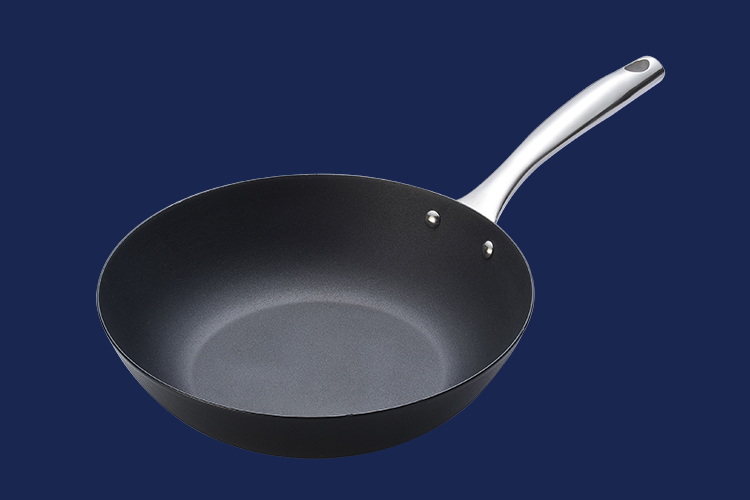
Why choose a Lotus Rock Stir Wok?
1. Material. Carbon steel is the material that is used in all Lotus Rock cookware and bakeware items. Because of the nature of stir frying most experts agree that carbon steel is the most appropriate metal for a stir wok.
In the market place today other types of metal substrates are used for stir woks, however they all have drawbacks for this type of cookware item.
These include:
- Cast iron – Long pre-heat times and it is very cumbersome to lift, which is essential for proper flipping
- Stainless steel – Doesn’t conduct heat very quickly, and especially not to the centre of the pan, where it is most needed for a stir wok.
2. Thickness. Most carbon steel manufacturers for stir woks will do a thin gauge, at either 0.8mm or 1.0mm, this can make a wok light and very price competitive. However, all Lotus Rock Stir Woks are produced at a 2.0mm gauge. This ensures a strong construction, even heating and a high heating effect for all of our stir woks.
3. Induction safe. Although carbon steel is magnetic and so suitable for induction use, if the gauge is too thin then the pan or coating on it will be damaged very easily if used on this type of cooking top surface. Induction transmits heat very efficiently, however with a Lotus Rock stir wok, the thick gauge will disperse the heat much better and therefore not impair the quality of the pan.
4. Heat resistance. Lotus Rock’s surface is a specially configured design which has very high heat resistance. Most general non-stick cookware, which is organic-bonded, can easily break under a high temperature. This can, consequently, create a harmful chemical smoke which is bad on environmental and health grounds. In contrast the Lotus Rock silicon-oxide crystal coating is made up of inorganic substances: it is in the form of a thin crystal, which has no traces of carbon within it. Conversely, the type of ceramic material that the silicon-oxide crystal coating rests on can resist temperatures of up to 350 degrees centigrade, which is particularly advantageous for a high-heat cooking method such as stir frying.
5. Scratch resistance. The layer of silicon-oxide crystal that rests on top of it is extremely thin. Even with modern day utensils humans are not able to peel off the material. This makes the surface between the silicon-oxide crystal and ceramic very compact and difficult to scratch. Furthermore, it means that, unlike most cookware, the Lotus Rock is metal utensil safe, making it very convenient to use in a busy kitchen.
Summary
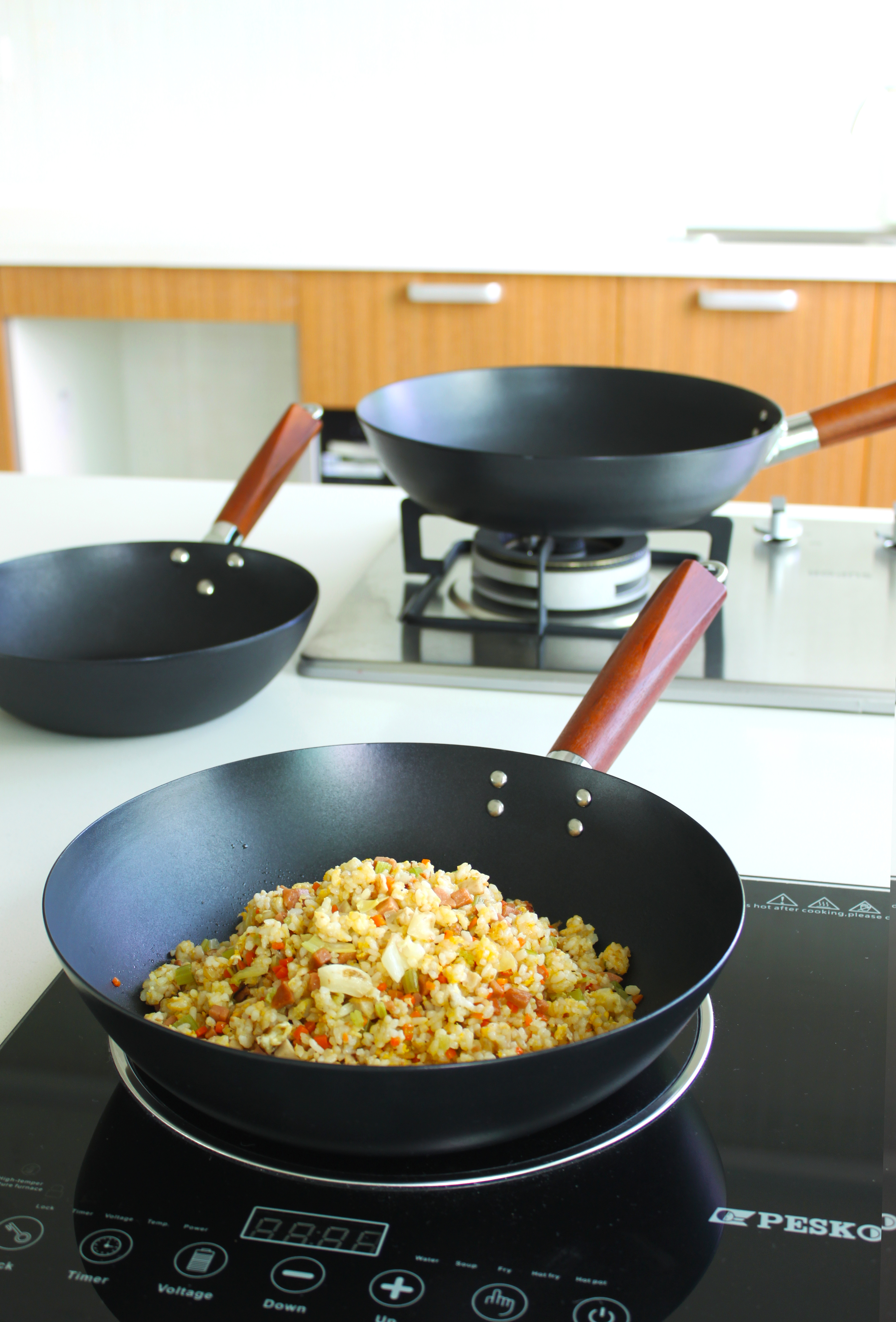 Lotus Rock, with its excellent PFOA/PTFE-free non-stick silicon-oxide crystal coating, is ideally suited for use with a stir wok. The heavy steel gauge and thick ceramic coating provides a Lotus Rock stir wok with amazing heat retention and dispersion, meaning the food is never steamed but instead always seared. Easy-to-clean, metal utensil safe, with 350 degree heat resistance, a Lotus Rock stir wok can be used in a kitchen for as long as a cast-iron wok.
March 18, 2014 / arnoldtnn / 0 Comments
For China: http://v.youku.com/v_show/id_XNjg3MTU1MTYw.html
For the rest of the world: http://youtu.be/eFWfQB8OyFg
Lotus Rock has an excellent, natural non-stick effect, for long term use without any PTFE included. As you can see in the video, not only does the fried egg release easily but the heating effect is evenly spread and fast, thus creating a delicious, crispy taste.
March 15, 2014 / arnoldtnn / 0 Comments
I thought I would start our first blog about Lotus Rock with some reviews from consumers who have actually used the product. Lotus Rock cookware is currently sold in the USA on a website where consumers often read reviews of the product before they make a purchase. In this way it doesn’t matter how great the marketing is of the product, the quality of the cookware will always be the most important factor in whether or not it is a sales success.
On this website the Lotus Rock 20cm, 26cm, 30cm frying pan and 24cm crepe pan are sold. The handle for each of these items is our own designed Zurich professional forged, stainless steel handle.
Lotus Rock Frying Pan
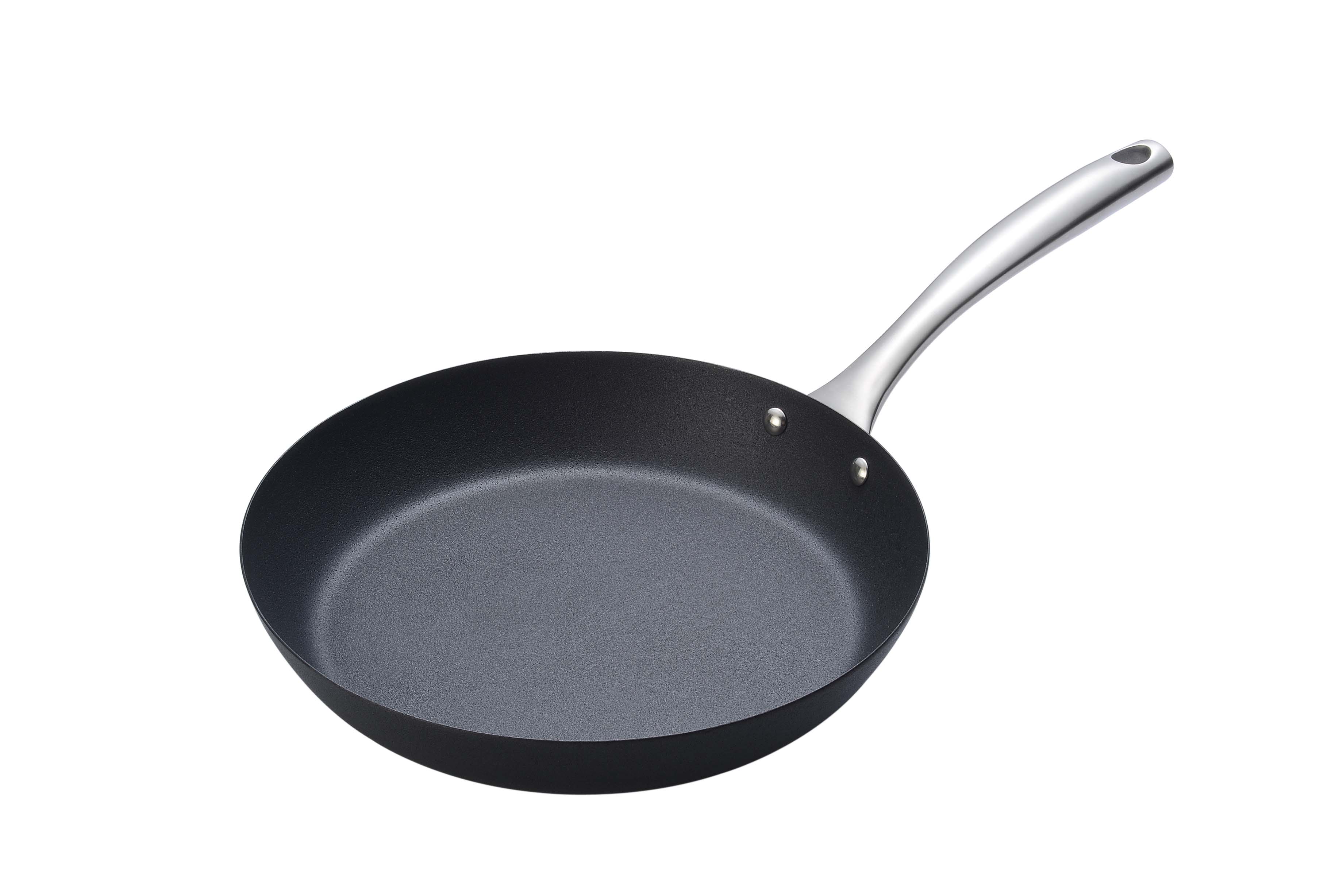
These are heavy, but not as heavy and awkward as cast iron.
Good for pan frying and pan searing and especially good for chops, steaks, frittatas and other foods that you want to finish in the oven.
Easy to clean and a good value.
Nick – Bay Area, California
LOVE, LOVE, LOVE these pans. So great to have non-stick without the coating chipping and flaking. I feel guilty every time I use metal utensils. These are so GREAT, I ordered another set for me!!
Anonymous – Pensacota, Florida
These pans are great. the best non-stick pans I have ever purchased, they wipe clean and heat evenly, and they look terrific.
Bill – Magna, Utah
Although I’ve only just gotten these pans, I’ve used each of them at least once, and I love them! I had to replace my old, no-longer-nonstick pans, and, with growing concerns about nonstick coatings, I was looking for something safe but not quite as heavy as my beloved cast iron.
They’re a tiny bit heavier than my old nonstick pans, but not much – just enough that they feel substantive. They’re not too heavy, not too light, but Just Right.
And metal utensils! I almost felt naughty using a metal spoon to stir with! The ceramic nonstick coating is (so far) holding up beautifully, though I only just started using them.
Overall, I’m very happy with these pans and look forward to using them often for a long time to come.
Kris – Greece, New York
I purchased the small pan for my husband. He cooks up scrambled eggs every morning as part of his breakfast ritual. The stirring he does for those eggs every single morning was too much for every other pan I have purchased. This pan appears to be the one. Very well built with a great surface and instructions on how to keep it in great condition. First cooking experience was perfect only time will tell how it will hold up, but I am very pleased.
A lucky wife – South Carolina
These pan’s are excellent. I like the fact that they have a bit of weight to them. The non stick surface seems bullet proof, they heat evenly and cleaning is a breeze.
Anonymous – Oregon
I love this pan. It works great with my induction stove top. I enjoy cooking stir fry with less oil as well as making omelets with no sticking what so ever.
Cocoa66 – Dover, Ohio
Lotus Rock Crepe Pan
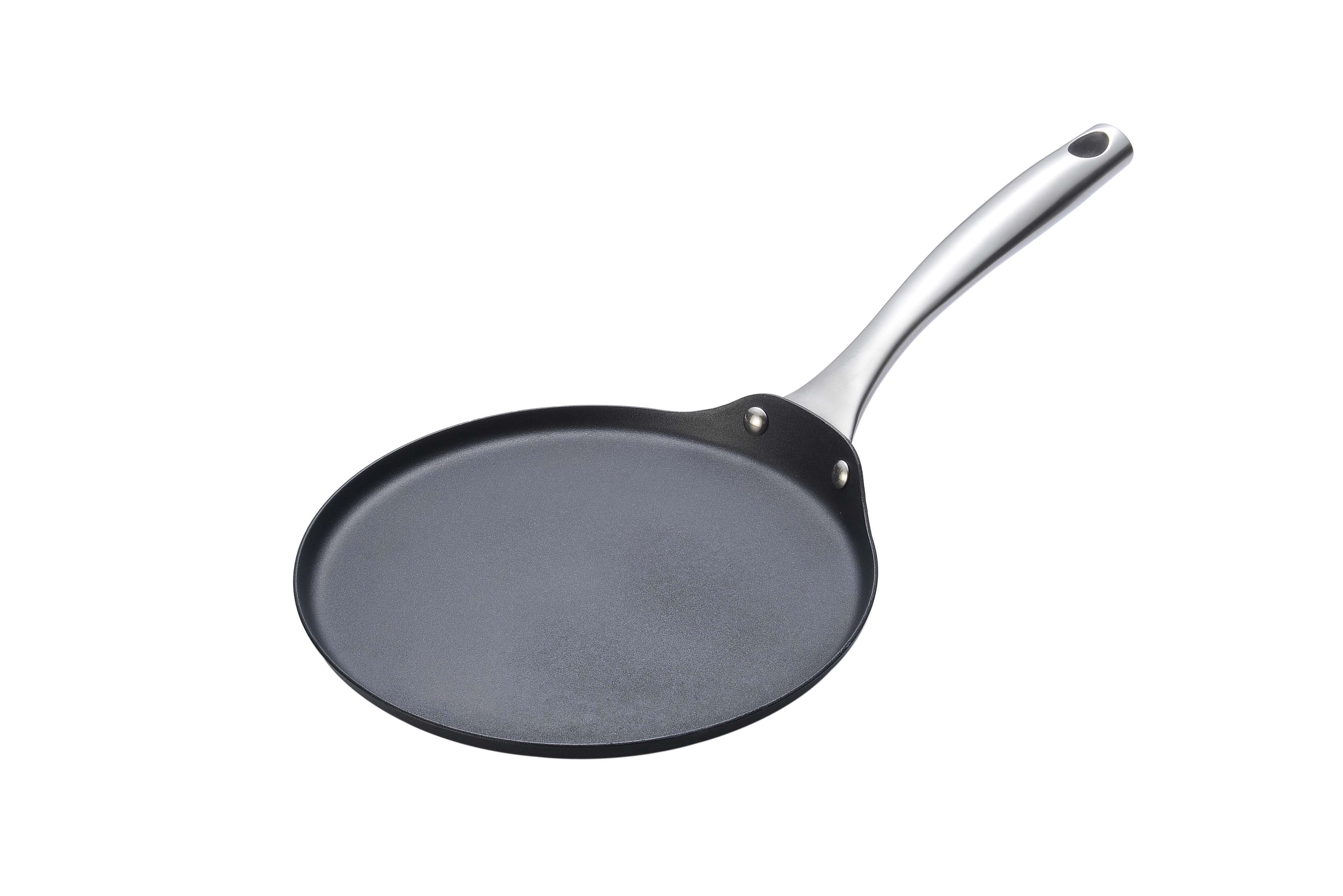
This is the most versatile pan I have ever used and it is just the right size. The biggest bonus is easy clean-up and the stay-cool handle. It is just perfect for eggs over easy, scrambled, or omelets, hash brown potato patties, two to three hamburger patties, sausage patties, toast buttered sides of hamburger buns, and more and more. I have yet to try crepes! Love, love, love this pan!
Barbara – Illinois
This pan is heavier than I anticipated and seems to be well made. I’ve only had it for a week, but it’s been used regularly for heating tortillas which was the primary reason for getting it. I like the construction of the handle on the pan. The overall quality is very good. One day I may even make crepes with it. 
Katy – TX
Best pan ever, makes crepes is seconds, also great for cooking eggs sunny side up
Jerry – Cocoa, Florida
My husband loves his new pan..fries his corn meal mush great
Kitchenboss – Monongahela,Pa
March 14, 2014 / arnoldtnn / 0 Comments
Today, we are thrilled to launch our new blog about Lotus Rock cookware and bakeware.
The Lotus Rock blog is the place where food and cooking enthusiasts can meet and better understand this new and highly innovative cookware and bakeware collection. Our goal for this blog is simple: to educate and explain the benefits of Lotus Rock. In the year ahead and beyond we hope that by sharing our knowledge and expertise about Lotus Rock more people can enjoy the advantages that this unique type of cookware and bakeware can bring to the modern day kitchen.
The most important part of the Lotus Rock blog is you. Our hope is that after reading a post or using one of the various pots or pans, you’ll let everyone know what you think. Share your thoughts in the “comments” section found at the end of each post. This is also the place to chat with us and other readers, ask and answer questions, share tips and stories and give feedback about your Lotus Rock experience. Come join the conversation – we can’t wait to hear from you.